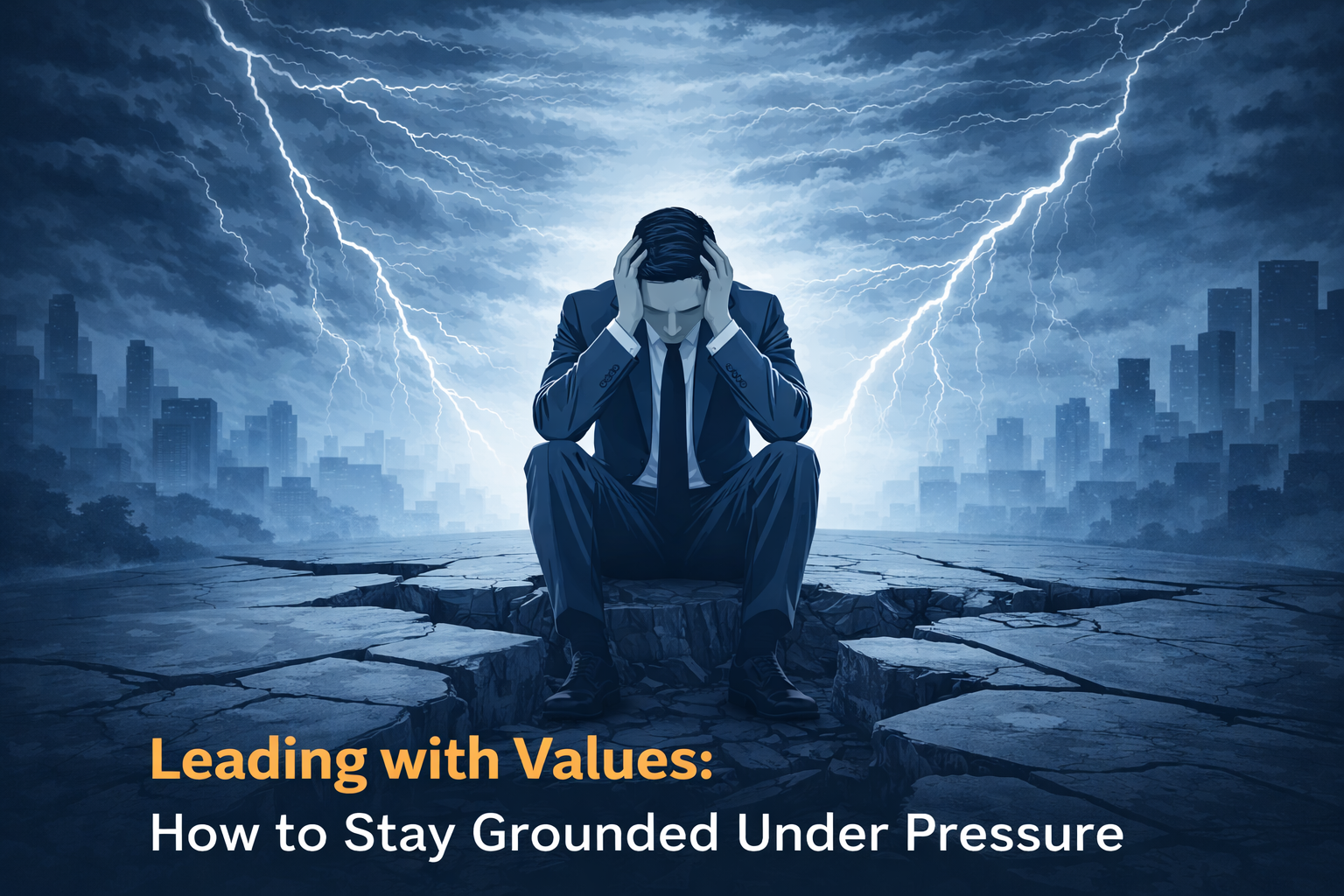
Pressure does not necessarily expose character flaws, but it may expose the absence of a compass you can trust when the room gets loud. Leaders who aren’t clear on their values tend to grab for control, go quiet, or just react. Values-based leaders do something different. They hold. Not because the pressure bounces off them, but because they’ve spent enough time building something inside that doesn’t fold when things get uncomfortable.
What does values-based leadership actually look like beyond a conference slide? How does it hold up for both the leader and the organization when things are uncertain and constantly shifting? That’s what this post explores.
What is Values-Based Leadership?
Values-based leadership involves consistently allowing your defined values and personal principles to guide your decision-making, rather than allowing urgency, ego, or convenience to dictate your actions.
An autocratic leadership style leans on control. A value-based leadership style does the opposite. It creates accountability through shared values and genuine humility, meaning you hold yourself to the same standard you set for your team. The gap between what you say and what you do? That’s where people stop trusting you. Under pressure, that gap tends to widen unless your values are actively supporting you.
Why Values Matter in Leadership Style
Core values should be practical. They make you predictable, and predictability builds trust.
When your team knows where you stand, they stop spending energy decoding you and start putting it into work that actually matters. According to Gallup’s 2025 workplace research, only 32% of U.S. employees are currently engaged at work. That’s roughly $2 trillion in lost productivity. It happens solely because employees don’t feel connected to their organization’s mission. They don’t see leadership living what it preaches.
Adding a values statement on the website doesn’t remedy that. Values only count when they show up in daily behavior, in the honesty and transparency people actually experience on the ground. Otherwise, employees start mentally checking out, and you’re left wondering why retention keeps dropping.
Understanding Pressure in Leadership Roles
People discuss leadership pressure as if it’s purely about managing deadlines and making difficult calls for the company. It’s more than that. It involves competing priorities that frequently divert you in entirely different directions. Managing stressed individuals adds an emotional burden that doesn’t switch off at the end of the day.
The expectation to lead by example, especially when you’re uncertain about what the right example looks like, is a significant and ongoing challenge. In both the private sector and public-facing roles, that strain can quietly impact motivation, decision-making, and relationships across entire teams.
When you don’t have a grounded sense of “What is integrity in the workplace?”, urgency overtakes judgment, and short-term decisions replace thoughtful leadership. Once that starts, it rarely corrects itself without conscious effort and reflection.
The Importance of Value-Based Leadership
Something shifts in a team when a leader’s values are clear and practiced. People start risking honesty. They introduce new ideas instead of keeping them to themselves. They take ownership because the environment indicates that it is safe to do so.
Amy Edmondson, Novartis Professor of Leadership and Management at Harvard Business School, nails this in her book The Fearless Organization: “If leaders want to unleash individual and collective talent, they must foster a psychologically safe climate where employees feel free to contribute ideas, share information, and report mistakes.”
Psychological safety doesn’t come from a handbook. It comes from ethical leadership. From people who set high standards, then actually live by them. That’s an important aspect of what separates transformational leaders from people who just manage deadlines, and it’s the foundation of authentic leadership that people actually trust.
Key Strategies for Leading Under Pressure
Staying grounded when the pressure builds is learned, practiced, and reinforced through self-discipline over time. Here are a few ways in which you can lead under pressure:
Pause Before Acting
Reactivity will wreck good leadership faster than almost anything, which is why it’s important to pause before responding to a crisis, a loaded email, or someone’s frustration in a meeting. Take sixty seconds; that’s it. That small gap between what happens and how you respond can change the outcome more than most people realize, often leading to more thoughtful decisions and positive outcomes you might otherwise miss.
Stay Aligned with Your Core Values
When personal values are clear, decision-making under pressure comes down to one question: Does this choice reflect who I want to be as an authentic leader, or is fear making the call?
Simple. Not easy. But simple.
Build a Strong Support System
No successful leader produces their best work all alone. They need a balanced mix of peers, mentors, and even a C-suite executive coach who sees blind spots you might miss. A follow-up meeting after a tough stretch can also help you develop perspective on what worked and what didn’t.
Focus on Facts, Not Assumptions
Stress makes everything louder. Under pressure, business leaders tend to fill gaps with worst-case thinking instead of verified facts. The key is to slow down, separate facts from assumptions, and question what you really know to be true. Once you have that clarity, you can move forward with decisions that are more grounded, measured, and effective.
Maintain Clear Communication
When the tension goes up, communication goes down. That’s the pattern. Break it. Be direct and show respect for your team’s intelligence. They don’t need you to have every answer. They need to know you’re not keeping things from them. That kind of commitment to transparency is what earns real loyalty.
Developing a Strong Leadership Mindset
Mindset is not the same thing as motivation. Motivation fluctuates. Mindset sits underneath it and holds steady when motivation runs thin.
Harry Kraemer, Professor at Northwestern University’s Kellogg School of Management and former CEO of Baxter International, puts it well in From Values to Action: “If you are not self-reflective, how can you know yourself? If you do not know yourself, how can you lead yourself? If you cannot lead yourself, how can you lead others?” That kind of self-reflection isn’t a one-time exercise. It’s what separates leaders who react from those who respond with passion and real clarity.
The strongest mindsets focus on the big picture, are built through repetition, and carry a future-oriented sense of where leadership can actually go. A solid training program for middle-level managers can accelerate that process by creating a structured space for reflection and growth.
Practical Techniques to Stay Grounded
The following are a few essential techniques you can try to stay grounded:
- Pick one guiding principle at the start of each day and align your actions with it
- After high-pressure moments, debrief with yourself. What went well? What needs to change?
- Practice active listening, especially in the conversations you’d rather avoid
- Invest in a mid-level leadership development program that focuses on self-awareness and developing leaders at every level of the business
A servant leader treats self-awareness and intentional leadership as daily work, not as something you check off once and then move on. It takes ethics, confidence, and a willingness to develop others alongside yourself.
Common Mistakes Leaders Make Under Pressure
Even experienced leaders fall into the same traps:
- Deciding alone when their teams should be in the room
- Grabbing for control when delegation would produce better performance
- Getting quieter at the exact moment people need more communication
- Swapping long-term values for short-term relief
- Ignoring their own emotional state until it bleeds into key relationships
New employees pick up on these things quickly. They notice whether a leader’s actions actually match their words. These patterns aren’t character failures; they’re what show up when self-awareness starts to slip.
How to Build Confidence as a Leader
Confidence doesn’t come from knowing the answer. It comes from trusting your process enough to act even when the answer isn’t clear yet.
Leaders who reflect consistently, chase honest feedback (not comfortable feedback), and hold similar values to those they publicly champion develop a kind of quiet confidence others naturally follow. According to Gallup’s research, managers alone account for 70% of the variance in employee engagement. The way you show up directly impacts the success and performance of everyone around you.
That’s not pressure but purpose. There’s a difference. If you’ve ever wondered “can leadership skills be taught?”, the answer is yes, but only when the learning is grounded in real practice, not just theory.
Real-World Examples of Value-Driven Leadership
When Satya Nadella took over as CEO of Microsoft in 2014, the company was culturally stuck. Internal teams competed against each other instead of collaborating, innovation had slowed, and the “know-it-all” mindset was choking creativity. Nadella didn’t start with a new product line. He started with values.
He replaced that rigid culture with what he called a “learn-it-all” mindset, grounded in empathy, curiosity, and genuine humility. He openly told employees he didn’t have all the answers and invited them to challenge assumptions. That shift drove Microsoft’s market value from around $300 billion to over $2.5 trillion, and internal surveys showed a 30% increase in employee satisfaction between 2014 and 2022.
Then there’s Indra Nooyi at PepsiCo. When she became CEO in 2006, she introduced “Performance with Purpose”, a strategy that tied financial performance directly to societal impact.
Investors pushed back. Some senior leaders questioned whether sustainability belonged in a company built on snacks and soda. Nooyi held firm. She shifted PepsiCo’s portfolio towards healthier products, cut environmental waste, and invested in her people.
By the time she stepped down in 2018, PepsiCo’s net revenue had grown by over 80%, and more than half the portfolio was classified as healthier options. She proved that leading with values doesn’t mean sacrificing results. It means building the kind of results that actually last.
Conclusion: Leading with Integrity in Every Situation
Pressure isn’t going anywhere. It’s part of the role. What can change is how you respond to it. When your values are clear, consistently practiced, and visible to the people who rely on you, pressure stops eroding your leadership and starts refining it.
The leaders people remember aren’t the ones who had every answer. They’re the ones who stayed steady under pressure, led with integrity, and built something others genuinely wanted to follow.
Frequently Asked Questions
What does it mean to lead with values?
Leading with values means making decisions that stay true to your core principles, even if they are unpopular or cost you something. It’s the difference between reacting to what’s convenient and choosing what actually aligns with your values.
How can leaders stay calm under pressure?
Start with emotional intelligence and self-awareness, not willpower. Leaders who build in pauses before reacting, practice self-reflection regularly, and keep a real support system around them handle pressure with more composure than those running purely on adrenaline and instinct.
Why is emotional intelligence important for leaders?
Emotional intelligence is important because it’s what lets you catch your triggers before they hit the room. It helps you read how your behavior lands with others and more effectively respond to conflict. Emotional intelligence is the connective tissue between your values and your actions, and it shapes team culture, trust, and long-term success more than most technical skills ever will.