When organizations talk about change, the focus almost always lands at the extremes. At the top, executives set bold visions, announce new strategies, and commission transformation initiatives. At the bottom, frontline employees are trained, restructured, or asked to “adopt” new behaviors.
Thank you for reading this post, don't forget to subscribe!
And in the middle? The middle is expected to absorb the shock. Mid-level leaders are asked to translate strategy into action, hold morale together, meet delivery targets, and somehow embody cultural change while receiving the least support to do so. They are the most pressured layer of the organization, and the least coached.
The middle is the single most overlooked lever for sustainable organizational change.
The Middle Is Where Strategy Either Lives or Dies

Mid-level leaders occupy the most complex position in the organization. They sit at the intersection of executive vision and frontline reality, long-term strategy and short-term execution, and organizational values and daily behavior. All at once, they’re often interpreters, translators, and buffers.
No matter how inspiring a strategy sounds in the boardroom, it only becomes real through the decisions mid-level leaders make every day. What gets prioritized when everything feels urgent? How is performance defined and measured? How can change be explained and emotionally processed by teams?
The sad truth is many organizations unintentionally set mid-level leaders up for failure. They’re often given more responsibility without authority, more accountability without autonomy, and more expectations without clear boundaries. They’re told to be agile and lead through ambiguity while simultaneously being measured on rigid metrics. Over time, this creates fatigue.
Many mid-level leaders start to experience things like decision paralysis, risk aversion, over-reliance on compliance instead of trust, and emotional disengagement. They need better support.
Coaching the Middle is About Unlocking Them
Traditional leadership development often treats mid-level leaders as “leaders in training,” focusing on skill gaps rather than systemic pressure. Coaching takes a fundamentally different approach.
Coaching the middle means creating space for leaders to:
- Make sense of competing demands instead of internalizing them as personal failure
- Develop judgment, not just follow directives
- Build confidence in navigating complexity rather than avoiding it
- Reconnect with purpose beyond task management
Effective coaching helps mid-level leaders move from reactive operators to intentional leaders by helping them think differently about power, influence, and choice within constraint.
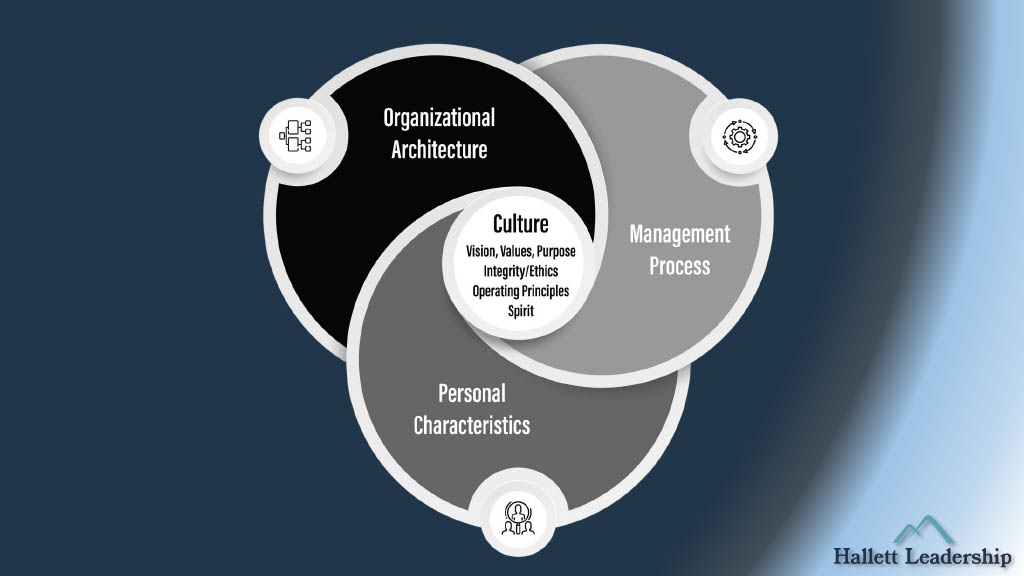
Ultimately, culture changes because of what happens in things like performance reviews, team meetings, one-on-one conversations, project tradeoffs, and how conflict is handled. The majority of the time, mid-level leaders control these moments. When you coach the middle, you’re activating the cultural flywheel.
For example, one leader models a different way of working, which shifts a team’s norms. This influences cross-functional behavior, which slowly and steadily reshapes the organization. This is how change actually sticks.
Many transformation efforts fail simply because they lack alignment in the middle. Executives may be aligned, and the frontline teams may be trained, but mid-level leaders are often left to explain decisions they didn’t shape. They have to defend priorities they don’t fully believe in, and then they have to absorb any emotional fallout without processing their own concerns.
Coaching gives mid-level leaders a place to think out loud, challenge assumptions, and integrate strategy into reality before they’re expected to sell it to others. So how do you coach the middle?
- Contextual leadership: helping leaders understand how their specific position shapes their influence
- Systems thinking: seeing patterns instead of isolated problems
- Boundary-setting: learning where to push back, where to adapt, and where to escalate
- Identity work: moving from “manager as enforcer” to “leader as multiplier”
The goal is to create leaders who can hold tension without collapsing under it. It allows them to guide others through uncertainty without pretending to have all the answers.
Coaching the Middle is The Missing Piece

Research from Harvard Business Review reveals that the average age at which managers receive their first leadership training is at a staggering 42 years old, while they assume managerial roles at just 30 years old. This has left most managers fumbling in the dark for over a decade!
In my book, The Missing Piece: How Successful Companies Develop High-Performance Cultures, I note that the most successful companies develop leaders at all levels of the organization. That the difference maker, the missing piece, is coaching the middle.
So, why is the Missing Piece largely ignored? Perhaps companies fear that they are spending money to train senior managers only to raise their profile for others that are shopping for talented executives. I personally love the story of the CFO who approaches the CEO and asks, “What if we spend the time and money training our people and then they leave?” The CEO replies, “What happens if we don’t train them and they stay?”
The truth is, in my experience employees whose companies invest in their personal development feel a heightened sense of loyalty and are far less eager to jump ship.
From an organizational standpoint, coaching the middle delivers disproportionate impact. When mid-level leaders are coached, employee engagement increases, turnover decreases, and leadership pipelines strengthen organically. Additionally, positive culture change often accelerates.
Building good momentum means allowing mid-level leaders to be intentional, supported, and self-aware. Good change happens when the people in the middle feel safe and valued, especially when they stop feeling like simple messengers.
It’s time to invest in the middle.