The closure raises real questions — not just about FEI's legacy, but about who trains the execution layer of the federal government going forward. This article covers what FEI was, how it worked, why it was shut down, and what the absence of a dedicated federal leadership institution means for agencies trying to develop their senior leaders now.
TL;DR
- FEI was an OPM-operated executive development center in Charlottesville, VA, training GS-15 and SES leaders for 57 years
- Leadership for a Democratic Society — FEI's flagship program — was a four-week residential cohort built around self-awareness and constitutional governance
- Federal News Network reported over 30,000 senior leaders graduated from FEI programs across 10 presidential administrations
- President Trump closed FEI via executive order in February 2025, citing lack of measurable public value
- Agencies and senior leaders must now source executive development from agency programs, university partnerships, and private firms
What Was the Federal Executive Institute?
FEI was an executive management and leadership development center operated under the U.S. Office of Personnel Management, located at 1301 Emmet St N in Charlottesville, Virginia — a campus in the former Thomas Jefferson Inn, a property later acquired by the University of Virginia after FEI's closure.
What made FEI structurally different from typical agency training was its interagency residential model. Rather than training leaders within their own organizational context, FEI pulled GS-15 and Senior Executive Service (SES) employees out of their agencies and placed them in cohorts with peers from across the federal government. The curriculum was explicitly values-based, focused on three interconnected priorities:
- Personal leadership growth — developing self-awareness and adaptive leadership skills
- Constitutional governance — grounding executives in the principles behind their authority
- Democratic context — connecting executive action to broader public service values
FEI ran as part of OPM's Center for Leadership Development under a full-cost-recovery revolving fund model, meaning agencies paid directly to send their people. This created both financial independence and a real market test: agencies that didn't find value would simply stop enrolling. Running continuously for more than five decades, FEI cleared that test repeatedly.
How FEI Was Founded: From 1958 Statute to 1968 Campus
The Legislative Foundation
Federal executive development didn't begin with FEI — it began with the Government Employees Training Act, signed into law on July 7, 1958. GETA gave agencies broad authority for employee training, including at non-government facilities, and established the statutory framework that would eventually enable a revenue-funded executive training center.
A decade later, President Lyndon B. Johnson formalized what that framework made possible. Johnson's administration issued a Presidential Memorandum on May 9, 1968, establishing FEI — a document that Executive Order 14207 would revoke 57 years later. Civil Service Commission Chairman John Macy implemented Johnson's directive, selecting Frank Sherwood as FEI's founding director and overseeing the institute's establishment.
The First Cohort
FEI opened on October 13, 1968, with CSC Chairman Macy present. The inaugural class included 53 federal executives, nearly all at the supergrade level — the senior-most tier of the civil service at the time. The site choice was deliberate: Charlottesville placed FEI near a major research university while keeping it accessible to Washington.
From day one, the program was designed around executive self-direction. The curriculum prioritized developing the individual leader — not transmitting policy or checking compliance boxes.
The Leadership Programs That Defined FEI
Leadership for a Democratic Society
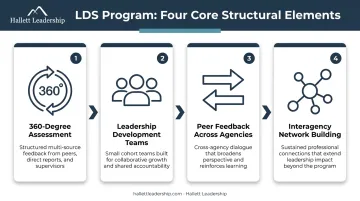
FEI's flagship offering was the Leadership for a Democratic Society (LDS) program — a four-week intensive residential experience for GS-15 or SES-equivalent participants. LDS ran up to ten sessions per fiscal year and later evolved to include a blended virtual/in-person delivery option introduced in 2014.
The program's value was structural, not just academic:
- Opened with 360-degree assessments to baseline self-perception against how others actually experience the leader
- Built Leadership Development Teams (LDTs) — small peer groups with professional facilitators driving honest reflection
- Facilitated peer feedback across agencies, surfacing blind spots that siloed organizations rarely expose
- Created interagency networks participants carried throughout their careers
An alumnus quoted by Federal News Network put it plainly: "The connections to other executives across the government are so valuable. You create a network and resources to lean on throughout your career."
Additional Programs in FEI's Portfolio
LDS was the flagship, but FEI's broader portfolio extended that development mission across the full arc of a federal executive's career:
- SES Leading EDGE Portfolio — a government-wide continuum for Senior Executive Service members at different career stages, including onboarding programs for new SES members
- Custom Executive Programs (CEPs) — tailored to individual agency needs, with clients including USAID and the FAA
- Open Enrollment Programs covering topics such as emotional competence and cross-boundary collaboration
- Footsteps series — experiential follow-on development for LDS alumni
FEI also maintained a faculty model that combined a core resident team with adjunct faculty from Harvard's Kennedy School, Georgetown University, and the Maxwell School of Syracuse University — a partnership structure that grounded its programs in credible academic thinking.
FEI's Impact: 57 Years Across 10 Administrations
Federal News Network reported that FEI graduated over 30,000 senior federal leaders across its history. The Federal Executive Institute Alumni Association (FEIAA) documents that FEI served continuously across 10 presidential administrations, from Lyndon B. Johnson through Donald J. Trump.
That continuity is worth pausing on. FEI survived:
- Budget battles across six decades
- Major restructurings of the federal civil service
- The creation of the SES in 1978
- Multiple administrations that were openly skeptical of federal bureaucracy
The revolving fund model meant FEI had to earn its place every year — agencies chose to send their leaders there, or they didn't. For more than 50 years, they kept choosing it.
That sustained demand helps explain why the alumni network (FEIAA) remains active long after participants leave the program. Members cite the peer cohort experience and the cross-agency relationships built at FEI as among the most career-defining of their federal service.
The 2025 Executive Order: Why FEI Was Eliminated
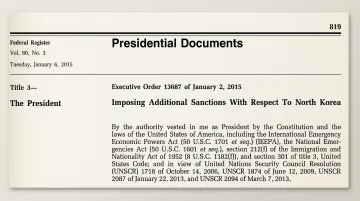
Executive Order 14207, "Eliminating the Federal Executive Institute," was signed on February 10, 2025 and published in the Federal Register on February 14, 2025. The order directed OPM to take "all necessary steps to eliminate" FEI and formally revoked the May 9, 1968 Presidential Memorandum that had established it.
The Administration's Rationale
The official White House fact sheet framed the closure as eliminating programs that "drain resources and empower government without achieving measurable results." The executive order itself argued that FEI had fostered a "Washington, D.C., managerial class" rather than producing outcomes that benefited ordinary Americans.
The Counterargument
Jason Briefel of the Senior Executives Association pushed back directly, stating: "I am not aware of any successful organization that does not train or invest in its people. I am not aware of a major corporation in this country that does not have some version of a corporate learning function."
Briefel also raised the question that remains unanswered: what is the administration's plan for senior career leadership training going forward?
That question points to a deeper disagreement. The White House assumed FEI's value was unproven. Critics countered that cutting leadership development infrastructure doesn't produce a leaner government — it produces a less capable one.
The Future of Federal Leadership Development After FEI
The Gap FEI Left
FEI's closure returns federal executive development to something resembling the fragmented model that existed before 1968. Agencies are now responsible for sourcing and funding senior leadership development independently — without a shared institutional home, without interagency cohorts, and without the cross-government peer networks that FEI spent 57 years building.
The loss isn't just a training program. It's the network effect: GS-15s and SES members who trained alongside peers from HHS, DoD, Treasury, and USDA came back to their agencies knowing people, trusting people, and able to solve problems across organizational lines. That's not easily replicated by a webinar series.
What OPM Has Launched
OPM did not leave a complete vacuum. On August 6, 2025, OPM launched new Executive Development Programs, including:
- Senior Executive Development Program (SEDP) — for SES and GS-15 leaders
- Leadership for an Efficient and Accountable Government (LEAG) — for high-potential GS-14 and GS-15 employees pursuing SES roles
These programs align with updated Executive Core Qualifications. They represent a portfolio approach rather than FEI's flagship residential model: more modular, more metrics-aligned, but potentially lacking the immersive cohort depth that defined LDS.
What Strong Replacements Will Need
For agencies and senior leaders evaluating alternatives, the best options — whether university-based, agency-specific, or from private development firms — will need to replicate three things FEI did well:
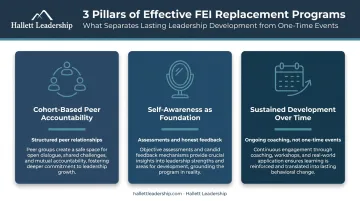
- Cohort-based peer accountability — not just classroom time, but structured relationships with peers facing the same challenges
- Self-awareness as the foundation — behavioral assessments, feedback exchanges, and honest reflection before any skill-building
- Sustained development over time — not a one-time event, but an ongoing coaching relationship that embeds growth into daily work
Firms like Hallett Leadership work from exactly these principles. Founded by former Disney and Fox executive Dean Hallett, the firm's Discovery Model combines behavioral science with experiential learning — building self-awareness before skill-building, the same sequence that made FEI's LDS program effective.
Programs like the Accelerated Leadership Program bring together cross-functional cohort groups with structured peer feedback, 360-style assessment tools (DISC, Enneagram, 16 Types), and weekly coaching accountability. For senior leaders who need structured, measurable development grounded in self-awareness and values, that methodology transfers directly from corporate to government contexts.
The Broader Case for Investment
A 2017 meta-analysis published in the Journal of Applied Psychology analyzed 335 independent samples and found that leadership training produced meaningful improvements across reactions, learning, behavioral transfer, and organizational results. FEI's 57-year run at the center of federal executive development wasn't a coincidence — it reflected what happens when leadership investment is treated as infrastructure, not overhead.
Capable individuals don't automatically become high-performing institutional leaders. That transition requires deliberate, structured development — the kind FEI provided for decades. Whoever fills that gap will need to build it back in, intentionally.
Frequently Asked Questions
What is the Federal Executive Institute?
FEI was a U.S. government executive leadership development center operated under OPM, located in Charlottesville, Virginia. It trained GS-15 and SES employees through interagency residential programs for over 50 years before being closed by executive order in February 2025.
What kind of leadership training did FEI offer?
FEI's core offering was the four-week Leadership for a Democratic Society residential program, built around cohort-based peer learning, 360-degree assessment, and constitutional leadership principles. The broader portfolio included SES onboarding, custom agency programs, and open enrollment courses.
Why was the Federal Executive Institute eliminated?
President Trump's February 2025 executive order argued that FEI had entrenched a federal managerial class without delivering measurable results for American taxpayers — framing the closure as part of a broader effort to reduce federal bureaucracy and refocus government on accountability.
How many people graduated from the Federal Executive Institute?
Federal News Network reported that more than 30,000 senior federal leaders graduated from FEI programs over its 57-year history, spanning 10 presidential administrations from Johnson through Trump.
What programs did FEI offer beyond Leadership for a Democratic Society?
FEI's broader portfolio included the SES Leading EDGE Portfolio for onboarding and ongoing SES development, Custom Executive Programs tailored to specific agency needs, Open Enrollment courses on topics like emotional competence, and the Footsteps alumni development series.
What are federal leaders' options for executive development now that FEI is closed?
Federal agencies and senior leaders can pursue OPM's new SEDP and LEAG programs, agency-specific development initiatives, university-based executive education, and private leadership development firms offering coaching, cohort programs, and experiential learning.