Introduction
Most leaders leave workshops feeling genuinely motivated. They have new frameworks, fresh notes, and real intentions to do things differently. Then Monday arrives. A direct report pushes back in a one-on-one, an underperformer dodges accountability again, and every insight from last week's session evaporates under the pressure of the actual moment.
That gap between insight and action is a design problem — and the data confirms it's widespread. According to McKinsey, U.S. companies spend nearly $14 billion annually on leadership development, yet poor outcomes persist because programs routinely overlook context, separate learning from real work, and fail to measure behavioral results.
Meanwhile, DDI's 2024 data shows employees rated only 40% of leaders as high quality — a number that should alarm any organization investing in development.
This article covers why traditional programs keep failing, what immersive leadership training actually means, and how to build a program that produces lasting behavior change rather than temporary inspiration.
Key Takeaways
- Traditional training creates knowledge without building the skill to act under pressure
- 40% of leaders are rated high quality — the gap is a design problem, not a budget problem
- Immersive training works by placing leaders inside realistic scenarios before those moments happen
- Spaced practice, specific behavioral feedback, and ongoing coaching are the three non-negotiables
- Programs should be measured on behavior change and team outcomes, not participant satisfaction
Why Traditional Leadership Training Keeps Falling Short
The Knowing-Doing Gap
A manager can describe great feedback in a workshop. They know the framework, they can recite the steps. But when a direct report gets defensive mid-conversation, that knowledge does not automatically translate into skilled execution.
Understanding a concept and performing it under emotional pressure are two separate cognitive tasks. Training that only addresses the first produces leaders who know more but behave no differently.
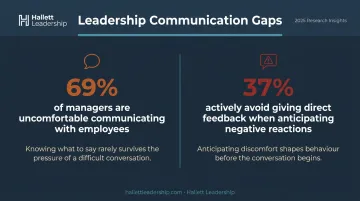
Harvard Business Review research puts a number on this: 69% of managers are uncomfortable communicating with employees, and 37% actively avoid giving direct feedback when they anticipate a negative reaction. These are not uninformed managers — they likely attended the workshops. The problem is that discomfort overrides knowledge when there is no practice history behind it.
The Safety and Feedback Problems
There are two compounding issues traditional training never solves:
No safe rehearsal space. The highest-stakes conversations — performance issues, conflict, difficult feedback — cannot be safely rehearsed in real life. Every fumbled attempt happens with a real person, carries real consequences, and often teaches the wrong lesson (avoidance works in the short term). So leaders default to saying less, softening the message, or delaying the conversation entirely.
Feedback that arrives too late. Even well-designed programs rarely tell leaders what they actually did. A 360 review arrives months later with broad themes. A post-workshop survey measures enjoyment. Neither delivers the specific, behavioral insight — "you acknowledged the issue but then immediately moved to your own solution before she finished speaking" — that actually rewires behavior.
What the Science Tells Us
Anders Ericsson's research on expert performance identified a consistent pattern: expertise in judgment-intensive fields is built through structured, focused repetition with immediate feedback — not hours of passive exposure. Leadership is exactly that kind of judgment-intensive skill, and lecture-based programs that treat it as an information problem will keep producing the same results.
What Is Immersive Leadership Training?
Immersive leadership training is a practice-based approach where leaders are placed inside realistic, high-stakes scenarios — feedback conversations, underperformance discussions, team conflict — and required to respond, adapt, and make decisions before those moments happen in real life. The goal is doing, not listening.
What "Immersive" Actually Means
Immersive does not require a VR headset or expensive technology. It includes:
- Experiential exercises with real emotional stakes
- Role-play simulations with dynamically responsive counterparts
- Scenario-based challenges tied to actual organizational dynamics
- One-on-one coaching with specific behavioral observation
- Peer feedback exchanges that surface blind spots in real time
The defining characteristic is psychological realism — the feeling that this situation is real and that the outcome matters.
What Makes It Different From Standard Role-Play
Most role-play fails for three reasons: the counterpart follows a script, the feedback is generic, and there is no iteration. Effective immersive training solves all three:
- Dynamic counterparts — the scenario responds to what the leader actually says, not a predetermined path
- Specific behavioral feedback — tied to precise words, tone, and choices ("you moved to problem-solving before acknowledging her frustration")
- Built-in iteration — try, receive feedback, try again; this is the loop that converts experience into lasting change
Customization Is What Makes It Transfer
Because scenarios can be built around a specific organization's culture, team dynamics, and strategic challenges, the practice leaders get maps directly onto the job. Generic leadership theory dressed up in exercises does not transfer. Scenarios that mirror real conversations leaders are actually about to have are the ones that stick.
Hallett Leadership builds every program around this standard. Each engagement is customized to the organization's specific culture and leadership challenges, with scenarios drawn from real team dynamics rather than generic templates. Dean Hallett's Discovery Model structures this work — pairing behavioral science tools like DISC and Myers-Briggs with experiential exercises so leaders practice the right behaviors, get precise feedback, and repeat until those behaviors become instinct.
Key Benefits of Immersive Leadership Training
Stronger Decision-Making Under Pressure
Immersive scenarios replicate the emotional and cognitive conditions of real leadership moments: conflicting priorities, time pressure, and defensive reactions from others. Leaders practice thinking clearly when it is difficult, not just when conditions are comfortable.
One participant who completed Hallett Leadership's Accelerated Leadership Program described it as giving them "the confidence I needed to become a proactive decision-maker, and taught me to trust my instincts in the process." Another, despite already holding an MBA and a decade of executive experience, credited the program with helping develop "the courage to be a results-producing leader under all types of business circumstances."

Accelerated Emotional Intelligence
Emotional intelligence is not fixed — a review of 104 peer-reviewed studies found that emotionally intelligent leaders improve both behaviors and business results. But EI builds through feedback and repeated interpersonal practice, not through reading about it.
Immersive learning accelerates this by forcing leaders to:
- Read emotional cues in real time
- Regulate their own reactions under pressure
- Receive specific feedback on how their responses actually landed
The difference between "you came across as dismissive" and "you interrupted twice and didn't acknowledge what she said" is the difference between a vague impression and something actionable.
Greater Self-Awareness and Authentic Leadership
Hallett Leadership's Discovery Model is built around surfacing blind spots — the behaviors and assumptions operating in a leader's subconscious that everyone else can see but the leader cannot. Tools like the DISC assessment and structured peer feedback exchanges (using a specific framework: "What I admire about you as a manager is..." and "What would make you an even better manager is...") move blind spots into conscious awareness.
When a leader sees how their tone, avoidance, or default communication style affects others, they gain the self-awareness to adjust rather than simply repeat the habit.
Higher Retention of Learning
Research consistently shows that spaced, active practice outperforms cramming everything into a single session. One intensive workshop rarely produces lasting behavior change. Repeated practice spread across weeks and months does.
Organizations invest in training to change how leaders actually behave — not just how they think for a day. Immersive formats built on spaced practice deliver that change more durably than lecture-based equivalents.
Core Elements That Make Immersive Training Stick
The strongest immersive programs are built on three interlocking pillars:
| Element | What It Means | Why It Matters |
|---|---|---|
| Realistic Scenario Design | Scenarios mirror the actual challenges leaders face in their specific organization | Practice transfers directly to the job |
| Specific Behavioral Feedback | Tied to what a leader actually said and did, not general impressions | Precise feedback changes behavior; vague feedback does not |
| Spaced Repetition | Practice spread across weeks, not compressed into one day | Distributed practice produces far stronger retention than massed practice |
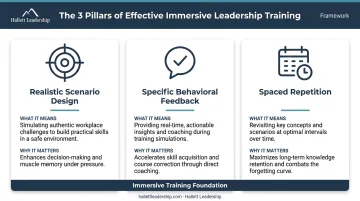
When all three elements are collapsed into a single-day workshop, the results rarely stick. Spaced repetition requires time. Behavioral feedback requires repeated practice. Realistic scenarios require iteration. A one-day event, however well-designed, can't deliver what weeks of structured experience can.
Behavioral Science as the Foundation
Immersive training grounded in behavioral science helps leaders understand the why behind their patterns, not just the what to do differently. This approach starts from the inside — examining values, assumptions, and emotional triggers — before addressing external skills. That sequence matters: new techniques grafted onto unchanged beliefs rarely hold.
Hallett Leadership's Discovery Model is built on this foundation. The model guides leaders through a process of breaking apart fixed beliefs (confusion), moving into genuine inquiry (curiosity), and arriving at new conscious competence — rather than grafting new techniques onto unchanged assumptions.
The Role of Ongoing Coaching
Sustained behavior change requires more than a well-designed simulation. It requires someone who observes, provides personalized feedback, and holds leaders accountable between sessions.
Within Hallett Leadership's programs, executive coaching runs approximately 1-2 hours per week in direct sessions. Between those sessions, coaches stay actively involved:
- Shadow leaders on the job to observe real behavior in context
- Set weekly goals tied to specific performance outcomes
- Stay available when challenges come up — not just at scheduled check-ins
Immersive Leadership Training in Practice
What a Session Looks Like
Consider a first-time manager preparing for a difficult performance conversation. In a traditional program, they learn the model: be specific, stay behavioral, link to impact. In an immersive session, they practice it — with a counterpart who pushes back, deflects, gets emotional, or challenges the assessment. The manager has to navigate tone, sequencing, and defensiveness in real time.
After the scenario, they receive specific feedback: what landed, what derailed the conversation, what to try differently. Then they do it again. That repetition builds the muscle memory that makes the real conversation — with a real employee — far more likely to succeed.
Highest-Return Situations
Immersive methods deliver the strongest return in moments leaders know how to describe but consistently handle poorly without prior practice:
- Giving difficult feedback — especially when the recipient may push back
- Managing underperformance — having the direct conversation before it becomes a larger problem
- Coaching a struggling team member — resisting the impulse to just tell them what to do
- Navigating team conflict — addressing dynamics directly rather than hoping they resolve themselves
- Leading through organizational change — communicating clearly when ambiguity is high
The common thread is emotional exposure combined with real stakes — and each one responds directly to the level of experience a leader brings into the room.
How It Looks Different Across Levels
One-size-fits-all programs miss the nuanced needs of each leadership tier:
- Emerging leaders: building foundational communication skills, developing confidence in their leadership voice, learning to give and receive feedback
- Mid-level managers: shifting from doing to coaching, building horizontal relationships across the organization, handling conflict directly
- Senior executives: developing presence and emotional regulation under complexity, learning to model the behaviors they want from their teams
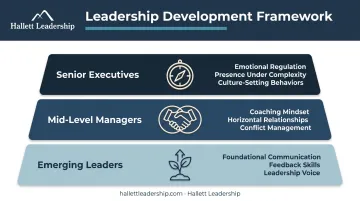
Hallett Leadership structures its programs around these distinctions. The nine-month Accelerated Leadership Program targets mid-level managers and high-potential emerging leaders. Senior leaders work through one-on-one executive coaching, with development focused on self-awareness, organizational influence, and the culture-setting behaviors that cascade through their teams.
How to Build Your Immersive Leadership Development Program
Start With Specificity
Before designing anything, get precise about the actual leadership gaps in the organization — by level. "Improve communication" is not trainable. "Mid-level managers default to directing rather than coaching when a team member is struggling" is.
Specificity determines whether a scenario is realistic enough to be useful. It also determines what success looks like. Build metrics tied to behavioral outcomes from the start:
- 360 feedback trends (are specific behaviors shifting over time?)
- Team engagement scores (are teams reporting better communication and psychological safety?)
- Internal mobility and retention (are leaders being developed and staying?)
Satisfaction surveys measure whether people enjoyed the experience. They do not measure whether anything changed.
Build the Program Architecture
Effective program design follows a clear structure:
- Sequence scenarios from lower to higher stakes — start with practice conversations that feel manageable, build toward more complex situations over weeks
- Blend experiential exercises with one-on-one coaching and peer exchange — each element reinforces what the others build
- Spread sessions across time — spaced learning produces significantly better retention than intensive single-event formats
- Layer on top of existing L&D infrastructure — immersive training works best as a practice layer added to existing frameworks, not as a replacement requiring full infrastructure rebuilds
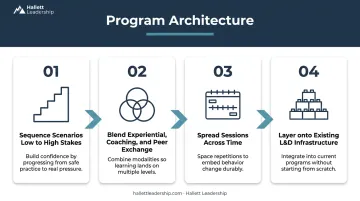
Hallett Leadership builds programs around this exact architecture — combining the Discovery Model, spaced experiential learning, and one-on-one executive coaching, refined over 15 years running leadership programs at 20th Century Fox.
Frequently Asked Questions
What is immersive leadership training?
Immersive leadership training is a practice-based approach where leaders rehearse high-stakes real-world scenarios — feedback conversations, conflict resolution, coaching moments — in a realistic setting before those situations arise on the job. Participants receive specific behavioral feedback and iterate, closing the gap between knowing what good leadership looks like and actually executing it under pressure.
What is the 70-20-10 rule for leaders?
The 70-20-10 model (from the Center for Creative Leadership) holds that 70% of leadership development comes from on-the-job experience, 20% from others, and 10% from formal training. Immersive training simulates that experiential 70% in a controlled environment — compressing years of trial and error into focused practice.
What are the 5 C's of leadership development?
The 5 C's are commonly referenced as Competence, Courage, Communication, Commitment, and Character — though framing varies by organization. Immersive training builds all five through scenario-based practice, pairing repetition and feedback with the self-reflection needed to tie behavioral change to real character development.
How is immersive leadership training different from a traditional workshop?
Workshops deliver knowledge and frameworks. Immersive training delivers practice. The defining difference is that participants do not just learn about leadership skills — they rehearse them in realistic scenarios and receive specific feedback on what they actually said and did, turning insight into executable behavior that traditional programs rarely achieve.
How do you measure the effectiveness of an immersive leadership program?
Move beyond satisfaction surveys. The Kirkpatrick Model offers a sharper framework — measuring reaction and knowledge acquisition, but prioritizing behavior change and business results. Metrics like 360 trends, coaching follow-through, and observed feedback quality are what actually connect training investment to organizational outcomes.