Introduction
Most organizations promote their best performers into leadership roles and then leave them to figure it out. The skills that made someone exceptional as an individual contributor — technical expertise, focused execution, personal accountability — don't automatically translate into leading people effectively. Yet that's exactly what most organizations expect — and the gap it creates is measurable.
This gap is expensive. Gallup research shows that 70% of the variance in team engagement is determined solely by the manager, meaning leadership quality isn't a soft metric — it's the primary driver of whether teams perform or disengage. And according to Gallup, 42% of employees who voluntarily left their jobs said their manager or organization could have done something to prevent their departure.
Leadership coaching and mentoring are two proven tools for closing this gap. This article covers what each approach means, how they differ, the skills they build, and how to structure programs that actually move the needle.
Key Takeaways
- Coaching is structured and performance-focused; mentoring is relationship-based and career-focused — both serve distinct, complementary roles in leader development
- Per Gallup research, 70% of team engagement variance traces back to manager quality
- EQ, communication, and decision-making are the core skills coaching and mentoring develop
- Effective programs combine both approaches, set clear goals, and measure outcomes from day one
- Developing middle managers often delivers the highest organizational ROI
What Is Leadership Coaching and Mentoring?
These two terms get used interchangeably, which creates real problems for organizations trying to develop their leaders — because the two approaches serve very different purposes.
Leadership coaching is a structured, goal-oriented process. A trained coach works one-on-one with a leader to identify strengths, uncover blind spots, and develop specific behaviors — with clear timelines and measurable outcomes. The International Coaching Federation describes coaching as "partnering with clients in a thought-provoking and creative process" that helps people maximize their professional potential. The focus is current performance and near-term growth.
Leadership mentoring is a longer-term, relationship-based approach. A more experienced leader shares wisdom, career guidance, and organizational knowledge with a less experienced one. As ATD defines it, mentoring is "a reciprocal and collaborative at-will relationship" focused on the mentee's growth, learning, and career development. The focus is future potential, not just present behavior.
The practical difference matters:
- Coaching targets a specific gap or transition
- Mentoring builds contextual knowledge and career perspective over time
- Coaching is typically delivered by a trained coach; mentoring is usually an internal senior leader
- Coaching is measured; mentoring is relational
Most high-performing organizations don't choose between the two — they use coaching to drive near-term performance while mentoring builds the long-term pipeline. The sections below break down how each works, and when to deploy them.
Coaching vs. Mentoring: Key Differences Leaders Need to Know
Side-by-Side Comparison
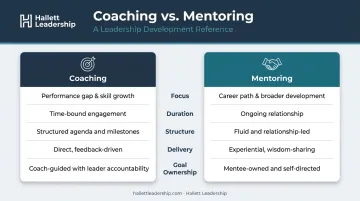
| Dimension | Coaching | Mentoring |
|---|---|---|
| Focus | Specific behaviors, performance gaps, defined skills | Career development, whole-person growth, knowledge transfer |
| Duration | Time-bound (typically 6–12 months) | Longer-term, ongoing relationship |
| Structure | Highly structured with defined goals and check-ins | More organic, though formal programs add structure |
| Delivery | Trained coach (internal or external) | Senior leader or experienced peer |
| Goal ownership | Often tied to organizational performance needs | Mentee typically sets the direction |
When to Use Each
Choose coaching when:
- A leader needs to close a specific performance gap
- A leader is preparing for a high-stakes role transition
- You need measurable behavioral change within a defined timeframe
- Skills like executive presence, decision-making, or conflict management need targeted development
Choose mentoring when:
- Grooming high-potential employees for future leadership
- Transferring institutional knowledge during leadership transitions
- Supporting cultural integration or succession planning
- Building long-term career confidence and organizational perspective
Why Using One Without the Other Falls Short
Treating coaching and mentoring as interchangeable. When an organization assigns a senior leader as a "mentor" to fix an urgent performance issue, they get neither good mentoring nor effective coaching. The strongest leadership development programs run both simultaneously: coaching addresses the immediate performance gap while mentoring builds the long-term perspective and organizational confidence that sustains growth beyond the engagement.
Core Leadership Skills Developed Through Coaching and Mentoring
Communication and Active Listening
Both approaches sharpen a leader's ability to communicate clearly and listen without rushing to respond. Coaching builds this through structured feedback and role-play, exposing leaders to how their words land differently than intended. Mentoring transfers it through observed example — watching how a senior leader navigates difficult conversations and asking them about it afterward.
At Hallett Leadership, active listening is developed through dynamic one-on-one sessions that combine behavioral science with experiential exercises, helping leaders stop automatic responses and genuinely hear what's being communicated before acting.
Emotional Intelligence
Leadership coaching has a measurable impact on EQ development. It helps leaders understand their emotional triggers, recognize patterns in how they respond under pressure, and develop the self-awareness needed to lead with composure rather than reactivity.
A 2018 meta-analysis of 98 papers and 27,330 participants found that leader emotional intelligence correlated with leadership effectiveness at r = 0.39 — a meaningful relationship that holds up across industries and organizational levels.
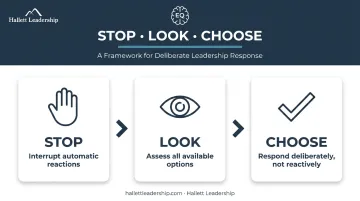
Hallett Leadership's STOP-LOOK-CHOOSE framework directly targets this. Leaders learn to stop automatic reactions, look at all available options, and choose how to respond rather than just react. Combined with behavioral assessments (DISC, 16 Types, Enneagram), this gives leaders specific, personalized insight into their own emotional patterns.
Decision-Making and Strategic Thinking
Both coaching and mentoring shift leaders from reactive, task-focused thinking to proactive, big-picture decision-making. Coaches ask powerful questions that surface unexamined assumptions. Mentors share hard-won experience from navigating similar situations — the hard-won context no framework captures.
Most managers default to completing the task in front of them. Leaders ask what decision best serves the organization six months out. That shift doesn't happen by accident — it happens through repeated, deliberate practice with someone who pushes the thinking further.
The Multiplier Effect: Coached Leaders Become Better Coaches
One of the most undervalued outcomes of leadership coaching is downstream. Leaders who've been coached well start coaching their own teams more effectively — asking better questions, holding developmental conversations, and creating the kind of psychological safety that lets teams raise problems early.
At Hallett Leadership, this is built into the methodology: as executives work through the Discovery Model themselves, they internalize a coaching approach they can apply directly with their own teams. The result is a development culture that extends well beyond the original engagement.
The Business Case for Leadership Coaching and Mentoring
Retention
Poor management is one of the most preventable causes of turnover. The Work Institute's 2025 Retention Report attributed 9.7% of 2024 turnover directly to management issues — and those numbers only count explicit management-related exits.
The retention benefit runs in both directions: leaders being developed feel valued and stay, and the teams they manage experience better leadership and are more likely to stay as well. An investment in manager development is, in practical terms, a retention strategy.
Productivity and Engagement
Manager quality doesn't just influence retention — it determines how teams perform day-to-day. That Gallup statistic bears repeating: 70% of team engagement variance is driven by the manager alone. Not the company's strategy, not its culture initiatives, not its perks package — the direct manager.
When leaders improve their communication, emotional intelligence, and decision-making through coaching, their teams notice. Engagement rises, collaboration deepens, and measurable output follows.
Succession Planning
External executive hires cost more and underperform. Wharton research found that external hires received significantly lower performance evaluations for their first two years compared to internal promotees in equivalent roles. And only one-third of executives report being satisfied with their organization's succession management outcomes, according to a Korn Ferry global study.
Organizations that invest in coaching and mentoring proactively build their bench. When a senior leader departs, the next generation is ready — rather than the organization scrambling to hire someone who will need 18 months to become effective.
Measuring ROI
The ICF/PwC Global Coaching Client Study found that 86% of companies reported recouping their coaching investment, with a median company ROI of 700%. These figures come with important caveats — only 189 respondents provided financial data — but they confirm that well-structured coaching programs deliver real financial returns.
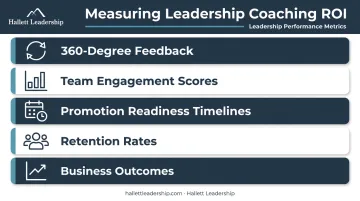
To build that evidence internally, organizations should track:
- Pre/post 360-degree feedback improvements
- Team engagement scores under coached leaders
- Promotion readiness timelines
- Retention rates among high-potential employees
- Business outcomes in coached leaders' teams
Build measurement in from the start. Programs that treat evaluation as an afterthought produce activity, not evidence.
How to Build a Leadership Coaching and Mentoring Program That Works
Start With Purpose and Sponsorship
Programs fail when they're HR initiatives instead of organizational commitments. Executive sponsors must participate, not just endorse. Before any matching or scheduling happens, answer these questions:
- Are you building a succession pipeline or closing urgent performance gaps?
- Which leadership tier are you targeting — C-suite, middle managers, or emerging leaders?
- What behavioral and business outcomes will define success?
These answers shape every decision that follows — who gets coached, how, and for how long.
Match Leaders to the Right Approach
Not every leader needs the same intervention:
- Immediate performance gaps or role transitions → structured coaching
- High-potential employees being groomed for future roles → mentoring relationships
- Senior leaders preparing for C-suite transitions → both, running concurrently
Matching matters. Pair mentors and mentees based on developmental goals and complementary experience — not just seniority or availability.
Build Structure Into Both Programs
For coaching programs:
- Define clear timelines, goals, and behavioral outcomes upfront
- Schedule regular check-ins with accountability for progress
- Use pre/post assessments to track change, not just satisfaction
- Set weekly goals aligned to both personal development and business results
For mentoring programs:
- Establish meeting cadences and protect time for them
- Set confidentiality norms early — mentoring only works if both parties speak candidly
- Train both mentors and mentees on how to make the relationship productive
- Define start and end dates even for relationship-based programs
Develop a Culture of Ongoing Feedback
Even the best-designed programs stall when the surrounding culture doesn't support them. Coaching and mentoring produce lasting results when honest dialogue, learning from setbacks, and peer-to-peer accountability are treated as everyday expectations — not scheduled events.
That shift requires leaders at every level to build three specific habits:
- Ask powerful questions instead of defaulting to directives
- Give constructive feedback regularly, not just during reviews
- Model the behaviors they expect from their teams
Developing Leaders From the Inside Out
Most leadership development treats behavior as the starting point. Fix the behavior, and the leader improves. Hallett Leadership's approach goes the other direction.
The BE-DO-HAVE model — the framework at the core of Hallett Leadership's methodology — holds that lasting change starts with identity, not action. Leaders must first BE the right kind of leader in mindset and character before they DO the right things, and only then will they HAVE the results they're after.
Most organizations run this backward: "When I have the authority, I'll be able to do the things that will make me successful." That sequence produces performance that's conditional on circumstances. The inside-out approach produces leadership that holds under pressure.
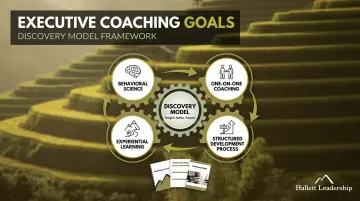
The Discovery Model translates this philosophy into a structured development process. It combines behavioral science, experiential learning, and one-on-one coaching to help executives and mid-level managers challenge the fixed beliefs and automatic behaviors that limit their effectiveness. The outcome is genuine change in how leaders think, communicate, and make decisions — not just a new set of techniques layered over old habits.
This approach powered Dean Hallett's 15-year program at 20th Century Fox, where approximately 1,100 leaders completed the nine-month Accelerated Leadership Program. The program transformed Fox's culture from siloed divisions into a collaborative, high-performing organization — and when a new Chairman arrived to champion higher employee engagement, the leaders who'd been through the program were already ready. That durability is exactly what inside-out development is built to produce.
For organizations in technology, healthcare, finance, or nonprofits, the highest leverage comes from targeting middle managers directly. They're the translation layer between executive strategy and daily execution — and when that layer is strong, the results are concrete:
- Strategy gets implemented instead of stalling between the C-suite and the front line
- Teams receive consistent direction aligned with organizational goals
- Culture shifts happen at the ground level, not just in leadership off-sites
Frequently Asked Questions
What is leadership coaching and mentoring?
Leadership coaching is a structured, goal-oriented development process focused on improving a leader's current performance through defined timelines, measurable outcomes, and targeted skill development. Mentoring is a longer-term guidance relationship in which a more experienced leader transfers knowledge, career perspective, and organizational wisdom to a less experienced one. Both are complementary tools that work best in combination.
What are the 5 C's of coaching and mentoring?
The University of Cambridge's People Development group describes a 5 Cs mentoring session model: Challenges, Choices, Consequences, Creative Solutions, and Conclusions. This mentoring-specific framework maps a structured conversation from surfacing the initial challenge through to actionable conclusions — not a universal standard that applies to coaching as well.
What is the difference between coaching and mentoring in leadership?
Coaching is typically time-bound (6–12 months), structured around specific goals, and delivered by a trained coach focused on behavioral change. Mentoring is longer-term, relationship-based, and focused on career development and institutional knowledge transfer — usually led by a senior internal leader. Coaching solves defined problems; mentoring builds long-term capability and context.
How does leadership coaching improve team performance?
Coaching helps leaders sharpen communication, emotional intelligence, and decision-making — producing clearer direction, stronger collaboration, and higher team engagement. Manager behavior accounts for 70% of team engagement variance, so even modest leadership improvements have outsized effects on output and retention.
When should an organization use coaching versus mentoring?
The right choice depends on the goal:
- Coaching fits time-sensitive performance gaps, specific skill development, or leaders preparing for major role transitions
- Mentoring fits succession planning, cultural integration, and developing high-potential employees over the long term
Most organizations benefit from running both — coaching for targeted intervention, mentoring as a sustained development thread running in parallel.