Introduction
What separates a manager who gets things done from a leader who changes how people think, work, and grow? Organizations navigating constant disruption, high turnover, and disengaged teams are asking that question more urgently than ever. Process-focused training doesn't close that gap.
Transformational leadership coaching works differently. Rather than layering new techniques onto existing habits, it addresses what's underneath: the beliefs, values, and mindset that drive every decision a leader makes. Change those foundations, and the outward behavior shifts permanently.
That's what this article is built around. It covers what transformational leadership coaching actually is, the four core principles that anchor it, how the coaching process creates lasting individual and organizational change, and how leaders at any level can get started.
Key Takeaways
- Transformational leadership coaching reshapes mindset, values, and emotional intelligence — not just surface-level skills
- It's built on four core principles: idealized influence, inspirational motivation, intellectual stimulation, and individualized consideration
- Unlike one-time training, it creates lasting behavioral change by targeting the beliefs and habits that drive how leaders act
- Organizations investing in transformational coaching see measurable gains in engagement, collaboration, innovation, and retention
- Leaders at every level, from emerging managers to C-suite executives, can build transformational leadership capabilities through structured coaching
What Is Transformational Leadership Coaching?
Transformational leadership coaching is a developmental process focused on the inner dimensions of leadership — values, beliefs, emotional intelligence, and sense of purpose — rather than tactical skill-building alone.
The concept has deep academic roots. James MacGregor Burns introduced the idea of leadership as a transforming relationship in 1978, and Bernard Bass extended it in 1985 with his research on leaders who inspire performance beyond expectations. Where transactional leadership relies on rewards and compliance, transformational leadership creates vision and intrinsic motivation that moves people beyond what's required.
Reactive vs. Generative Leadership
The practical distinction is this: reactive leaders respond to circumstances. Generative leaders consciously shape conditions for others to thrive. Transformational coaching moves leaders from the first mode to the second — not by teaching a new set of responses, but by changing how they see their own role.
At Hallett Leadership, this philosophy is formalized in the BE – DO – HAVE model: leaders first clarify who they need to be, then what they need to do, and finally what they'll have as a result. Most leadership training reverses this sequence, focusing on outputs before identity. The inside-out approach flips that logic — and changes built on identity tend to outlast those built on behavior alone.
Coaching vs. Mentoring
Coaching and mentoring are often used interchangeably, but they work differently. A mentor shares experience and advice — their playbook becomes your guide. A coach, as the International Coaching Federation defines it, partners in a thought-provoking, creative process that helps leaders maximize their own potential.
That difference has real consequences:
- Mentoring transfers knowledge — useful for learning known paths
- Coaching surfaces the leader's own answers — useful for navigating uncharted ones
- Dependency follows advice; ownership follows discovery
Ownership is what makes change durable. When leaders arrive at their own insight, they act on it — because it's theirs.
The 4 Principles of Transformational Leadership
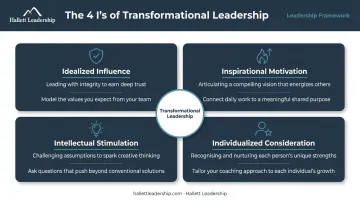
Bass and Avolio's Full-Range Leadership Model introduced four components — often called the "4 I's" — that translate transformational leadership into measurable, teachable behaviors. These aren't abstract ideals. Each represents a skill set that coaching can strengthen over time.
Idealized Influence
Idealized influence means leading by example — demonstrating integrity and consistency so that others are naturally motivated to follow. Trust isn't built through communication campaigns or vision statements; it's built through the gap (or absence of a gap) between what leaders say and what they do.
Hallett Leadership addresses this directly by helping leaders examine whether their actions align with their stated values, particularly under pressure. The real test of values-driven leadership, as their coaching framework emphasizes, is how you behave when decisions involve risk, trade-offs, or discomfort — not when everything is easy.
Inspirational Motivation
Most teams can follow objectives. Fewer will follow a leader whose direction genuinely connects to their aspirations. Inspirational motivation is the difference — communicating why that direction matters in ways that respect people's intelligence and experience.
Coaching in this area helps leaders distinguish between vision that sounds aspirational but feels hollow, and direction that genuinely lands. The goal is communication that feels grounded rather than inflated, linking organizational priorities to individual meaning.
Intellectual Stimulation
Transformational leaders don't want compliance — they want thinking. Intellectual stimulation means creating conditions where team members question assumptions, surface risks, and propose alternatives without fear of criticism.
Hallett Leadership's Discovery Model is built around this principle. Through experiential exercises and the STOP–LOOK–CHOOSE framework, leaders learn to interrupt automatic responses, survey the available options, and model curiosity rather than certainty. That shift — from projecting certainty to modeling curiosity — is where real organizational learning begins.
Individualized Consideration
Individualized consideration means recognizing that each team member has different strengths, motivations, and development needs — and responding accordingly.
Hallett Leadership uses DISC behavioral assessments to help leaders understand different working styles and develop what the framework calls behavioral versatility: the ability to communicate in terms each person understands and values most. The coaching trains leaders to provide specific, behaviorally grounded feedback while supporting growth without removing accountability.
How Leadership Coaching Drives Lasting Change
Most leadership training fails not because the content is wrong, but because it addresses behavior without touching the beliefs that produce it. McKinsey's research on leadership development identifies addressing underlying mindsets as a precondition for removing the roadblocks to behavioral change — without that work, new techniques get grafted onto old patterns and erode quickly.
Coaching works differently because it targets the source. A 2023 meta-analysis of 20 randomized controlled studies found executive coaching produced a meaningful overall effect (Hedges' g = 0.43), with stronger results specifically on behavioral outcomes (g = 0.73). Change shows up in how leaders actually behave, not just in what they report believing.
The Four Stages of a Coaching Journey
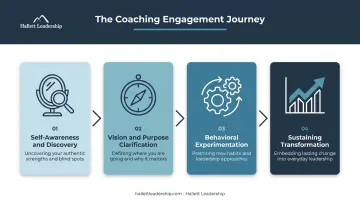
A well-structured coaching engagement typically progresses through four linked phases:
- Self-awareness and discovery — Surfacing personal motivations, blind spots, and leadership identity. At Hallett Leadership, this begins with detailed values and behavioral assessment to establish a genuine baseline
- Vision and purpose clarification — Identifying the leader's deeper "why" and connecting it to the organization's direction
- Behavioral experimentation — Testing new ways of communicating, delegating, and inspiring within real work contexts, not hypothetical scenarios
- Sustaining transformation — Embedding new mindsets through reflection, accountability, and ongoing refinement until new behaviors become default
The Role of Emotional Intelligence
Throughout this process, emotional intelligence functions as both a development target and a coaching tool. As Daniel Goleman argued in HBR, technical skills matter, but EI is the foundation that separates good managers from genuinely effective leaders. Developing EI — through tools like DISC assessments, affirmation practices, and the STOP–LOOK–CHOOSE paradigm — helps leaders recognize their automatic responses and consciously choose how to show up.
Coaching Behaviors Spread
Effective coaching changes how leaders lead others. They start asking questions instead of dictating answers, and creating space for thinking rather than demanding compliance. Hallett Leadership's Discovery Model is designed precisely around this transfer: executives don't just receive coaching, they develop the capacity to coach. That capacity ripples through their teams. Google's Project Aristotle studied 180 teams and found psychological safety to be the single most important factor in team effectiveness — the exact culture this kind of modeling builds.
Sustaining that culture requires structure, not just intention. Hallett Leadership's model includes weekly goal-setting sessions, 1–2 hours of direct coaching per week, and additional touchpoints between sessions. Coaches stay available when real crises or opportunities arise — challenging assumptions and holding leaders to their commitments when it counts most.
The Organizational Impact of Transformational Coaching
When a leader shifts how they communicate, motivate, and empower, the effects move outward. Gallup data puts a sharp point on why this matters: disengaged employees cost the global economy $8.8 trillion in lost productivity — roughly 9% of global GDP. High-engagement business units, by contrast, show 23% higher profitability and 18% higher sales productivity than low-engagement counterparts.
Transformational leadership coaching doesn't directly produce those numbers. But it develops the leadership behaviors that drive the engagement conditions that do.
Three organizational-level shifts are particularly well-documented:
- Cultural renewal: Teams shift from compliance-driven behavior to commitment-driven engagement, where initiative and ownership become the norm
- Collaboration gains: Authentic, empathetic communication builds trust across diverse teams, cutting the silo-driven friction that kills efficiency. Hallett Leadership's work with a major film studio — addressing collaboration breakdowns between departments — produced measurable improvements in communication, efficiency, and team cohesion
- Purpose-driven performance: When employees connect to meaningful direction, motivation becomes intrinsic rather than imposed. Innovation follows naturally when internal drive replaces external pressure
Transformational leadership compounds over time. Leaders who internalize these principles model them for others, who do the same. Over 15 years at 20th Century Fox, Dean Hallett's Accelerated Leadership Program developed more than 1,100 leaders — shifting a studio culture from siloed and idea-inhibiting to one where frontline managers actively championed change.

That kind of cultural momentum doesn't come from a training day.
How to Start Your Transformational Leadership Coaching Journey
Getting started requires three concrete commitments:
Find the right coach. Look for a credentialed coach (ICF's ACC, PCC, and MCC credentials reflect verified education and experience) who prioritizes relational chemistry and a personalized approach over a generic curriculum. The coaching relationship itself is where transformation begins. A poor fit undermines everything else.
Surface your blind spots. The research on self-awareness is humbling: while 95% of people believe they're self-aware, only 10–15% actually meet the criteria when evaluated objectively. Gather structured feedback (through 360-degree instruments, peer input, or a behavioral assessment like DISC) before assuming you know where the gaps are.
Integrate, don't separate. The most effective coaching engagements work around actual decisions, relationships, and organizational dynamics the leader is navigating right now. Hallett Leadership's one-on-one coaching is built on this principle — sessions are tied to real goals, real challenges, and real contexts, not hypothetical leadership scenarios. That's what moves insight into sustained behavior change.
Transformation requires showing up consistently, not just committing to a process on paper. Real change takes repetition, reflection, and time — typically several months before new behaviors fully embed. The leaders who see the biggest shifts are those who treat coaching as an ongoing practice, not a one-time intervention.
Frequently Asked Questions
What is transformational leadership coaching?
Transformational leadership coaching is a developmental process focused on shifting a leader's mindset, beliefs, values, and emotional intelligence to inspire lasting change — in themselves and their teams. Unlike management training focused on techniques, it works from the inside out, changing who a leader is before addressing what they do.
What are the 4 principles of transformational leadership?
The four principles are idealized influence, inspirational motivation, intellectual stimulation, and individualized consideration. Each is a learnable dimension of leadership, not a fixed personality trait, that coaching develops through deliberate practice and behavioral feedback.
How is transformational leadership coaching different from traditional leadership training?
Traditional training focuses on skills and processes: what to do in a given situation. Transformational coaching addresses the mindset and beliefs that drive behavior, targeting who you are as a leader. The result is deeper, more durable change because underlying thought patterns are replaced, not just temporarily overridden.
Who benefits most from transformational leadership coaching?
Mid-level managers, emerging leaders, and C-suite executives all benefit. Controlled coaching interventions have shown strong results across organizational levels, and the 4 I's are validated across industries and cultures.
How long does it take to see results from transformational leadership coaching?
Initial shifts in self-awareness and communication can appear within weeks. Lasting behavioral change typically unfolds over months: controlled studies show measurable gains at three months, with improvements maintained at four-month follow-up.