Introduction
Most organizations have experienced some version of this: a group of managers completes a multi-day leadership program, returns to work energized, and within a few weeks has reverted to every habit the training was supposed to change. The investment was real, the content was solid — but the behavior change never stuck.
This isn't a failure of individual motivation — it's a structural flaw in how most leadership development is designed. Traditional programs teach about leadership in settings removed from actual leadership work. Action learning was built to fix that.
The data backs this up: a 2024 peer-reviewed workplace training study found that as little as 30% of training content is successfully transferred and applied on the job. Action learning addresses this directly by embedding development inside real work, not alongside it.
This guide breaks down how action learning works, what it actually develops in leaders, and how to implement it in a way that produces lasting change.
Key Takeaways
- Action learning develops leaders through real organizational challenges — not simulations or lectures
- Small groups (4–8 people) use structured questioning, reflection, and committed action to solve live problems
- Action learning closes the behavior-transfer gap that traditional training consistently leaves open
- Skilled facilitation is non-negotiable — without it, sessions devolve into status meetings
- Programs run several months, with sessions spaced every few weeks for real-world implementation between meetings
What Is Action Learning?
Action learning is a structured group process in which small teams tackle real organizational challenges, question their assumptions, take action, and reflect on outcomes. The dual goal is solving the problem and developing leadership capacity at the same time.
Reg Revans introduced the concept in the 1940s after observing coal mine managers in Wales and England. His insight: managers learned most effectively when working together on live challenges, not through lectures. That observation reshaped how organizations think about developing leaders — and it's still the foundation of action learning today.
What Action Learning Is Not
This distinction matters more than it might seem:
- Not a simulation — the problem is real, with genuine organizational consequences
- Participants drive the process through questioning and action, not passive listening
- Not a one-time event — it unfolds over multiple sessions with accountability between them
- Historical case studies can't replicate the ambiguity of live challenges
The Standard Structure
Every action learning implementation shares the same building blocks:
- A problem or challenge — complex, meaningful, with no obvious single answer
- An action learning set — typically 4–8 participants drawn from different functions or levels
- Structured questioning and reflection — inquiry precedes advice-giving
- Committed actions — each session ends with individual commitments
- A skilled facilitator — maintains the process, not the solution
Together, these elements create the conditions where real work and real development happen simultaneously.
Why Traditional Leadership Training Falls Short
McKinsey has reported that US companies spend nearly $14 billion annually on leadership development — with customized business school programs running up to $150,000 per person. Yet in a 2009 Ashridge Business School poll, only 7% of senior managers said their companies develop global leaders effectively. That gap has persisted across decades of increased spending.
The gap isn't funding. It's design.
Three Structural Failures
Most conventional programs share the same limitations:
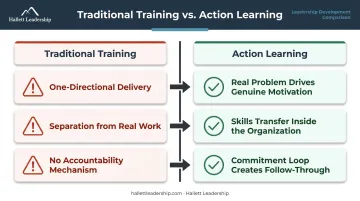
- One-directional delivery: content flows from instructor to participant, with little application pressure
- Separation from real work: skills are practiced in artificial settings, not actual leadership contexts
- No accountability mechanism: participants leave with good intentions and no follow-through structure
Action learning addresses all three. The problem is real, so motivation is genuine. The work happens inside the organization, so skills transfer immediately. And the commitment loop — returning to each session with evidence of what you did — creates the accountability that classroom training never provides.
This is exactly the flaw that Hallett Leadership's Accelerated Leadership Program is built to fix. Rather than short-term workshops that are "mostly didactic in nature," the program integrates development into daily work activities across nine months — prioritizing mastery of new thinking and new skills over one-time knowledge transfer.
How Action Learning Works: The Step-by-Step Process
Forming the Group and Selecting the Challenge
The challenge selection is where many programs succeed or fail before the first session begins.
A strong action learning challenge is:
- Complex, with no predetermined answer
- Meaningful to the organization — not a training exercise dressed as a real problem
- Unfamiliar enough that participants must genuinely think rather than apply existing routines
- Cross-functional in its implications
Routine operational issues don't qualify. The best fit is what Rittel and Webber (1973) called wicked problems — challenges with no definitive formulation, no stopping rule, and solutions that are "better or worse" rather than simply right or wrong. Organizational strategy, culture change, and cross-functional alignment are classic examples.
Group composition follows a similar principle: 4–8 participants drawn from different functions or levels. The diversity of viewpoint is the point, not a complication to manage.
Structured Questioning and Reflection
Action learning sessions operate by a discipline most groups find uncomfortable at first: statements can only be made in response to questions. This norm, established by WIAL (World Institute for Action Learning), forces participants to ask before they advise.
The result is a different quality of thinking. Instead of the group immediately generating solutions, participants surface assumptions, expose gaps in their framing, and develop a richer understanding of the actual challenge.
Reflection deepens this further. After questioning and discussion, the group pauses to examine not just the problem but how they are thinking about it. Useful reflection questions include:
- Why did we approach this the way we did?
- What assumptions are we making about the problem or about each other?
- What patterns are showing up in this conversation that also show up at work?
These questions are what separate action learning from a productive team meeting. The content insight matters. The leadership insight is what changes behavior.
Taking Action and Accountability
Each session concludes with individual commitments: specific actions participants will take before the next meeting. When the group reconvenes, those commitments are reviewed.
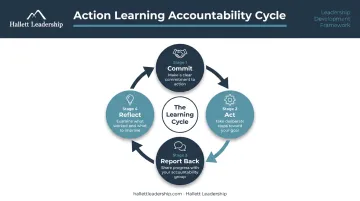
This four-part cycle is what makes the learning last:
- Commit — each participant names a specific action before leaving the session
- Act — they execute it inside their actual organization
- Report back — the group reviews what happened and why
- Reflect — patterns and leadership insights are drawn from the experience
Leaders aren't theorizing about leadership in the abstract. They're running real experiments and bringing the data back to the group.
The Role of the Facilitator
The facilitator in action learning is not a teacher. They hold the process without solving the problem.
Their core responsibilities:
- Maintain the questioning discipline (preventing the group from slipping into advice-giving)
- Intervene when there's a learning opportunity the group is missing
- Ensure psychological safety so participants can be honest about uncertainty
- Keep reflection from becoming either superficial or avoidant
Skilled facilitation is what separates effective action learning from ineffective group problem-solving. The methodology's structure is rigorous: without someone maintaining it, groups default to what feels natural — sharing opinions and generating solutions before the deeper reflection that produces real leadership growth ever happens.
Hallett Leadership's Discovery Model is built on this same principle. Rather than delivering answers, it draws insights out of participants directly, helping leaders recognize automatic behaviors, weigh their options, and act with greater intention. The facilitator's job is to create the conditions for that shift, not to shortcut it.
The Leadership Skills Action Learning Develops
Because participants solve real, complex challenges under structured reflection, skill development happens organically rather than through instruction.
Emotional Intelligence
Working through live challenges with peers — under time pressure, with real stakes — surfaces emotional patterns quickly. Leaders notice how they react when challenged, when they're ignored, or when the group takes a direction they disagree with. The structured reflection process makes those reactions visible and discussable.
EQ isn't installed from the outside — it's developed through exactly this kind of structured self-examination. Hallett Leadership's BE-DO-HAVE framework is grounded in the same principle: choosing how to be before acting is the foundation of emotional regulation, and action learning builds that capacity session by session.
Decision-Making Under Ambiguity
Action learning challenges have no predetermined answers. Participants must evaluate competing options, tolerate uncertainty, and commit to a course of action — then report back on what happened. That cycle, repeated over months, builds the decision-making muscle that abstract frameworks alone cannot.
Communication: Questioning and Listening
The structured questioning model teaches two communication skills that transfer immediately to team settings: asking powerful questions rather than asserting positions, and listening without an agenda. These skills shift how leaders show up in meetings, performance conversations, and conflict — moving from telling to drawing out, which is where real influence lives.
Learning Agility
Repeated cycles of action, feedback, and reflection develop what Korn Ferry calls learning agility — the capacity to adapt based on experience rather than relying on existing knowledge. Korn Ferry's research found that companies with highly agile executives had 25% higher profit margins than peer companies with less agile executives.
Key Components of an Effective Action Learning Program
Psychological Safety
Google's Project Aristotle research identified psychological safety as the first and most critical factor in team effectiveness — more important than who is on the team. Without it, action learning sessions become performative: participants perform competence rather than admitting uncertainty.
Building safety requires deliberate program design. Hallett Leadership addresses this by spending time at the outset discussing the value of taking risks, using experiential activities that create shared emotional experiences, and establishing norms where mistakes are learning opportunities rather than failures. These same principles apply directly to action learning set design.
Session Frequency and Duration
Spacing matters. Compressing action learning into a single intensive event defeats the purpose — participants need time between sessions to implement commitments and return with real data.
Practical guidance:
- In-person or virtual sessions: 90–120 minutes per session
- Frequency: Every few weeks to monthly, allowing time for action between meetings
- Program duration: Published program models vary, with some running five to six months
The rhythm creates the learning. Action learning derives its power from the cycle of commitment, implementation, and reflection, which requires time between sessions rather than back-to-back scheduling.
Accountability Structure
The most effective programs build accountability into the structure itself. Participants return to each session and report what they actually did — not what they intended to do. That expectation is established from day one.
Hallett Leadership's cohort model provides a useful parallel: weekly goal setting, regular coaching touchpoints, and peer accountability built into the nine-month program. The same design logic applies to action learning: if the program doesn't build in a mechanism for follow-through, follow-through won't happen.
Integration with Broader Development
Action learning works best as part of a coherent development journey, not a standalone intervention. It complements:
- One-on-one coaching: helps participants connect set discussions to their specific leadership challenges between sessions
- Behavioral assessments (DISC, Myers-Briggs, Enneagram): give participants a shared vocabulary for the patterns they notice in themselves and others
- Feedback frameworks: create consistent language across the team for naming and addressing interpersonal dynamics
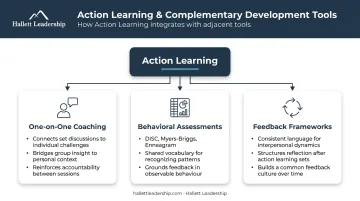
Hallett Leadership's Discovery Model integrates all three of these elements, which is why it pairs naturally with action learning cohorts. When behavioral science, experiential exercises, and executive coaching run alongside the set process, participants have the tools to act on what they're discovering — not just discuss it.
Common Pitfalls to Avoid
Selecting the wrong challenge. The most common mistake is choosing a problem that's too narrow, already decided, or lacking genuine complexity. When participants sense the outcome is predetermined, engagement collapses. The challenge must demand real thinking and real decisions: wicked problems, not operational housekeeping.
Losing the questioning discipline. Without a skilled facilitator enforcing the structure, action learning sessions become brainstorming meetings or status updates. The methodology's power lives in the discipline of inquiry before advocacy. Once that discipline erodes, the developmental value goes with it.
Neglecting organizational infrastructure. Hallett Leadership observed this firsthand at 20th Century Fox: after running 1,100 people through a nine-month program, the organization suddenly had a large cohort of energized leaders expecting their ideas to be heard. Without a structure to receive that energy (steering committees, task forces, feedback loops, and clear decision pathways), the training can inadvertently create frustration rather than momentum. Organizations that plan for this outcome — building infrastructure alongside the program — see far stronger results.
Abandoning the method after one poor execution. Organizations sometimes conclude action learning doesn't work after a single poorly designed pilot. More often, the challenge was weak, the facilitation was inadequate, or the program was too compressed. Start with one well-designed cohort, evaluate carefully, and iterate before scaling.
Frequently Asked Questions
How is action learning different from a case study or simulation?
Case studies and simulations use fictional or historical scenarios. Action learning uses live organizational challenges — meaning the stakes are real, the outcomes directly benefit the organization, and the learning is tied to actual work rather than a constructed exercise.
How many people should be in an action learning set?
The standard range is 4–8 participants. Small enough that everyone contributes meaningfully in each session, large enough to provide diverse perspectives on complex challenges.
How long does an action learning program typically last?
Most programs run five to six months across multiple sessions. Participants need time between sessions to implement commitments and return with real-world data, which is why compressed formats tend to underdeliver.
What types of challenges work best for action learning?
The best candidates are complex, unresolved problems with no obvious answer and cross-functional implications — what researchers call "wicked problems." Routine operational issues don't generate the depth of thinking that makes action learning worthwhile.
Do you need a professional facilitator to run action learning?
Yes, particularly for early implementations. The facilitator maintains the questioning discipline, ensures psychological safety, and prevents groups from defaulting to advice-giving. Without skilled facilitation, the structure collapses and the developmental value disappears.
Can action learning be run virtually?
Yes. WIAL guidance supports virtual delivery, recommending 90–120 minute sessions and preserving the methodology's structure as closely as possible. When well-facilitated, virtual action learning develops leadership skills just as effectively as in-person formats.