Introduction
Organizational change is relentless. Technology shifts, market disruption, restructuring, workforce evolution — leaders face them all simultaneously, often without pause. Yet according to McKinsey, 70% of change programs fail to achieve their goals, largely because of employee resistance and inadequate management support, not flawed strategy.
That number has persisted for decades because organizations keep solving the wrong problem. They invest in change frameworks, project timelines, and communication plans. What they underinvest in is the quality of leadership guiding people through the transition.
Leaders who know how to coach, not just direct, are the ones who convert resistance into momentum. They build the trust that makes adoption possible, and help their teams process uncertainty rather than be paralyzed by it.
This article covers:
- Why change fails at the leadership level
- How coaching for change differs from development coaching
- The specific skills that make leaders effective change agents
- Why middle managers are the most critical — and most underserved — group in any transition
Key Takeaways
- 70% of change initiatives fail — most often because of leadership gaps and poor communication, not flawed strategy
- Change coaching targets organizational outcomes, making it distinct from standard leadership development
- Effective change leaders develop specific skills — vision, empathy, emotional intelligence, and adaptive communication
- Middle managers are the execution layer where change succeeds or stalls
- A coaching culture, not just a coaching engagement, is what makes change durable
Why Most Change Initiatives Fail — and What It Means for Leadership
The Resistance Problem Nobody Wants to Talk About
Change creates real disruption for employees — shifted roles, abandoned workflows, unclear job futures. When leaders respond with directives and slide decks instead of dialogue, resistance doesn't shrink. It compounds.
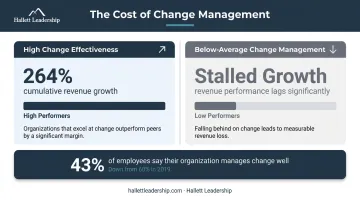
Prosci research notes that more than half of employee resistance to change is avoidable — meaning it's a leadership and communication failure, not an inevitable human reaction. Yet only 43% of employees say their organization is good at managing change, down from nearly 60% in 2019, according to WTW.
The consequences are measurable. WTW's 2023 research found that companies with high change effectiveness see 264% more revenue growth than those with below-average change management. For organizations navigating transformation, that gap is the measurable cost of neglecting the human side of change.
Where Leadership Breaks Down
When change fails, leadership quality is almost always implicated. Prosci data shows that projects with highly ineffective sponsors have only a 27% chance of meeting objectives, while those with effective sponsors succeed 79% of the time.
The gap between those two numbers comes down to a few consistent leadership failures:
- Top-down communication that bypasses trust-building
- Inconsistent messaging that creates rumor and anxiety
- Leaders who manage the operational checklist but ignore emotional reality
- Absence at the moments employees most need visibility and reassurance
The Coaching Solution
Each of those failures points to the same underlying gap: leaders equipped to manage tasks, but not people in motion. Coaching addresses that directly — giving leaders the mindset and behavioral tools to handle the emotional realities of change, not just the project plan.
Hallett Leadership's approach to this begins with what founder Dean Hallett calls "inside-out" development. Sustainable change starts within the leader — their values, communication habits, self-awareness — before it can genuinely influence their teams. The BE–DO–HAVE model puts into practice this: leaders first clarify who they want to be during the change (BE), then align their actions to that identity (DO), and the organizational results follow (HAVE). This reverses the instinct to manage change from the outside in, which is where most change programs lose traction.
Coaching for Change vs. Coaching for Development: What's the Difference?
Both types of coaching have real value — but in change situations, applying the wrong one produces the wrong outcomes. The distinction is worth understanding clearly.
Coaching for Development
This is an individually-focused engagement where the leader sets the agenda. They might work on executive presence, strategic thinking, or emotional regulation. The organization benefits, but indirectly — through the ripple effect of a better-equipped leader over time.
Coaching for Change
This is a strategically-directed engagement where coach and coachee move in deliberate alignment toward an organizational outcome. The goal isn't to make a leader a better person — it's to help them become an effective change agent for a specific initiative, right now.
| Dimension | Coaching for Development | Coaching for Change |
|---|---|---|
| Audience | Typically executives | All leadership levels |
| Direction | Self-directed by coachee | Aligned to shared organizational goal |
| Strategic intent | Individual impact | Direct organizational impact |
| Timeline | Longer-term, ongoing | Initiative-specific, embedded rhythms |
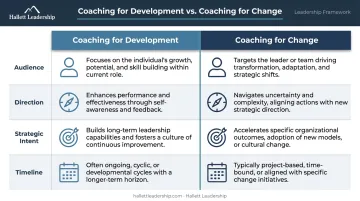
Organizations navigating active change need the second approach. This doesn't mean setting aside development work. It means ensuring the coaching engagement has explicit strategic intent tied to a specific outcome, not just a general improvement orientation.
The Leadership Skills That Drive Successful Change
Vision and Clarity
Leaders must articulate not just what is changing, but why it matters — and connect that vision to values that resonate across different team contexts. Vague messaging during uncertainty doesn't calm anxiety; it amplifies it.
Coaching helps leaders stress-test their vision before they broadcast it. At Hallett Leadership, this involves challenging leaders to move beyond the operational description of the change and find the human meaning within it — the "why" that makes people want to participate rather than comply.
Emotional Intelligence and Empathy
Change provokes fear, grief, and frustration. Leaders who can recognize those emotional responses — and validate them without amplifying panic — retain their team's trust during the transition.
The data here is striking. Catalyst research found that employees with highly empathic senior leaders reported 76% engagement and 61% innovation, compared to just 32% and 13% with less empathic leaders.
Coaching builds this capacity through structured reflection and feedback. Hallett Leadership treats emotional intelligence as the foundation of every coaching engagement — not a soft add-on, but the mechanism through which leaders interrupt their automatic stress responses and choose constructive action instead.
Adaptive Communication
A single message delivered one way to every employee fails during change. Different audiences need different things. Some need reassurance. Others want data, autonomy, or explicit acknowledgment that their concerns have been heard.
Coaching helps leaders read what a given audience needs and adjust their approach — precisely, not inauthentically. At Hallett Leadership, this is practiced through experiential exercises that place leaders in real communication scenarios and provide immediate feedback on what landed and what didn't.
Decision-Making Under Uncertainty
Change rarely unfolds on schedule. Leaders who need perfect information before acting become bottlenecks. Coaching builds the capacity to make sound decisions with incomplete data. That means practicing through:
- Scenario exploration that mirrors real change pressure
- Structured reflection on past decision patterns
- Repeated reps in conditions that require action before certainty
What Effective Change Management Coaching Looks Like in Practice
Start with Honest Assessment
Effective coaching for change begins by mapping the leader's current strengths, blind spots, stress responses, and communication patterns — all of which are amplified during change. A skilled coach uses this baseline to anticipate where the leader will unintentionally create friction.
At Hallett Leadership, this involves tools like DISC behavioral assessments alongside direct observation and structured dialogue. The goal isn't to label the leader — it's to give them precise, actionable self-knowledge before the pressure of change intensifies.
Create Space for Doubt
Coaching conversations give leaders a confidential environment to surface doubts, test their reasoning, and explore options without political consequences. That clarity-under-pressure translates directly into more confident, transparent communication with their teams.
Leaders who can't process their own uncertainty privately tend to project it publicly — or overcorrect into false confidence. Neither serves the organization.
Embed Consistent Rhythms
One-off coaching sessions don't produce lasting behavior change. Effective change coaching involves structured, recurring touchpoints throughout the initiative:
- Weekly or bi-weekly 1:1 sessions tied to real-time challenges
- Mid-initiative check-ins to recalibrate as circumstances shift
- Reflection exercises connected to live situations, not abstract theory
- Availability for unplanned moments — a difficult conversation, a resistant team, an urgent decision
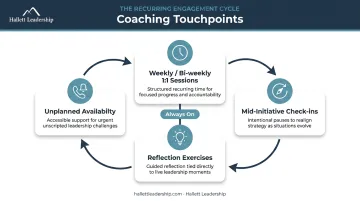
Hallett Leadership structures engagements with weekly direct sessions and ongoing indirect communication support, recognizing that behavioral change requires repetition and reinforcement across the arc of the initiative — not just at the front end.
Turn Leaders into Coaches
Those recurring rhythms do something else over time: they shift how leaders show up with their own teams. Rather than directing, they start asking better questions. They listen before responding. They pull back on over-managing and create room for others to step up.
Dean Hallett has seen this play out consistently — executives who go through the coaching process absorb and begin replicating effective coaching behaviors with their direct reports. One well-structured engagement extends its reach well beyond the individual receiving it.
Measure What Actually Changed
Real coaching is tied to observable, work-related results — not just satisfaction scores. In change contexts, that means tracking:
- How leaders communicate in high-stakes meetings
- How quickly they engage resistant team members
- Whether they follow through on commitments made to their teams
- How team performance and alignment shift over the course of the initiative
When coaching is working, you see it in how decisions get made, how teams respond under pressure, and whether the culture is shifting in the direction the initiative requires — not just in how a leader felt about the experience afterward.
Why Middle Managers Are Critical to Leading Change
Senior leaders announce change. Middle managers live it — absorbing pressure from above while fielding confusion, resistance, and anxiety from below. They are simultaneously the most influential and most overwhelmed population in any transition.
The data is clear about their importance. Prosci research found that 58% of employees prefer to hear about the personal impact of change from their direct supervisors — not from senior leadership. Middle managers are the trusted translators. When they're equipped, change moves. When they're not, it stalls.
The Underinvestment Problem
Most change coaching resources flow to the C-suite. Middle managers are frequently left to interpret executive strategy, manage resistant teams, and maintain operational continuity without meaningful support. DDI's 2024 research found that nearly 40% of managers report inadequate coaching — and that lacking manager coaching doubles turnover risk.
This gap is where change fractures. The executive team is aligned, the frontline hears conflicting messages, and somewhere between the two, the strategy gets diluted or abandoned entirely.
What Changes When Middle Managers Are Coached
With targeted coaching support, mid-level leaders stop being passive messengers and start becoming active change champions. Specifically:
- They surface team-level friction early, before it becomes a formal obstacle
- They model the new behaviors the change requires, making them credible rather than hypocritical
- They translate executive vision into concrete, day-to-day relevance for their teams
- They manage their own stress responses well enough to hold space for their teams' reactions
That's the core of what Hallett Leadership's middle management coaching is built around: giving mid-level leaders the tools to carry change forward, not just communicate it.
Building a Coaching Culture for Lasting Change
Deploying a coach for one senior leader during a specific initiative is a tactical response. It helps. But it doesn't address the underlying organizational capability gap.
A coaching culture embeds the principles of coaching into how leaders at every level operate every day:
- Active listening and genuine curiosity
- Psychological safety that allows honest dialogue
- Constructive feedback delivered consistently, not just during reviews
The result is an organization that doesn't just manage change better on a given initiative — it becomes structurally more adaptable.
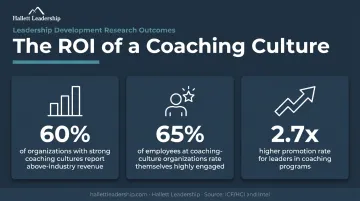
The business case is compelling. ICF and Human Capital Institute research found that 60% of organizations with strong coaching cultures reported revenue above their industry peer group — and 65% of employees at those organizations rated themselves as highly engaged.
Intel's experience offers a more specific data point: their internal coaching program was documented by the ICF as contributing approximately $1 billion per year in operating margin, with leaders in the coaching population showing a 2.7x higher promotion rate.
Building this culture requires more than budget — it requires a different expectation of leaders at every level. Hallett Leadership's nine-month Accelerated Leadership Program is built on this premise: rather than treating coaching as a discrete event, it embeds development directly into participants' daily work — structured around real challenges they're already navigating — so behavioral shifts accumulate over time and the surrounding cultural norms shift with them.
When that shift takes hold, coaching stops being a program leaders participate in. It becomes the operating standard they hold each other to.
Frequently Asked Questions
What are the key C's of change leadership?
The most commonly cited are Communication, Clarity, Collaboration, Commitment, and Courage. Together, they describe the consistent behaviors that separate leaders who move organizations forward from those who stall in uncertainty.
What is the 70/30 rule in coaching?
The 70/30 rule holds that the coachee speaks 70% of the time; the coach speaks 30%. Effective coaching is led by listening and questioning, not telling. In change contexts, this matters because the goal is to build the leader's own awareness and capability — not create dependency on the coach's answers.
What is the difference between coaching for change and coaching for development?
Coaching for development focuses on individual growth, with organizational impact as a secondary effect over time. Coaching for change directly targets a specific organizational outcome — it requires the coach and coachee to move in deliberate alignment toward that goal, not just toward general improvement.
How does leadership coaching reduce resistance to organizational change?
Coaching builds the empathy, communication skills, and emotional intelligence leaders need to address employee concerns before they harden into resistance. When leaders communicate honestly and create space for questions, employees are far more likely to engage with change rather than quietly push back against it.
What role do middle managers play in change management?
Middle managers translate strategic change into daily team behavior — they're where change either gains traction or quietly stalls. Because most employees prefer to hear about change impacts from their direct supervisor, coaching this population specifically is essential for moving from announcement to adoption.
How long does coaching for change management take to show results?
Individual behavioral shifts can emerge within weeks of consistent coaching. Meaningful organizational outcomes generally take 3–6 months to materialize. Embedding coaching rhythms throughout a change initiative — rather than front-loading or back-loading them — produces the most durable results.