That gap between how people actually develop skills and how organizations try to develop leaders is exactly what experiential learning addresses.
This article covers what experiential learning is, why the research supports it, its core benefits for leaders, and how to embed it into programs that produce real behavioral change — not just reaction-survey scores.
Key Takeaways
- Experiential learning develops leaders through active challenge and reflection, not passive instruction
- Only 7% of senior managers say their companies develop global leaders effectively — despite massive annual investment
- Structured debriefs after experiences improve performance by roughly 20–25%, according to a meta-analysis of 46 studies
- Effective programs integrate tailored activities, guided reflection, and ongoing coaching — each element depends on the others
- Lasting behavioral change means shifting who a leader is, not just what they know
Why Traditional Leadership Training Falls Short
Organizations globally spend an estimated $60 billion annually on leadership development. The return on that investment? Largely unmeasurable — and largely unimpressive.
McKinsey found that only 7% of senior managers believe their companies develop global leaders effectively. A 2023 Harvard Business Publishing report found that 96% of CEOs agree business impact from leadership programs should be measured, yet only 8% say it actually is.
The VUCA Problem
Part of the disconnect is contextual. Today's leaders operate in what strategists call a VUCA environment — Volatile, Uncertain, Complex, and Ambiguous. The term, drawn from post-Cold War military thinking and later popularized in business by Warren Bennis and Burt Nanus, describes conditions where yesterday's playbook regularly fails.
Seminars and slide-deck workshops were designed for a more predictable world. They deliver information about leadership — definitions, frameworks, case studies. What they cannot do is replicate the pressure, ambiguity, and interpersonal friction that leaders face every day.
What the Research Actually Shows
That gap between classroom and reality isn't just anecdotal — research confirms it. Edgar Dale's Cone of Experience (1946) introduced a foundational principle: learning becomes more durable as it moves from abstract to concrete.
The commonly cited retention percentages ("10% of what we read, 90% of what we do") lack verified empirical backing and shouldn't be treated as hard data. The underlying logic, however, is well-supported by behavioral science.
The real evidence for active over passive learning comes from behavioral science:
- Transfer to real performance is significantly higher when learners practice under realistic conditions
- Error-management training — where learners work through mistakes rather than avoid them — produces better transfer to novel situations than error-avoidant instruction
- Structured reflection after experience improves performance by 20–25%, with an average effect size of d = .67 across 46 studies and 2,136 participants
The spending isn't the issue. The dominant training format — passive, event-based, disconnected from real work — is structurally poor at producing behavioral change.
What Is Experiential Learning — And Why Does It Work?
Experiential learning is a process where participants gain knowledge, skills, and behavioral shifts by actively engaging in real or simulated challenges — then reflecting on and drawing meaning from those experiences. The key word is actively. Receiving information is not the same as processing it through action.
Kolb's Four-Stage Cycle
David Kolb formalized this in his 1984 Experiential Learning framework, which describes a four-stage cycle particularly well-suited to leadership development:
- Concrete Experience — the leader acts in a real or simulated situation
- Reflective Observation — they step back and observe what happened
- Abstract Conceptualization — they draw a principle or insight from the experience
- Active Experimentation — they test that insight in the next situation
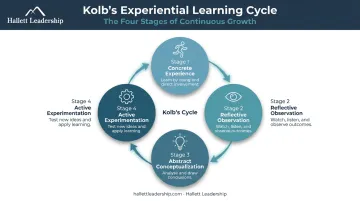
The cycle doesn't end. Each new experience feeds the next iteration, which is why leaders who train this way keep developing long after the formal program ends.
The Neuroscience Behind It
When people engage in emotionally charged, high-stakes scenarios, the brain activates the amygdala and hippocampus in ways that strengthen memory encoding. Research published in Frontiers in Psychology (Tyng et al., 2017) confirms that emotional arousal during learning enhances retention. Active learning mechanisms — including learner agency, novelty, and exploration — further support durable neural pathway formation.
A corporate simulation isn't neurologically identical to a real crisis. But an activity that creates genuine pressure is far more likely to produce lasting behavioral change than watching someone else navigate that pressure on a whiteboard.
Why Reflection Is Non-Negotiable
The activity alone is not the learning. The reflection is what makes it stick.
Without structured debriefing, participants leave with a memorable experience but no transferable insight. The facilitated debrief converts the experience into a leadership lesson the participant can apply Monday morning. That process typically involves:
- Guided questions that surface assumptions and blind spots
- Peer dialogue that broadens perspective beyond individual reaction
- Honest self-assessment that connects the experience to real work behavior
Hallett Leadership's Discovery Model builds this directly into its design. Rather than delivering prescriptive advice, the model treats confusion as productive — a signal that fixed assumptions are being challenged and new behavioral patterns can take hold. As founder Dean Hallett describes it, the goal is "a quest where participants can venture beyond the realm of what they know."
The Key Benefits of Experiential Learning for Leaders
Bridges the Knowing-Doing Gap
Most leaders can articulate what good leadership looks like. The problem is that under pressure — in a difficult conversation, a high-stakes decision, a team conflict — their stated values and their actual behavior often diverge.
Experiential learning forces that gap into the open. When a leader has to make a real-time decision in a realistic scenario, with peers watching, the performance reveals who they actually are under pressure, not who they intend to be.
This is what Hallett Leadership calls inside-out development, grounded in the BE–DO–HAVE model. Effective leaders ask first: Who do I need to be to accomplish this goal? Not what authority do I need to acquire, or what resources do I need to have first.
That shift from "Have-Do-Be" thinking to "Be-Do-Have" thinking is a genuine identity shift. Experiential programs are the most effective environment for producing it.
Builds Emotional Intelligence
EQ — the capacity for self-awareness, empathy, and social effectiveness — is consistently linked to leadership performance. Research by Mills (2009) across 11 studies and 1,258 participants found an average correlation of r = .39 between emotional intelligence and leadership effectiveness.
Korn Ferry's research goes further, arguing EQ predicts leadership effectiveness in ways that IQ alone cannot.
EQ is also trainable. Mattingly and Kraiger's 2019 meta-analysis confirmed emotional intelligence improves through deliberate practice in adults.
Experiential programs develop EQ by placing leaders in emotionally charged situations — ambiguity, conflict, feedback pressure — where self-regulation and empathy aren't theoretical constructs but live requirements. Hallett Leadership's programs integrate active listening, real-time feedback, and mindfulness practices directly into the experiential exercises, building emotional resilience through repetition rather than instruction.

Develops Adaptability Under Uncertainty
Keith and Frese's 2008 meta-analysis found that error-management training — where learners work through mistakes in realistic conditions — produces significantly better transfer to novel, unfamiliar situations than approaches that discourage errors. For leadership development, this is the adaptability argument in evidence form.
Leaders who regularly practice decision-making under simulated uncertainty develop the cognitive flexibility to handle real-world disruption. The Hallett Leadership Discovery Model operationalizes this through a STOP–LOOK–CHOOSE framework: participants practice interrupting automatic responses, scanning for available options, and selecting the best course of action. That habit transfers directly when unpredictable real-world conditions hit.
Strengthens Team Trust and Collaboration
Shared high-stakes experiences accelerate trust formation in ways that icebreakers and team lunches simply cannot.
Hallett Leadership regularly uses high ropes challenge courses to open their nine-month Accelerated Leadership Program cohorts. Intense shared emotional states — adrenaline, vulnerability, mutual reliance — forge the kind of personal bonds that typically take months of working together to develop. From there, the program builds on that foundation through regular peer feedback exchanges and structured dialogue.
The peer feedback format deserves attention. Participants exchange two statements: "What I admire about you as a manager is…" and "What would make you an even better manager is…" Participants report this as one of the most impactful elements of the program. The honesty it produces is only possible because trust was built first.
Produces Lasting Behavioral Change
Single-day workshops produce insight. Multi-month experiential programs produce behavioral change. The difference is reinforcement.
Harvard Business Publishing's 2023 data documents that 74% of CEOs want ROI data from leadership programs, but only 4% receive it. Part of the problem is that organizations measure the wrong things — participant satisfaction rather than behavior change.
The Kirkpatrick Model offers a cleaner lens: move evaluation from Level 1 (reaction) to Level 3 (behavior) and Level 4 (organizational results). Hallett Leadership tracks outcomes at those levels, including:
- Quality of collaborative working relationships
- Team communication effectiveness
- Shift from individual to team-based results
- Retention as a signal of cultural health
The 5 Principles of Experiential Learning in Practice
Understanding these principles helps organizations evaluate whether a program will genuinely develop leaders — or simply fill a day on the calendar.
| Principle | What It Means in Practice |
|---|---|
| Active Participation | Leaders make real decisions, not watch demonstrations. Mental and emotional engagement is required, not optional. |
| Realistic Challenges | Scenarios mirror actual leadership conditions: resource constraints, ambiguous information, team conflict, competing priorities. |
| Structured Reflection | Every activity is followed by guided debriefing — facilitated questions that surface what happened, why, and what it means for the leader's practice. |
| Feedback and Iteration | Immediate, specific feedback during and after activities builds the habit of continuous self-correction. In Hallett Leadership's ALP, coaches connect 1–2 hours per week with direct coaching plus ongoing check-ins between sessions. |
| Application and Transfer | Participants leave each experience with concrete commitments about how they will apply what they discovered in their actual role. Without this step, even powerful experiences fade. |
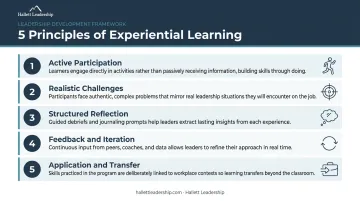
When programs skip structured reflection or application commitments, even the most engaging activities stop at the door of the training room.
How to Build Experiential Learning Into Your Leadership Development Program
Step 1: Design Around Specific Leadership Gaps
Start with a diagnosis. What are your leaders actually struggling with — communication under pressure, decision-making in ambiguity, cross-functional influence, managing conflict? Generic team-building activities address none of these specifically.
Hallett Leadership's approach begins here: programs are customized to each organization's culture, challenges, and objectives. Activities are chosen because they surface specific behavioral patterns, not because they're engaging.
The difference between a well-designed experiential program and a superficial one is whether the activity was selected to expose a specific leadership gap — or to fill a schedule.
Step 2: Pair Every Experience With Structured Reflection
Debrief time is not an afterthought. Build it into the program design as an equal partner to the activity itself.
Effective debrief questions don't deliver conclusions — they help participants find their own:
- What happened? Walk me through what you observed.
- What did you notice about your own behavior in that moment?
- What would you do differently if you ran this scenario again?
- How does this connect to a challenge you're navigating right now?
The goal is insight the participant owns, not advice they received.
Step 3: Integrate Coaching as the Reinforcement Layer
A single well-designed experience produces a moment of clarity. Sustained behavioral change requires accountability over time — and that accountability needs a consistent structure.
One-on-one coaching between program sessions is where new behaviors get tested, refined, and embedded. Hallett Leadership structures this as weekly goal-setting tied to personal development and real performance outcomes, with direct coach contact roughly 1–2 hours per week plus availability when specific situations arise. The coaching reinforces the experiential program by keeping leaders accountable to the changes they committed to making.
Step 4: Measure What Actually Matters
Move beyond participant satisfaction scores. Track behavior change using Kirkpatrick's Level 3 and Level 4 indicators:
- Quality of communication across teams
- Speed and quality of decision-making
- Frequency and resolution of conflict
- Team engagement and retention of high performers
- Business-unit performance over time
Harvard Business Publishing identifies innovation rate, talent pipeline strength, and business-unit results as the metrics CEOs actually care about. Build those into your measurement framework before the program launches, not after.
Frequently Asked Questions
What is the role of experiential learning in leadership development?
Experiential learning develops leaders by placing them in real or simulated challenges where they must act, reflect, and adapt. Unlike passive instruction, it produces the self-awareness, practical skills, and behavioral shifts that transfer directly into how leaders perform on the job.
What are the 5 principles of experiential learning?
The five principles are active participation, realistic challenges, structured reflection, feedback and iteration, and deliberate application and transfer. Programs missing any one of these — particularly structured reflection — tend to produce memorable experiences but limited behavioral change.
What is the 70-20-10 rule for leadership development?
The 70-20-10 model comes from CCL's research on how executives develop. It suggests roughly 70% of leadership growth comes from on-the-job experience, 20% from coaching and feedback, and 10% from formal training. Treat it as a design principle, not a fixed formula — it reinforces why experiential practice and coaching should anchor any serious program.
How does experiential learning differ from traditional leadership training?
Traditional training delivers information about leadership; experiential learning requires leaders to practice it. The distinction shows up in retention and transfer: passive instruction rarely changes behavior because leaders never have to perform under pressure in a training room.
What makes a leadership development program truly effective?
The most effective programs combine tailored experiential activities, structured reflection, ongoing coaching reinforcement, and measurement against real business outcomes. No single element does the job alone — and one-time events, however well-designed, rarely produce lasting change.
How long does it take to see results from experiential leadership training?
Early shifts — improved self-awareness, more deliberate communication — often appear within weeks of a well-designed program. Deeper behavioral change typically requires 6–12 months of consistent coaching. Hallett Leadership's nine-month Accelerated Leadership Program is built on this principle, designed to drive lasting transformation rather than short-term momentum.