Introduction
Most organizations invest heavily in leadership development and still struggle to show for it. McKinsey found that US companies spend roughly $14 billion annually on leadership training — yet only 7% of senior managers believe their companies develop leaders effectively.
The gap isn't budget. It's method. Workshops get forgotten. Classroom content doesn't transfer. Leadership pipelines stay thin despite real investment.
The most durable leadership development happens through doing: structured activities that put participants under realistic pressure, surface natural behavioral tendencies, and build habits through repetition rather than instruction.
This guide covers 39 of the best leadership development activities and games, organized by the core skill each one targets: Communication & Trust, Problem-Solving & Strategic Thinking, Emotional Intelligence & Self-Awareness, and Team Cohesion, Delegation & Accountability.
Each section is structured so you can match the right exercise to your team's specific gap — because the wrong activity at the wrong time produces the wrong habits.
TL;DR
- Leadership development activities simulate real leadership conditions in low-stakes environments
- Match each activity to a specific skill gap — random selection undercuts results
- A 2017 meta-analysis of 335 leadership training samples found a δ = .82 transfer effect when programs combined practice, feedback, and multiple delivery methods
- The 39 activities below span four skill categories and range from no-cost pair exercises to structured multi-hour workshops
- Debrief every activity — that's where the real learning sticks
What Makes Leadership Development Activities Effective
The reason activities outperform lectures isn't mysterious. Activities simulate the conditions leaders actually face — ambiguity, competing priorities, communication breakdowns, time pressure — and let participants discover how they naturally respond. That self-discovery creates the kind of motivation to change that no slide deck can manufacture.
The activity itself, though, is only half the equation. The structure around it determines whether participants leave with a felt experience or a transferable insight.
The Role of Reflection and Debrief
Kolb's Experiential Learning Theory frames learning as a four-stage cycle: concrete experience, reflective observation, abstract conceptualization, and active experimentation. Skip the reflection stages, and the cycle breaks. Participants have an experience, but draw no lasting conclusions from it.
This is why the debrief matters more than most facilitators acknowledge. Connecting what happened during the exercise to what happens back at work is where behavioral change actually takes root.
The Inside-Out Principle
Hallett Leadership's Discovery Model takes this a step further. Rather than teaching leadership behaviors from the outside in, the model helps leaders first understand why they behave as they do — moving from unconscious autopilot, through productive confusion, toward genuine curiosity about new approaches.
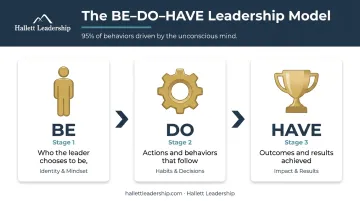
The underlying insight: 95% of our decisions and behaviors are driven by the unconscious mind. Even small increases in self-awareness give leaders access to options they previously couldn't see.
The BE–DO–HAVE model at the core of Hallett's programs follows this logic directly. Leaders first define who they want to be, which shapes what they do, which determines what they have. When activities are designed to trigger that inside-out reflection, they stop being exercises and start being turning points.
Leadership Activities for Communication & Trust
Communication and trust underpin every other leadership skill. PMI research found that ineffective communication puts 56% of project dollars at risk — roughly $75M for every $1B spent — and that highly effective communicators are 5x more likely to be high performers. The following activities target those gaps head-on.
Minefield Navigation
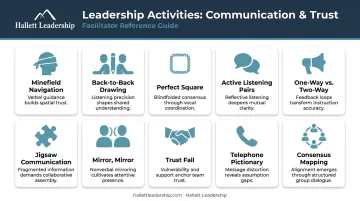
One partner is blindfolded and guided through a field of obstacles using only verbal commands. This builds trust and precision under pressure. Works especially well for pairs who don't typically work closely together — the discomfort is the point.
Back-to-Back Drawing
Partners sit back-to-back. One describes a shape or image verbally while the other draws it without seeing it. The gap between what was said and what gets drawn reveals how assumptions create misalignment — a visceral lesson for leaders whose instructions routinely get misinterpreted.
Building Instructions (Hidden Model)
A leader studies a hidden pre-built structure and must instruct a builder to replicate it through a delegator — without seeing the model themselves. This three-layer communication chain exposes how clearly a leader can translate vision into actionable direction.
Blind Retriever
One "driver" guides blindfolded teammates using voice only to collect scattered objects. Forces calm, real-time directional communication while teammates navigate trust in a pressure environment.
The Perfect Square
The whole team, all blindfolded, holds a rope tied in a circle and must form a perfect square. Removes visual cues entirely. Reveals who naturally coordinates through voice — and who goes quiet when certainty disappears.
Tallest Tale (Story Chain)
Each participant adds one sentence to a shared story that must build logically on the previous contribution. Builds active listening and adaptability — two skills leaders need when working with others' ideas rather than overriding them.
STAR Storytelling Framework
Participants use the Situation-Task-Action-Result structure to share a real leadership experience. Sharpens how managers articulate their leadership philosophy — useful for anyone preparing to coach, present, or influence upward.
What I Need From You (WINFY)
Teams state specific needs from each other using "What I need from you is…" with responses limited to: yes, no, I'll try, or unclear. Breaks vague interdepartmental friction into direct, actionable requests. It's the kind of clear expectation-setting that separates effective leaders from reactive ones.
Silent Lineup
The group must arrange themselves in a specific order — by hire date, birth month, or similar — without speaking, using only gestures and nonverbal signals. Highlights nonverbal communication blind spots that leaders often don't know they have.
Zoom (Sequential Pictures)
Each participant receives one image from a sequential visual story and must work with the group to reconstruct the correct order without showing their image to others. Practices patience, information sequencing, and collaborative problem-solving under ambiguity.
Leadership Activities for Problem-Solving & Strategic Thinking
Real leadership challenges rarely arrive with complete information or unlimited resources. These 10 exercises develop analytical reasoning, creative decision-making, and the composure to act when conditions are ambiguous.
Survival Leadership
Teams receive a survival scenario (plane crash, shipwreck, desert stranding) and must agree on the five most useful items from a provided list. The real test isn't the ranking — it's watching how teams handle disagreement when everyone believes they're right.
Skyscraper / Marshmallow Challenge
Teams use 20 sticks of spaghetti, one yard of tape, one yard of string, and one marshmallow to build the tallest freestanding structure in 18 minutes. The marshmallow goes on top. Most teams spend too long planning and not enough time prototyping — and discover this only when the structure collapses at the end. The lesson: iterative testing beats perfect planning.
Crocodile River Crossing
The whole team must cross a designated "river" using one fewer platform than there are participants, where platforms only stay "afloat" when touched. The physical constraint forces real-time communication and exposes how teams allocate resources when there genuinely isn't enough to go around.
Sneak-a-Peek
One team member views a hidden Lego structure for 10 seconds, then returns to instruct their team on how to build it. After each round, a new member peeks. Most teams are surprised how much the structure changes by the third round — a direct parallel to how strategic direction degrades across management layers.
All Aboard
Teams build a "boat" from provided materials and must all stand on it simultaneously. Pieces are gradually removed; the team must reorganize to stay on board. As space disappears, teams reveal whether they default to panic or to creative adaptation — a reliable indicator of how they'll respond to real budget or resource cuts.
Scavenger Hunt (Delegation Edition)
A designated leader must split the group and delegate tasks to complete a scavenger hunt within a time limit — but cannot complete any task personally. A practical delegation exercise: leaders quickly learn their job is to empower, not execute.
Plane Crash (Desert Island Prioritization)
Participants rank survival items individually, then as a group. The gap between individual rankings and the group's final list reveals how consensus-building actually works, and challenges leaders to influence outcomes without overriding others.
Team Jigsaw Puzzle
Two teams each receive a puzzle that is missing pieces held by the other team. They must eventually realize cooperation is required and negotiate piece exchanges one at a time. Most teams spend significant time trying to solve the puzzle independently before recognizing that the solution requires the other group — a frustration that mirrors real cross-functional leadership challenges.
Fishbone Root Cause Analysis
The team maps a shared workplace problem onto a fishbone diagram, working backward from symptom to root causes across six categories. Key outcomes for participants:
- Distinguishes symptoms from root causes using a structured visual framework
- Builds systems thinking by tracing problems across six contributing categories
- Particularly effective for mid-level managers dealing with recurring performance issues
Circles of Influence Mapping
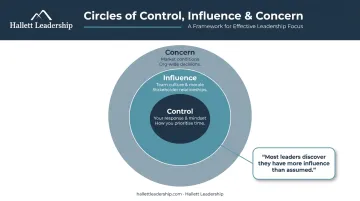
Participants map concerns onto three concentric circles labeled Control, Influence, and Concern. Key outcomes for participants:
- Surfaces assumptions about what leaders can and cannot control
- Most participants discover they have more influence than they assumed
- Shifts focus from reactive worry to proactive action in areas that matter
Leadership Games for Emotional Intelligence & Self-Awareness
A cross-cultural meta-analysis found leader emotional intelligence correlated with subordinate task performance at ρ = .48 — a meaningful effect that holds across cultures and industries. These 9 activities help leaders develop EQ through structured self-reflection — because the clearest view of how you lead others starts with understanding yourself.
Leaders You Admire
Small groups discuss leaders they admire — living or historical — and choose one to present to the full group. The debrief highlights recurring traits, helping participants consciously identify the leadership characteristics they want to embody rather than inherit by accident.
30 Seconds Left
Each participant reflects on the single best moment of their life, narrows it to 30 seconds, and shares it with the group. Builds psychological safety and humanizes team members for one another. Personal connection isn't incidental to good leadership — it's part of how trust gets built.
Explore Your Values
Participants write their top 10 personal values on Post-its, then rapidly discard them in timed rounds until only three remain. Time pressure forces instinctive choices rather than curated ones, revealing the values leaders genuinely hold versus the ones they think they should have.
Leadership Coat of Arms
Participants draw their own personal "coat of arms" divided into four quadrants: leadership skills, values, recent achievements, and what they find most meaningful at work. Makes leadership identity tangible and discussable — a strong foundation for individual coaching conversations.
Heard, Seen, Respected
In pairs, participants share a personal story about a time they were not heard, seen, or respected — while the partner listens without interrupting or problem-solving. Develops empathic listening and gives leaders a firsthand experience of what it feels like to go unacknowledged — making them more attuned to those moments in their own teams.
Silver Lining
One person shares a negative work experience while their partner reflects only on what was positive about the same event. Then they switch. Sharpens perspective-taking and resilience, helping leaders practice finding constructive meaning in difficulty rather than getting stuck in it.
Leadership Pizza (Self-Assessment)
Participants draw a circle divided into slices representing key leadership skills, rating their own development in each area. Creates a personalized development map that can anchor individual coaching conversations — particularly useful for managers beginning a structured program.
What If (Hypothetical Scenarios)
Individuals or pairs work through a difficult hypothetical — for example, losing a client due to a process failure — and explain their reasoning and proposed response. Develops accountability and self-awareness about how one responds when things go wrong, without the stakes of an actual failure.
Playing with Status Roleplay
Pairs role-play professional scenarios (coaching conversation, job interview) while consciously switching between high-status and low-status behaviors. Gives leaders a felt sense of how power dynamics affect communication — and how their own status signals land with team members.
Activities for Team Cohesion, Delegation & Accountability
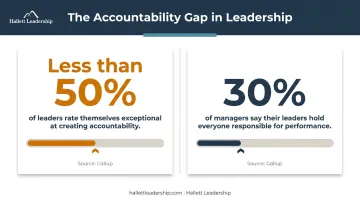
Cohesion and accountability are where leadership meets culture. Gallup data shows that less than half of leaders rate themselves as exceptional at creating accountability — and only 30% of managers say their leaders are exceptional at holding everyone responsible for performance. These 10 activities build the relational and structural habits that close that gap.
Human Knot
Participants stand in a circle, grasp the hands of two non-adjacent people, and must untangle into an open circle without releasing any grip. Demands real-time group decision-making, negotiation, and natural leadership emergence. Ideal for newly formed teams.
Untangle
A variation where participants hold hands across the circle and must unwind into a clean ring. The key debrief question: who stepped up to coordinate, and how did the group navigate disagreement about the path forward?
Round Tables
Four multi-step tasks are set up at four tables. A team leader at each table can only communicate and delegate — not participate. Teams rotate; the lowest total completion time wins. One of the best exercises for practicing leadership through others, not alongside them.
Leader's Task (3-Part Activity)
- Participants write an essay or debate a leadership topic.
- Winners become team leaders.
- Those leaders complete an assignment by organizing and mobilizing their team.
This end-to-end structure mirrors how leadership actually works: you demonstrate your thinking first, then you direct others.
Leadership Race
Participants take one step forward for each "I am…" leadership quality statement that applies to them — with explanations required as the game progresses. Surfaces self-perception about leadership strengths and can help managers identify team members ready for more responsibility.
Accountability Exercise
A manager announces that the seating arrangement is wrong and gives the group 60 seconds to fix it — with no further explanation. Reveals how teams respond to ambiguous authority and what behavior patterns emerge under time pressure. The debrief typically surfaces specific patterns: who froze, who defaulted to consensus, and who acted on assumptions — all useful data for a conversation about how clarity shapes team performance.
Feedback: Start, Stop, Continue
Each participant writes structured feedback for peers using three prompts: what they should start doing, stop doing, and continue doing. The combination of written and verbal delivery builds the habit of normalizing constructive feedback — and creates the psychological safety required for honest communication over time.
Dotmocracy Voting
Participants use dot stickers to vote on priorities displayed on a shared surface. It prevents the highest-paid person's opinion from dominating, and demonstrates that inclusive decision-making tends to build more durable commitment than top-down mandates.
Team Canvas Goal Setting
Teams work through a structured canvas covering nine elements: purpose, roles, goals, personal goals, values, needs, rules, strengths, and risks. Best used when forming a new team or resetting an existing one — creates shared ownership of direction rather than compliance with it.
Icebreaker (Question Points)
Each participant writes five general questions about people ("Who has lived in more than two cities?") and asks them to the full group, earning a point for each person who fits. A low-stakes way to open sessions, reduce tension, and help leaders practice making others feel seen and included.
How to Choose the Right Leadership Development Activity for Your Team
The most common mistake facilitators make is selecting an activity they enjoy running rather than one that addresses the team's actual gap. Start by identifying what's actually broken before you pick a format.
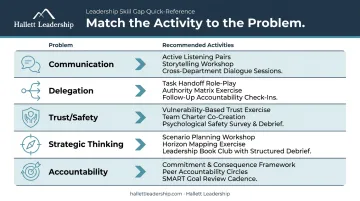
Match the Activity to the Problem
Ask these questions first:
- Is the team struggling with communication? → Communication & Trust activities (Minefield Navigation, Back-to-Back Drawing, WINFY)
- Are leaders avoiding delegation? → Scavenger Hunt Delegation, Round Tables, Leader's Task
- Is trust low or psychological safety absent? → Heard, Seen, Respected; Human Knot; 30 Seconds Left
- Are strategic decisions reactive and short-term? → Circles of Influence, Fishbone Analysis, Marshmallow Challenge
- Does the team struggle with accountability? → Accountability Exercise, Start-Stop-Continue, Dotmocracy
Secondary Selection Factors
- Group size: Pair exercises (Back-to-Back Drawing, Silver Lining) work for any size. Physical coordination activities (Human Knot, Crocodile River) need in-person attendance
- Remote or hybrid teams: STAR Storytelling, Circles of Influence, Values Exploration, and Dotmocracy all adapt well to digital collaboration platforms
- Seniority level: Executives often benefit more from EQ and self-awareness activities; emerging leaders gain more from structured communication and delegation exercises
Build In a Structured Debrief
Without a structured debrief, even the best activity produces little lasting change. Use these questions after any exercise:
- What did you notice about how leadership emerged during that activity?
- Where did communication break down — and why?
- What would you do differently if you ran that exercise again?
- How does what just happened connect to a challenge you're facing at work right now?
Conclusion
Leadership is not a trait people either have or don't. It's a set of practiced behaviors that develop through repeated, intentional experience — the same way any skill does. These 39 activities provide a starting point, but lasting growth requires what comes after: sustained feedback, honest coaching, and a structure that connects individual exercises to real behavioral change over time.
For organizations ready to build that structure, Hallett Leadership builds customized programs — from two-day alignment workshops to nine-month cohort engagements — around a single principle: who a leader is drives what they do. That's the foundation of the Discovery Model, which combines behavioral science, experiential learning, and one-on-one coaching to produce measurable change. Contact Hallett Leadership to explore how a sustained program can complement the activities in this guide.
Frequently Asked Questions
What are the 5 C's of leadership development?
The 5 C's vary by framework, but commonly include Competence, Confidence, Communication, Commitment, and Character. No single canonical version exists. Treat it as a practical organizing tool, and let your organization define which C's apply.
What are some leadership development activities?
Good starting points include Minefield Navigation for communication, the Marshmallow Challenge for problem-solving, Explore Your Values for self-awareness, and the Human Knot for team cohesion. The best choice depends entirely on the specific skill gap your team needs to address.
How do leadership activities differ from team-building exercises?
Leadership activities specifically target individual and group leadership behaviors — communication, delegation, decision-making, accountability — and are designed to surface and develop leadership capacity. Team-building exercises focus more broadly on group morale and connection, without necessarily developing specific leadership skills.
How often should leadership development activities be conducted?
Monthly structured activities are a reasonable baseline. The 70-20-10 framework suggests formal training accounts for only 10% of leadership growth — making regular, low-stakes practice activities important complements to ongoing coaching and on-the-job experience.
Can leadership development games work for remote or hybrid teams?
Yes — STAR Storytelling, Circles of Influence Mapping, Values Exploration, and Dotmocracy all work well on digital collaboration platforms. Physical activities like Minefield Navigation, Human Knot, and Crocodile River Crossing require in-person attendance and cannot be meaningfully adapted for virtual settings.
What is the difference between leadership training and leadership development?
Leadership training is typically a structured, time-bound event focused on teaching specific skills. Leadership development is an ongoing process of behavioral growth that includes training, coaching, experience, and reflection over time.