The difference between a redesign that sticks and one that collapses within months often comes down to one decision: which firm you bring in. The right partner doesn't just redraw reporting lines — it connects structure to strategy, and strategy to the people who execute it.
This guide covers five of the top organizational design consulting firms, what each specializes in, and how to evaluate which model fits your organization's goals.
TL;DR
- Korn Ferry centers org design on talent and behavioral science, linking structure to how people work and make decisions
- Navalent integrates leadership development, culture, and structural redesign into one cohesive system, supported by 240+ org diagnostics
- BCG brings data-driven diagnostics at global scale, with a proven track record of reducing structural complexity and cutting costs
- Eagle Hill Consulting takes an embedded, hands-on approach that builds solutions around how a company actually operates
- Accenture combines AI-powered workforce analytics with enterprise org design, making it a strong fit for digital transformation at scale
What Is Organizational Design Consulting?
Organizational design consulting is the process of aligning a company's structure, roles, decision rights, and workflows to support its business strategy. When structure and strategy drift apart, even high-performing teams lose traction — decision-making slows, accountability blurs, and strategic initiatives get stuck in the middle.
The demand for outside help is well-founded. Deloitte research found that 92% of leaders prioritize organizational redesign, but only 11% feel confident executing it successfully. That gap is wide enough that most organizations can't close it without experienced outside perspective.
The firms profiled below range from global enterprise consultancies to boutique specialists, so you can identify which model fits your size, industry, and transformation goals.
Top Organizational Design Consulting Firms
These firms were selected based on depth of methodology, demonstrated client results, breadth of services, and ability to connect structural change to real business outcomes.
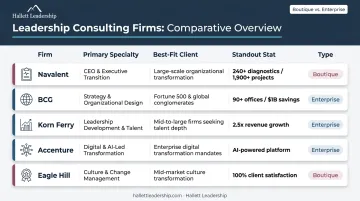
Korn Ferry
Korn Ferry is a global organizational consulting firm that places talent and behavioral science at the center of every engagement. Its org design work focuses on aligning operating models, structures, and workforce capacity to enable faster decision-making and growth — producing cleaner org charts as a byproduct, not the end goal.
What separates Korn Ferry from generalist consultancies is its proprietary Critical Role Index, which scores and ranks roles based on strategic impact, operational contribution, and functional weight. This framework helps organizations identify which roles actually drive outcomes versus which ones add structural weight. Korn Ferry's own data shows that organizations with high engagement scores achieve 2.5x the revenue growth of those with lower scores — a reminder that structural design and people performance are inseparable.
| Category | Details |
|---|---|
| Best For | Large enterprises undergoing talent-led restructuring or cultural transformation |
| Key Services | Operating model design, workforce analytics, role architecture, M&A integration, culture transformation |
| Notable Industries | Financial services, insurance, chemicals/ingredients distribution, healthcare, technology |
Navalent
Navalent is a boutique consultancy that treats organizational design as inseparable from leadership development and culture. Where many firms start with an org chart, Navalent begins with a deep diagnostic — examining decision-making patterns, power dynamics, and structural inefficiencies at their root before recommending any structural changes.
The numbers behind their approach are notable: 240+ organization diagnostics completed, 1,900+ transformation projects, 700 leaders and C-suite executives coached, and 3,600+ leaders interviewed. They've also consulted with 50+ CEOs across high-stakes transformations. One documented outcome: Navalent helped a $3 billion company avoid bankruptcy and double its bottom line within four years.
What makes this model distinct is the sequencing: Navalent resolves leadership misalignment before touching the org chart, which is why structural changes they recommend tend to hold.
| Category | Details |
|---|---|
| Best For | Mid-market and enterprise organizations where leadership dysfunction is driving structural breakdown |
| Key Services | Organizational redesign, strategic planning, senior team development, change management, executive coaching |
| Notable Industries / Clients | Food and agriculture (Cargill, Land O'Lakes), retail/consumer (Shinola, Windsor Stores), healthcare (Ardent Health Services) |
Boston Consulting Group (BCG)
BCG brings data science, change management, and global scale to organizational design. With 90+ offices across 50+ countries, it has the reach to support complex, multi-region restructurings that smaller boutiques cannot match.
BCG's methodology — branded Smart Design for Performance — centers on changing organizational context to change performance. The approach combines OrgVantage diagnostics to identify root causes, Smart Simplicity to reduce organizational complicatedness, and program management to embed new ways of working. The outcomes are quantifiable: in one documented engagement, BCG helped a global biotechnology firm reduce gross labor and non-labor costs by 20%, contributing to nearly $1 billion in savings.
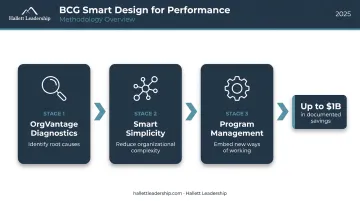
For organizations where cost reduction and execution speed are the core design objectives — rather than culture change or leadership alignment — BCG's data-first approach is hard to match.
| Category | Details |
|---|---|
| Best For | Large, complex organizations seeking data-driven delayering and execution improvements |
| Key Services | Enterprise operating model design, organizational effectiveness, agile transformation, workforce planning, change management |
| Notable Industries | Biotechnology/healthcare, financial services, high-growth technology, NGOs and conglomerates |
Eagle Hill Consulting
Eagle Hill is a boutique, woman-owned, family-run consulting firm that takes an embedded approach to organizational design. Rather than applying pre-packaged frameworks, their teams trace actual decision paths within each client organization — then redesign structure and culture in tandem based on what they find.
This translates to solutions built around how a business truly operates, not how leadership assumes it does. In financial services, Eagle Hill transformed a decentralized global operating model into a cohesive structure with a clear roadmap for continued growth. In a separate engagement with a major airline, they redesigned the operating model to improve customer experience and care delivery. The firm reports 100% client satisfaction across its engagements — a metric that reflects both their tailored approach and the senior-level attention each client receives.
| Category | Details |
|---|---|
| Best For | Mid-size organizations, nonprofits, and government entities needing customized, senior-led design support |
| Key Services | Org design strategy, workforce planning, change management, process improvement, culture realignment |
| Notable Industries | Federal government, financial services, healthcare, transportation/airlines |
Accenture
Accenture brings AI and advanced analytics directly into the organizational design process. Their Intelligent Organization Accelerator — a patented, generative AI-powered platform — analyzes workforce data to support operating model and org design decisions at a speed and scale that manual diagnostic approaches typically take months to achieve.
In 2020, Accenture acquired Kates Kesler, a firm recognized for award-winning operating models, deepening their org design capability. The combined offering allows Accenture to design organizations and configure the underlying digital systems simultaneously — ensuring structural changes translate into operational reality. That integration matters most when digital transformation and org redesign need to move in lockstep, not sequentially.
| Category | Details |
|---|---|
| Best For | Large enterprises undergoing digital transformation requiring org design integrated with technology implementation |
| Key Services | Enterprise org architecture, digital organization design, AI-enabled workforce analytics, large-scale change management, operating model reinvention |
| Notable Industries | Consumer goods, technology, financial services, healthcare, public sector |
What Sets the Best Organizational Design Consulting Firms Apart
Brand recognition matters less than most buyers think. What separates firms that deliver durable change from those that hand over a strategy deck and disappear comes down to a few specific things.
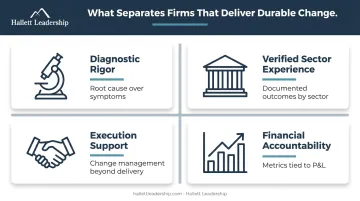
Diagnostic Rigor Over Surface-Level Assessment
Most redesigns don't fail because of flawed frameworks — they fail because the analysis stopped too early. McKinsey's transformation research shows that value leakage happens primarily during and after implementation, not in planning. A firm that diagnoses symptoms rather than root causes will build a structure that looks correct on paper but breaks down under daily operating conditions.
Ask prospective firms how they distinguish structural problems from leadership problems before recommending a redesign.
Verified Sector Experience
A firm that has designed organizations in biotech operates in a fundamentally different context from one working inside fintech or media. Regulatory environment, decision cadence, talent market dynamics — these aren't minor variables. The firms profiled above demonstrate sector depth through documented cases, not just industry page listings.
Prioritize firms that can show you actual outcomes from engagements in your industry, not generalized frameworks applied across all sectors.
Execution Support That Outlasts the Engagement
The best firms don't hand off a new org chart and exit. They embed change management, leadership coaching, and adoption support to ensure new structures take hold in actual behavior — not just on paper.
Organizations that invest in structural change without developing the leaders who must operate within the new model tend to revert. Firms that address both — or partner with specialized providers — produce more durable results.
Where leadership capability is the deeper constraint, firms like Hallett Leadership focus specifically on developing decision-making and behavioral capability at the middle management and executive layers, which is often what determines whether a new structure actually functions as designed.
Financial Accountability
The right firm connects structural changes to measurable outcomes — cost savings, decision speed, employee engagement — and tracks those results through implementation. If a firm's deliverable is a presentation rather than a set of defined metrics tied to your P&L, that's a meaningful signal about how they define success.
Conclusion
Organizational design is not a one-time project. It's an ongoing alignment between structure, strategy, and the people who execute against both. The five firms profiled here represent the range of available approaches — from AI-powered enterprise transformation to hands-on boutique work built around your specific operating reality.
When evaluating a partner, look past the brand and assess their engagement team quality, their diagnostic process, their track record in your industry, and their willingness to stay accountable to measurable outcomes past the delivery date.
Structural redesign rarely succeeds on its own. When leadership alignment and culture are the real constraints, new org charts won't hold unless the executives and managers responsible for them have the skills to carry them forward.
Hallett Leadership works at exactly that intersection — developing the executives and middle managers who must bring new structures to life through daily decisions, team dynamics, and cultural behavior. Programs like the nine-month Accelerated Leadership Program and C-Suite Coaching are built for organizations in transition. If your redesign needs leadership capability to match, explore Hallett Leadership's executive coaching and development programs.
Frequently Asked Questions
What is an organizational consulting firm?
An organizational consulting firm is a specialized advisory firm that helps companies align their structure, roles, decision-making processes, and workflows with their business strategy. They're typically brought in when an organization is scaling, restructuring, or struggling to execute on its goals.
What does an organizational consultant do?
An organizational consultant diagnoses structural and operational inefficiencies, recommends changes to reporting lines, governance, and role clarity, and supports implementation through change management and leadership alignment. The goal is improved execution speed, accountability, and overall performance.
What is the difference between organizational design and organizational development?
Organizational design focuses on structural elements — roles, reporting lines, decision rights, and workflows. Organizational development focuses on human and cultural elements such as leadership capability, team dynamics, and behavioral change. In practice, structural changes rarely hold without the cultural and behavioral work running alongside them.
Why do most organizational redesigns fail?
Most redesigns fail due to incomplete diagnostics, structural changes that never translate into day-to-day behavior, and inadequate change management. McKinsey research found only 30% of transformations sustain performance gains, with 55% of value lost post-implementation.
What are the key services offered by organizational design consulting firms?
Core services include operating model design, role and decision-rights mapping, change management, workforce planning, and post-merger integration. The strongest firms also offer leadership alignment and culture support to ensure new structures embed into day-to-day operations.
How much does organizational design consulting typically cost?
Pricing is custom-scoped and varies based on firm type, engagement scope, global complexity, and implementation support required. Request itemized deliverables and milestone-based pricing to maintain accountability throughout the engagement.