Most companies respond with compliance workshops and annual off-sites. The ones that actually outperform their peers do something different: they build structured, repeatable systems that develop leaders at every level, not just the C-suite.
This article profiles five companies that have done exactly that — selected not for brand recognition, but for programs with measurable depth, multi-level scope, and documented outcomes. It also covers what those programs share, and what any organization can do to replicate those results.
Key Takeaways
- Leadership development differs from employee training — it targets behavior, judgment, and emotional intelligence, not just skills
- Microsoft, Deloitte, Marriott, Adobe, and Cisco have built programs with documented structural depth and measurable outcomes
- Top programs share four traits: multi-level focus, behavioral science methods, coaching integration, and outcome tracking
- Companies without internal capacity can partner with specialized leadership development firms to access proven, research-backed methods
Why Leadership Development Deserves Its Own Category
Employee training covers skills, processes, and compliance. Leadership development targets something harder to measure and harder to change: how people think, decide, communicate, and influence others under pressure.
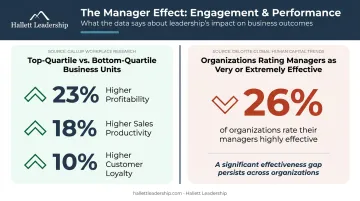
That distinction matters because the performance gap is real. Gallup's engagement research shows top-quartile business units outperform bottom-quartile units by 23% in profitability, 18% in sales productivity, and 10% in customer loyalty — and those differences trace directly to manager behavior. Yet Deloitte's 2025 Human Capital Trends data found only 26% of organizations rate their managers as very or extremely effective.
A seminar won't close that gap. Closing it requires sustained, deliberate investment in how leaders actually think — not just what they know.
The companies below have moved beyond one-time training events. Each has built a repeatable system that weaves learning into daily work, applies behavioral science, and holds itself accountable to measurable results.
Companies With Exceptional Employee Development & Leadership Training
These companies were selected for the depth, measurability, and multi-level scope of their leadership programs — not just brand name.
Microsoft
Microsoft's approach to leadership development starts with a cultural premise: leaders should be "learn-it-alls," not "know-it-alls." CEO Satya Nadella championed this growth mindset philosophy company-wide, and it shapes how managers at every level are expected to operate.
The operational expression of that culture is the "Model, Coach, Care" framework, which Microsoft WorkLab identifies as the standard for how people managers deliver success. The three expectations are straightforward but demanding: model the behaviors you want to see, actively coach your reports, and demonstrate genuine care for the people you lead.
What separates this from typical management training is top-down accountability. Senior leaders publicly model the behaviors, shortcomings included, which creates a self-reinforcing cycle rather than a one-time program rollout.
| Element | Detail |
|---|---|
| Program Focus | Growth mindset culture and manager effectiveness across all levels |
| Core Framework | "Model, Coach, Care" — three behavioral expectations for every people manager |
| Notable Feature | CEO-led modeling ensures top-down accountability, not just HR-driven delivery |
Deloitte
In 2011, Deloitte opened a $300 million dedicated learning facility in Westlake, Texas. The timing was notable: the investment was announced during an economic downturn, signaling that leadership development was a strategic priority, not a budget line item to cut.
Deloitte University now serves 65,000+ professionals annually across a global network, combining on-site learning, virtual classrooms, and individualized curriculum. The facility functions as both a training center and a cultural touchstone — a physical expression of what Deloitte wants people to experience as employees.
For new hires and interns, onboarding includes dedicated mentorship: a coach and onboarding advisor are assigned from day one. Development starts before the first full week ends, and the support structure stays in place long after onboarding closes.
| Element | Detail |
|---|---|
| Program Focus | Leadership and professional development for all employee levels |
| Delivery Model | On-site learning center, virtual classrooms, and individualized training |
| Notable Feature | Interns receive a dedicated coach and onboarding advisor from day one |
Marriott International
Marriott's Global Voyage Leadership Development Program launched in 2013 for university graduates, combining hands-on discipline-specific training with a structured leadership curriculum over 12 to 18 months. The program is designed as an internal talent pipeline, developing people into leadership roles rather than recruiting from outside.
The results are concrete. According to Marriott's 2021 Serve 360 report, 100% of Emerging Leader Program completers were promoted or selected for strategic management or P&L roles. The pipeline also feeds measurable representation outcomes:
- Women held approximately 44% of global executive leadership roles (year-end 2020)
- Women held approximately 48% of U.S. executive leadership roles the same year
| Element | Detail |
|---|---|
| Program Focus | Internal talent promotion and inclusive leadership pipeline development |
| Program Structure | 12–18 month global leadership development curriculum |
| Notable Outcome | 100% of Emerging Leader Program completers promoted or placed in strategic roles |
Adobe
Adobe's Leadership Circles program was built to solve a specific problem: women were underrepresented in senior sales leadership. Senior leaders nominate high-potential women below Director level to participate in a year-long cohort combining peer coaching groups, one-on-one executive coaching, and structured curriculum.
The structure combines two reinforcing development tracks:
- Mastermind groups of four to six peers provide ongoing accountability as a core learning mechanism, not a social add-on
- Six executive coaching sessions focus on strengths, career navigation, and blind-spot development
According to Forbes reporting, the program has graduated 800+ women, with 35% promoted to Director-level or above, including 24 Senior Directors and 4 Vice Presidents.
| Element | Detail |
|---|---|
| Program Focus | Leadership pipeline development for high-potential women in sales and beyond |
| Delivery Model | Small peer cohorts ("Masterminds") plus one-on-one coaching over 12 months |
| Notable Outcome | 35% of participants promoted to Director-level or above (per Forbes, 2023) |
Cisco
Cisco built a multi-tiered suite targeting different leadership levels, from new managers navigating their first people management role to senior executives leading global teams. The programs span the full career arc:
- Manager Assimilation — support for newly promoted managers
- Business Leader Program — simulation-based learning for senior managers and directors
- Global Technical Leader Program — high-potential technical leaders, with 90% of participants promoted or taking on new responsibilities
- Leadership Fellows Program — senior employees placed full-time with nonprofits for up to one year, developing real-world strategic leadership in a different organizational context
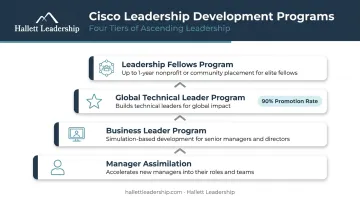
The Leadership Fellows Program puts experienced executives in unfamiliar environments where they lead without positional authority. That constraint is deliberate: it builds the kind of adaptive leadership that formal corporate settings rarely demand.
| Element | Detail |
|---|---|
| Program Focus | Multi-level leadership development from first-time managers to senior executives |
| Core Programs | Manager Assimilation, Business Leader Program, Global Technical Leader Program, Leadership Fellows |
| Notable Feature | Leadership Fellows ties executive development to nonprofit community impact |
What the Best Leadership Development Programs Have in Common
Across all five companies, four structural patterns appear consistently.
Multi-Level Focus
None of these programs target only the C-suite. From Marriott's university graduate pipeline to Cisco's new manager assimilation, effective leadership development treats every leadership transition — not just the top floor — as worth investing in.
Behavioral Science Integration
The best programs change how leaders think and behave, not just what they know. Research from the Center for Creative Leadership describes the 70-20-10 model — 70% of leadership development comes from on-the-job challenges, 20% from coaching and mentoring, 10% from formal instruction. The programs above are built around this ratio. Adobe's Masterminds, Cisco's nonprofit placements, and Microsoft's daily manager expectations all prioritize applied learning over classroom content.
The "Inside-Out" Principle
The strongest programs build self-awareness before targeting external skills. Korn Ferry's research found that diverse teams led with emotional intelligence make better decisions up to 87% of the time — and that capacity begins with leaders who understand their own patterns, blind spots, and behavioral defaults.
Hallett Leadership's Discovery Model makes this principle explicit. The BE–DO–HAVE sequence holds that who a leader needs to be shapes what they do and what results they have. The model is grounded in research showing humans are conscious of only 5% of their cognitive activity, making self-awareness work foundational to any behavior change. The best corporate programs apply the same logic — Hallett's methodology simply names it directly.
Coaching and Peer Learning as Infrastructure
Across all five companies, one-on-one coaching, structured mentoring, and peer learning groups are core delivery mechanisms, not optional extras. What separates these programs from one-time training events:
- Adobe builds Mastermind groups into the program architecture
- Deloitte assigns advisors from day one
- Cisco deploys fellows into real organizational challenges
The content matters far less than the sustained human relationships that hold learning accountable over time.
What to Look for When Choosing a Leadership Development Partner
The most common mistake in selecting a leadership development program is choosing based on brand recognition or content volume. A program can have impressive-looking modules and still produce no lasting behavior change if it doesn't address how leaders actually show up in real situations.
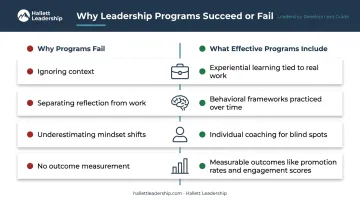
McKinsey identifies four reasons leadership programs fail: ignoring organizational context, separating reflection from real work, underestimating mindset shifts, and failing to measure outcomes. Programs that avoid these failures tend to share specific characteristics:
- Experiential learning tied to actual work challenges, not simulated scenarios
- Behavioral frameworks leaders practice over time, not just learn about in a classroom
- Individual coaching that surfaces and addresses blind spots specific to each leader
- Measurable outcomes — promotion rates, retention, manager effectiveness scores, engagement — not just attendance
Organizations of any size can access this level of rigor. It doesn't require a $300 million campus.
Hallett Leadership is a boutique firm that applies these same principles at scale. Dean Hallett's Discovery Model combines behavioral science with experiential learning, guiding leaders from unconscious fixed patterns toward genuine self-awareness and new behavioral choices.
His nine-month Accelerated Leadership Program ran for 15 years at 20th Century Fox, developing approximately 1,100 leaders and producing documented culture shifts, including breaking down silos between departments as the studio faced industry disruption. That same methodology has since been applied at the Walt Disney Company — demonstrating its durability across different organizational cultures.
For organizations that want the methodology behind those results without the overhead of a large internal L&D department, a specialized partner like Hallett Leadership delivers the coaching infrastructure, behavioral frameworks, and outcome tracking that most internal programs aren't resourced to sustain.
Conclusion
The companies on this list share a common conviction: leadership development is a business investment, not a training perk. Their programs are intentional, multi-level, behaviorally grounded, and consistently measured. The results show up in retention, promotion rates, and bottom-line performance.
These same principles scale to any organization. The real question is whether your current approach is actually changing how leaders think and behave — or just delivering information that gets left at the door. If it's the latter, the gap between program and impact is where real development work begins.
For organizations ready to build a high-performance leadership culture from the inside out, Hallett Leadership offers customized programs built on Dean Hallett's Discovery Model — a behavioral science and experiential learning approach refined over 15 years at 20th Century Fox. Programs include executive coaching, cohort-based learning, and team alignment work designed to develop leaders from the inside out. Reach out at dch@hallettleadership.com or call (310) 971-4667 to start a conversation.
Frequently Asked Questions
What companies have the best leadership development programs?
Microsoft, Deloitte, Marriott, Adobe, and Cisco consistently rank among the strongest. What they share matters more than the names: multi-level focus, behavioral science methods, integrated coaching, and outcomes tied to internal promotion rates and manager effectiveness scores.
What are the 5 C's of leadership development?
Character, Communication, Competence, Courage, and Commitment are the five pillars cited across leading frameworks. Top corporate programs consistently target all five, with the most meaningful growth happening in the shift from technical competence toward behavioral and relational effectiveness.
What is the 70-20-10 rule for leaders?
Developed at the Center for Creative Leadership, the model holds that 70% of leadership growth comes from on-the-job challenges, 20% from coaching and mentoring relationships, and 10% from formal instruction. The strongest programs like those at Microsoft and Deloitte are designed to activate all three channels, not just the 10%.
What is the difference between employee training and leadership development?
Employee training focuses on skills, processes, and compliance. Leadership development targets behavior change, emotional intelligence, decision-making, and the ability to influence others. That requires a fundamentally different methodology, longer timeframes, and sustained coaching.
How do companies measure the ROI of leadership development programs?
Leading organizations track metrics like:
- Internal promotion rates and high-potential retention
- Manager effectiveness scores and team engagement
- Reduction in external hiring costs
The strongest programs tie every initiative to at least one measurable business outcome, not just completion rates.