Choosing the wrong development partner means buying activity, not change. The right one builds leadership capability that directly affects team performance, retention, and culture — and can withstand the scrutiny of real business outcomes.
This article gives you a complete evaluation framework: the criteria that separate high-impact consultants from content deliverers, the red flags to watch for, and how to anchor this decision to measurable results.
Key Takeaways
- Methodology, customization, and outcome measurement matter more than a consultant's reputation alone
- Customized programs aligned to specific business behaviors are 8.1x more likely to succeed than generic ones
- Require a clear ROI and measurement framework before signing any engagement
- Prioritize consultants with lived senior leadership experience over those with training credentials alone
- Watch for red flags: pre-packaged curricula, vague success metrics, and no post-program follow-through
What Is a Leadership Development Consultant?
A leadership development consultant is an external expert who helps organizations assess, design, and implement programs that build leadership capability — at the individual, team, and organizational levels — aligned with strategic goals.
The distinction from a generic training vendor matters. Effective consultants blend assessment, behavioral science, experiential learning, and ongoing coaching into a connected system — one designed to produce sustained behavioral change, not a one-time event.
Core Functions
A well-structured engagement covers three interconnected functions:
| Function | What It Involves |
|---|---|
| Assessment & Diagnostics | 360-degree feedback, behavioral assessments, and structured interviews to establish a baseline before any program design |
| Customized Program Design | Tailored development plans, including executive coaching, action learning, and workshops, aligned to culture and strategy |
| Implementation & Measurement | Embedded accountability structures, progress tracking, and program adjustments based on real behavioral outcomes |
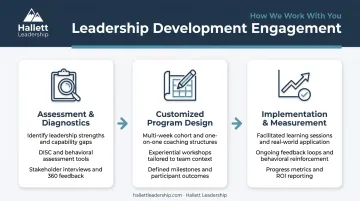
The sequencing is deliberate: diagnosis before design, design before delivery, and measurement integrated from the start.
What to Look For When Evaluating Leadership Development Consultants
Organizations rarely struggle to find a consultant. They struggle to select the right one. These six criteria distinguish consultants who deliver strategic impact from those who deliver activity.
Criterion 1: Depth and Integrity of Methodology
Ask how the program is built. Does the methodology explain how leaders change behavior — or just what skills they'll practice?
Rigorous methodology combines behavioral science, experiential learning, and personalized coaching into a sequence. According to McKinsey research, programs linking content to stretch projects and requiring application over an extended period were 6.1x more likely to succeed, and programs encouraging daily behavioral practice showed a 4.9x higher success likelihood.
Key questions to ask:
- How do you help leaders change embedded behaviors, not just add new skills?
- What's the difference between how you design this program versus what you'd deliver to another client?
- How does learning get applied between sessions?
Criterion 2: Demonstrated Track Record with Measurable Outcomes
Testimonials are a starting point, not evidence. Ask for data.
- Did engagement scores improve after the program?
- Did promotion-ready pipelines deepen?
- Can the consultant point to retention improvements or team performance gains?
According to DDI, one organization that invested in structured leadership development saw 80% lower salaried turnover — a concrete benchmark for what rigorous programs can produce. A credible consultant points to comparable, work-related outcomes from their engagements — not just participant satisfaction scores.
Criterion 3: Alignment with Organizational Culture and Strategic Goals
The best consultants diagnose before they prescribe. Watch for consultants who arrive with a solution already in hand — before they've understood your culture, your industry dynamics, or the specific leadership gaps you're trying to close.
Two things to assess:
- Watch the timeline on their initial proposal. One that arrives within 48 hours of first contact signals that real customization isn't happening.
- Ask how learning connects to day-to-day work. Behaviors practiced only in a classroom rarely transfer — application in real operational contexts is what makes change stick.
Criterion 4: A Clear ROI and Measurement Framework
Require this before signing. A credible consulting partner will articulate both:
- Leading indicators: behavioral shifts, quality of feedback, improved team dynamics, communication patterns
- Lagging indicators: retention rates, productivity metrics, promotion readiness, business results
The absence of a measurement framework isn't just a gap — it's a red flag. According to Brandon Hall Group research, more than three-quarters of companies report needing to improve measurement to understand the impact of leader training. Many organizations skip this step entirely. Don't.
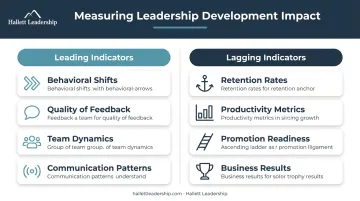
Ask: What's the baseline? How will you measure progress at 90 days, 6 months, and 12 months?
Criterion 5: Ongoing Support and Accountability Structures
Leadership development isn't a one-time exposure. Ask what happens after delivery.
Strong consulting engagements include:
- Regular check-ins and coaching touchpoints between sessions
- Peer accountability structures (cohort feedback, learning partnerships)
- A defined protocol for when participants revert to old behaviors
- Progress reviews tied to real work outcomes, not just program milestones
Ask directly: what accountability exists six months after the program wraps? If there's no answer, that's your answer.
Criterion 6: The Consultant's Own Senior Leadership Experience
This is the differentiator that's hardest to fake. Consultants who have held actual senior roles — navigated organizational complexity, managed competing priorities, driven performance under pressure — bring something career trainers cannot: credibility with the leaders they're coaching.
Senior leaders disengage quickly from coaches they perceive as purely academic. Real experience sharpens the questions a coach asks — and examples drawn from lived situations land in ways that textbook scenarios never do.
Ask directly: Where did you lead before you started consulting? What leadership challenges did you personally navigate?
Red Flags That Signal the Wrong Consulting Partner
Move carefully — or walk away — when you observe any of these patterns:
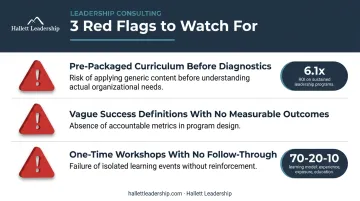
Pre-packaged curriculum before any diagnostics. If a consultant arrives with a fully formed program before conducting any assessment of your organization, they're selling content delivery, not development.
Vague success definitions. "Improved leadership culture" isn't a measurable outcome. If a consultant can't define specifically how success will be observed or measured, they're not accountable to results.
One-time workshops with no follow-through. McKinsey found that successful programs were 6.1x more likely to connect content to real work application over an extended period. CCL's 70-20-10 framework confirms that only 10% of development comes from formal coursework — the other 90% comes from on-the-job experience and learning from others.
How Hallett Leadership Approaches This Differently
Hallett Leadership addresses the criteria outlined above through the structure of how it actually works — built on decades of organizational experience before any consulting credential.
Dean spent 27 years as a senior executive in the entertainment industry, including as EVP and CFO of The Walt Disney Studios and 17 years at 20th Century Fox. At Fox, he developed and ran the company's Accelerated Leadership Program (ALP) for over 15 years.
He workshopped 1,100 leaders through that program. That depth of in-the-trenches experience shapes every element of his consulting practice.
The Discovery Model and BE-DO-HAVE Framework
Hallett Leadership's proprietary Discovery Model doesn't start with skills — it starts with identity. The BE-DO-HAVE framework reverses the conventional sequence: rather than waiting to achieve results before defining who you are as a leader, participants begin by establishing who they need to be first. Behavioral change precedes skill application, not the other way around.
In practice, this involves:
- Challenging fixed beliefs and automatic behaviors using a STOP-LOOK-CHOOSE method
- Weekly experiential exercises applied directly to real work challenges
- Peer feedback exchanges that build horizontal accountability across cohorts
- One-on-one coaching embedded throughout the nine-month ALP, integrated from day one rather than bolted on at the end
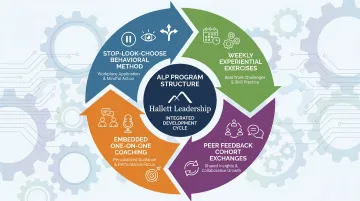
This integration distinguishes the model from event-based training. Development happens during the work, not separate from it.
Accountability Built In
The coaching structure includes approximately 1–2 hours of direct coaching per week, with additional touchpoints via email and availability during critical moments. Weekly goal setting and checkpoints make progress visible and measurable. An added benefit: executives who go through Hallett Leadership's coaching typically become better coaches themselves, transferring the methods to their own teams.
That internal transfer has real organizational consequences. When a new chairman at Fox championed high employee engagement, 1,100 ALP graduates were already culture-ready. Senior leadership had to form a steering committee just to manage the volume of new ideas employees were bringing forward.
Conclusion
Selecting the right leadership development consultant is one of the more consequential decisions an organization makes. The criteria covered here form a complete evaluation framework:
- Methodology depth — how the consultant builds capability, not just delivers content
- Measurable track record — demonstrated outcomes, not just client logos
- Cultural alignment — fit with your organization's values and working style
- ROI measurement — clear metrics tied to business results
- Ongoing support — presence beyond the initial engagement
- Lived leadership experience — firsthand, not purely academic
Use it before you commit, not after you're disappointed.
Leadership development done well doesn't create dependency on an outside expert. It builds sustainable internal capability. The right consultant makes themselves less necessary as your leaders grow. As your strategy evolves, so should the engagement — revisit effectiveness regularly and expect the relationship to shift as your organization does.
Frequently Asked Questions
What does a leadership development consultant actually do?
A leadership development consultant assesses an organization's current leadership capabilities, designs and delivers customized development programs, and provides coaching and accountability structures to ensure behavioral change tied to business goals. Unlike a one-time trainer, a consultant stays engaged through implementation and measurement.
How is leadership development consulting different from executive coaching?
Executive coaching focuses on an individual leader's growth through one-on-one sessions. Leadership development consulting addresses capability across the organization: program design, team dynamics, cultural gaps, and systemic leadership issues. Most rigorous consulting engagements incorporate coaching as a core component, not a standalone service.
How do you measure the ROI of a leadership development program?
ROI is measured through leading indicators (behavioral shifts, engagement scores, team collaboration quality) and lagging indicators (retention, productivity, business performance). A clear baseline must be established before the program begins. Without one, measuring change is impossible.
How long does it take to see results from leadership development consulting?
Early behavioral indicators can emerge within weeks — CCL research found 80-90% of leaders reported increased effectiveness at the eight-week mark. Broader organizational impact, including retention improvements and team performance gains, typically takes 6-18 months depending on program depth and integration into daily work.
What questions should you ask a leadership development consultant before hiring them?
Ask: How do you customize your approach to our specific context? What does success look like, and how will you measure it? Can you share measurable outcomes from similar engagements? What support do participants receive between sessions? Where did you lead before you started consulting?
How do you know if your organization needs a leadership development consultant?
Several patterns point to a clear need:
- High turnover among high-potential employees
- Underperforming middle management
- Poor cross-functional collaboration
- A leadership pipeline not keeping pace with growth
- A culture misaligned with the company's stated strategic direction