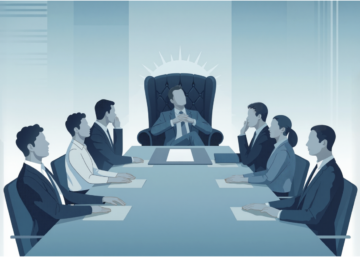
Some of the most challenging leadership dynamics in organizations emerge when people mistake ego-driven certainty for leadership. Individuals who are highly vocal, quick to offer opinions, and eager to influence decisions can easily be perceived as leadership material, particularly in cultures that reward decisiveness and visibility. There is nothing wrong with being bold, confident, or outspoken. The problem arises when those qualities are driven by a need to prove oneself, protect one’s status, or be seen as the smartest person in the room. When ego becomes the driving force, decisions can become more about validation than about what is best for the organization and its people.
After years of coaching professionals, executives, and emerging leaders, I’ve found that the most effective leaders are not defined by how much space they take up in a room, but by the quality of the space they create for others. They can be confident, decisive, and highly influential, yet they do not feel compelled to dominate every discussion or have the final word on every issue. Instead, they foster trust and psychological safety so that people feel comfortable contributing ideas, raising concerns, and challenging assumptions. They understand that better decisions emerge when diverse perspectives are heard, rather than when everyone follows the loudest voice in the room. These leaders are secure enough to listen, curious enough to learn, and self-aware enough to separate disagreement from personal criticism. Their leadership is grounded not in the need to elevate themselves, but in the desire to elevate the performance, growth, and success of those around them.
Quiet leaders create calm, and in today’s workplace, a calm atmosphere is rare. Many leadership problems stem from ego, not strategy, and it’s become common to see teams break down because leaders take feedback personally. Innovation stalls because managers can’t tolerate being challenged, and employees stop speaking honestly because leadership punishes vulnerability while pretending to encourage it.
People talk endlessly about communication issues at work, but most communication failures sit on top of lingering insecurity. Insecure leadership creates emotional traffic jams everywhere it goes.
You can feel it almost immediately when you work for someone driven by ego. Meetings become performances instead of discussions while feedback turns political, and every idea has to somehow reinforce the leader’s importance. Employees learn how to survive the personality instead of contributing their best work.
Over time, people stop taking risks because the environment punishes them. Ego-driven leadership kills trust and creativity, but authentic leadership works differently.
Embrace Being an Authentic Leader

Authentic leaders don’t panic when someone else has a great idea. They don’t feel diminished by capable employees. Leadership isn’t about being the most impressive person in the room. It’s about creating conditions where other people can do impressive things. By removing the urge to obsess over your image, you become more skilled at paying attention to the people around you.
Conversations become more open and teams become more resilient while employees learn they’re safe to tell the truth before lingering problems can transform into disasters. Authentic leaders ask questions because they actually want answers, something that sounds obvious, but it’s surprisingly uncommon.
Many leaders ask questions as a formality while waiting for their turn to speak, but authentic leaders listen differently. They understand that they don’t lose authority by admitting uncertainty. In fact, employees usually trust them more because of it. People know when someone is pretending to have all the answers. That kind of performance creates distance. Authenticity is what creates connection.
Perfection isn’t what makes employees loyal. They stay loyal to leaders who allow them to feel respected and valued. They stay where psychological safety exists, where mistakes become learning opportunities instead of public executions. An emotionally intelligent leader understands that fear might create short-term compliance, but it destroys long-term engagement.
Fear-Based Leadership Does Not Build Trust

Fear-based leadership still dominates a lot of workplaces because it creates the illusion of control. Employees stay quiet, deadlines get met, nobody pushes back, and from the outside, it can look really effective. However, people will disengage emotionally. In an atmosphere of ego and punishment, people will stop caring about the company’s mission, which is why you see a lot of people mentally check out long before they physically leave. In these environments, leadership acts shocked when retention drops.
Authentic leadership requires emotional maturity that many workplaces never teach. As leaders, we have to separate criticism of an idea from criticism of our identity. We have to regulate our own defensiveness before leading others through uncertainty, and we have to stop viewing every challenge as disrespect.
That kind of work is internal, uncomfortable, and requires humility, something that gets misunderstood constantly in leadership conversations. People assume humility means being overly soft or lacking confidence, but real humility comes from confidence. Secure leaders don’t need to constantly establish dominance because they already know who they are. That self-awareness gives them range.
They can admit mistakes quickly and change direction without spiraling into shame. They can empower employees without feeling threatened by them. Insecure leaders often surround themselves with people who make them feel comfortable, but secure leaders surround themselves with people who make the organization stronger.
One builds a fragile culture built around personality management while the other builds a healthy culture built around trust and capability. You can usually predict the long-term health of a workplace by watching how leadership responds to discomfort. Do they shut conversations down when tension appears? Do they punish honesty? Do they become defensive when employees challenge decisions, or do they stay grounded enough to remain curious?
At Hallett Leadership, we help leaders strengthen this capability through the STOP–LOOK–CHOOSE framework. Effective leaders first STOP and interrupt their automatic reactions, which are often driven by unconscious beliefs, assumptions, and habitual behaviors. Next, they LOOK honestly at what is influencing their response. Are they acting from a place of service and stewardship, focused on what is best for the organization and its people, or are they being influenced by ego, the need to be right, the desire to control outcomes, or the fear of appearing wrong? Finally, they CHOOSE a deliberate response that aligns with their values, serves the broader mission, and builds trust with those they lead. By practicing STOP–LOOK–CHOOSE, leaders develop the self-awareness and intentionality required to lead authentically, creating cultures where people feel valued, heard, and empowered to contribute their best.
Secure leadership doesn’t mean leaders never struggle with ego. We all struggle with it. But the difference lies in whether our ego drives the room or whether self-awareness does. The strongest leaders I know don’t have to waste energy trying to look important. They make other people feel empowered and capable, and that itself is the definition of real power.
For leaders who want to build healthier teams, stronger workplace cultures, and more emotionally intelligent organizations, connecting with us at Hallett Leadership can provide the guidance and leadership development needed to lead with clarity and trust. Our services focus on helping leaders create cultures where people thrive. Contact us today!