Leadership in 2026 looks nothing like the leadership playbook most executives learned coming up through the ranks. AI is transforming most categories of work. Employees now expect more than just a paycheck and are not hesitant to leave quietly when they don’t feel valued. Change no longer arrives as a single event to manage; it’s the permanent operating condition.
Together, these three forces are diluting the assumption that authority alone is enough to hold a team together. Leaders can no longer rely on a title, a hierarchy chart, or a decade of tenure to earn trust. They have to build it continuously through how they communicate, inspire people, and respond when conditions shift.
Companies that keep investing in their employees are doing better because leadership roles are changing. The rest of this guide breaks down exactly what’s driving that shift and what to do about it.
Why Leadership Is Changing in 2026
Three forces are converging to reshape what effective leadership looks like right now, and each one raises the stakes for a mindset shift around leadership itself.
AI Is Changing Work
AI is absorbing routine tasks faster than most training programs can adapt. The World Economic Forum’s Future of Jobs Report 2025 found that 39% of workers’ core skills will change by 2030, while skills rooted in human judgment, empathy, and active listening show almost no capacity to be replaced by generative AI, making these capabilities more valuable, not less.
Employees Want More Than a Paycheck
That same premium on human skills shows up in what employees expect from their leaders. They increasingly weigh purpose, flexibility, and growth alongside pay. LinkedIn’s 2025 Workplace Learning Report found that 88% of organizations name retention a top concern, and identify learning opportunities as the number one retention strategy.
Change Is the New Normal
Mergers, AI adoption, and restructuring now happen continuously rather than as isolated events. Leaders who treat every disruption as a one-off fall behind teams led by leaders who build change readiness into everyday practice.
Leadership Mindsets for Successful Organizations
Meeting these three forces requires more than a new skill set. It requires a different mindset about what leadership actually is.
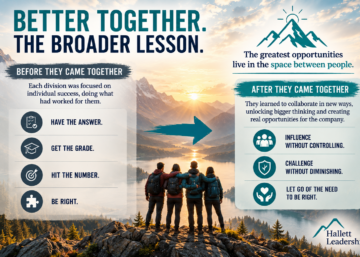
Hallett Leadership calls this shift STOP-LOOK-CHOOSE, where leaders stop automatic reactions, look at the options genuinely available, and choose a response grounded in self-awareness rather than habit. Three specific shifts appear repeatedly among leaders who make this transition well.
From Having All the Answers to Learning
Leaders who stay curious and keep learning outperform those who rely on outdated playbooks. Curiosity signals confidence, not weakness.
From Individual Success to Developing Others
Leaders who once optimized their output now need to build capability in the people around them. That shift creates lasting ownership across a team, not just short-term output.
From Control to Trust
Trust and transparency replace command-and-control as the engine of engagement. Teams led with trust take more ownership and recover faster from setbacks.
Leadership Trends Shaping Organizations
These mindset shifts aren’t abstract. They show up as four concrete capabilities that separate organizations built to adapt from organizations that stall.
Emotional Intelligence Matters More
Psychologist Daniel Goleman’s research established emotional intelligence, self-awareness, empathy, and relationship management as core leadership skills. Leaders who read a room accurately build stronger trust and make sharper decisions under pressure.
Employee Engagement Is a Business Priority
That same trust directly affects whether people stay engaged. Gallup’s 2025 workplace research found that only 31% of U.S. employees are actively engaged at work, unchanged from 2024. Disengagement directly erodes retention, productivity, and long-term performance.
Psychological Safety Supports Innovation
Engagement depends heavily on whether people feel safe contributing in the first place. Google’s Project Aristotle study of 180 internal teams found that psychological safety is a key priority. The belief that people can speak up without punishment is the single strongest predictor of team effectiveness. Teams without it stay quiet exactly when new ideas matter most.
Leadership Development at Every Level
None of these capabilities build themselves. They require deliberate development, and not just at the top. DDI’s Global Leadership Forecast 2023 found organizations offering leadership development at every level are 2.7x more likely to rank as a top financial performer in their industry.
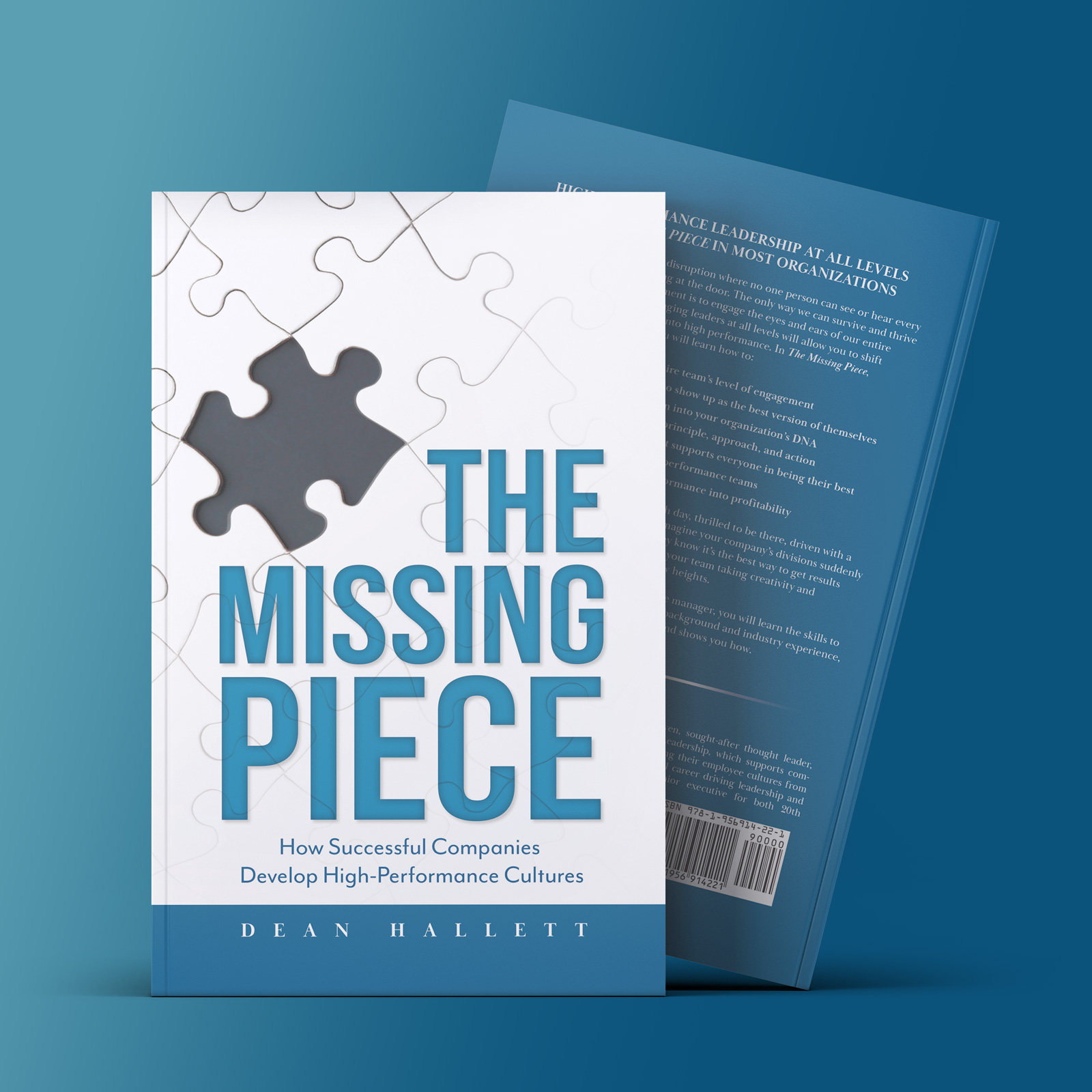
That’s the same gap I explore in my guide on building an emerging leaders program and in The Missing Piece, my book on developing leaders throughout an organization rather than only at the top.
The Hidden Leadership Behaviors That Hold Organizations Back
Building these capabilities is only half the equation. Just as often, organizations hold themselves back not by what’s missing, but by daily behaviors that leaders don’t realize they’re modeling.
Believing Knowledge Is Power
Leaders who hold information close create the very confusion they later blame on poor communication. A lack of alignment is almost always the real cost.
Avoiding Difficult Conversations
Unresolved issues don’t disappear when leaders avoid them; they resurface later as disengagement. Follow-through on challenging conversations builds credibility that silence never does.
Focusing on Short-Term Results Over Long-Term Capability
Chasing quarterly wins at the expense of people development drains talent and ideas over time. Organizations that skip this investment quietly lose their best future leaders.
Leading from Fear Instead of Trust
Fear produces short-term compliance but suppresses innovation and honest feedback. Explore the real cost of fear-based leadership and why it persists in modern organizations.
What Happens When Organizations Stop Investing in People?
Left unaddressed, these behaviors don’t just limit growth. They actively cost organizations money and talent. Gallup’s 2025 research puts the cost of U.S. workforce disengagement at roughly $2 trillion in lost productivity annually. Beyond the balance sheet, organizations that stop investing in people lose their best talent, their freshest ideas, and their momentum, often before leadership notices the decline.
Developing Leaders for the Future
Avoiding that decline starts with treating leadership development as an ongoing process rather than an occasional event. Continuous development, not a single workshop, builds leaders who last. Behavioral integrity grows through coaching, honest assessments, structured feedback, and real-world practice, not classroom theory alone.
Hallett Leadership’s executive coaching programs pair personalized coaching with accountability that short-term group training alone rarely achieves.
Leadership in 2026 vs. the Past
That shift toward continuous, personalized development reflects a broader change in what leadership itself looks like compared to a decade ago.
| Factor | Traditional Leadership | Leadership in 2026 |
| Primary Focus | Authority and control | Trust and empowerment |
| Decision-Making | Top-down | Collaborative, inside-out |
| Communication | Directive | Transparent, two-way |
| Employee Role | Follow instructions | Contribute and grow |
| Development | Reserved for senior leaders | Built at every level |
| Response to Change | Resist or delay | Adapt continuously |
| Measure of Success | Compliance | Alignment and engagement |
How Hallett Leadership Helps Organizations Prepare
That above comparison is exactly the gap Hallett Leadership was built to close. Our Accelerated Leadership Program (ALP) combines behavioral assessments, experiential learning, and extensive personal coaching across a 9-month cohort of up to 25 leaders. The extensive personal coaching, not just the group curriculum, is what makes the change stick.
Our Discovery Model helps leaders build self-awareness, accountability, and adaptable habits that outlast any single training event. Organizations that pair this kind of structured coaching with real workplace application see the shift compound: better decisions lead to stronger teams, which lead to steadier retention and growth.
The Future Belongs to Organizations That Invest in People
Companies that invest in retaining top performers surface new ideas faster, and adapt quickly when markets shift. Companies that don’t lose talent to competitors, watch ideas go unheard, and struggle to respond when conditions change.
This compounding effect is precisely why the gap between organizations that invest in people and those that don’t keeps widening. Talent and ideas gravitate toward companies that visibly invest in growth. That gap rarely closes on its own.
Final Thoughts
Leadership in 2026 and the coming years rewards organizations willing to invest in people continuously, not occasionally. Waiting for stability before developing leaders is a strategy that no longer works, and the organizations that accept that now will spend the next several years pulling ahead of those still waiting for calmer conditions.
Momentum, once lost to disengagement or a stalled leadership pipeline, is expensive to rebuild. Building it early, through coaching, self-awareness, and consistent development, is far more affordable than trying to recover it later.
Contact Hallett Leadership to discuss what leadership development could look like within your organization.
Frequently Asked Questions
Answers to the questions leaders ask most often about leading through 2026’s shifts.
How is AI changing leadership?
AI is automating routine tasks while making distinctly human skills such as judgment, empathy, and collaboration more valuable, not less. Leaders who deliberately build these skills are positioned to guide their teams through technology shifts rather than be replaced by them.
What is psychological safety?
Psychological safety is the belief that a team member can speak up, ask questions, or admit mistakes without fear of punishment. Teams with strong psychological safety consistently outperform those without it because concerns and ideas surface before they become costly problems.
Why is employee engagement important?
Engagement drives retention, productivity, and long-term performance across an organization. Disengaged employees cost far more than their salary, showing up in turnover, lost innovation, and a weaker customer experience.
How can organizations prepare future leaders?
Organizations prepare future leaders through structured development, behavioral assessments, executive coaching, and real-world practice at every level, not just the top. Companies that build this kind of pipeline consistently outperform those that only develop senior executives.
What happens when organizations do not invest in their people?
Disengagement rises, top talent leaves, and innovation slows as ideas go unheard. The cost compounds quietly, widening the gap between organizations that continue to develop their people and those that don't.