From the time we are young, most of us are taught to work independently.
Think about school. You take your own test. You write your own paper. You get your own grade. And whatever you do, don’t look at the person sitting next to you. That’s called cheating.
We learn that success means knowing the answer—and preferably knowing it before everyone else does.
Then we enter the workplace and, in many ways, those lessons continue. We develop expertise. We build careers by producing results. We become known for what we know and what we can accomplish.
And then something interesting happens.
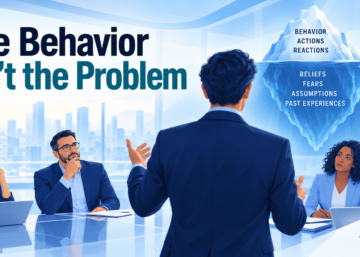
As the problems get bigger and more complex, the behaviors that helped make us successful individually can actually begin to limit what we are capable of accomplishing together.
I saw a remarkable example of this when Hallett Leadership was brought into an organization in the paper and packaging industry.
The traditional paper business had been declining for years. The company had continued to grow, in part, by acquiring other businesses and increasing market share. Over time, that strategy created four distinct distribution divisions, each with its own history, expertise, relationships, and ways of doing things.
Each had been relatively successful.
But the environment was changing.
The acquisition opportunities that had fueled much of the company’s growth were no longer there. The next phase would have to come much more organically.
And leadership recognized something important: the company’s greatest opportunity was no longer inside any one division. It was in the space between them.
The problem was that those divisions didn’t really know one another.
Four Divisions. One Company?

Hallett Leadership was asked to bring together representatives from all four divisions through our nine-month Accelerated Leadership Program (ALP).
When the program began, most of the participants didn’t know the people from the other divisions.
They worked for the same organization, but they didn’t yet think of themselves as one team.
That isn’t unusual.
Organizational charts may tell us we’re part of the same company. That doesn’t mean we behave that way.
We develop relationships with the people around us. We solve the problems directly in front of us. We protect the interests of our group. And without ever consciously deciding to build silos, silos emerge.
So we didn’t begin by telling this group that they needed to collaborate more.
We created an environment where they could discover for themselves what real collaboration required.
You Can't PowerPoint Your Way to Trust

The Accelerated Leadership Program uses what we call the Discovery Model of learning.
Rather than simply telling people what effective leadership looks like, we put them into situations where they experience it.
Through exercises, role-playing, real-time feedback, and challenging interactions with one another, participants begin seeing their own behavior differently.
They learn how they show up.
They discover how others experience them.
They experiment with different ways of communicating and influencing.
They begin developing a leadership toolkit they can use in the real world.
Something extraordinary happened with this group.
At the beginning, they were essentially strangers.
Within about 60 days, you would have thought they had known one another for years.
That wasn’t because we conducted a few team-building exercises and everybody suddenly became friends.
They had gone through something together.
They had taken risks together. They had given and received feedback. They had seen one another struggle, learn and grow. And through that process, they began building something that is very difficult to mandate from the top of an organization:
Trust.
Once trust developed, something else began to happen.
The boundaries between the divisions started becoming less important.
Instead of asking, “What’s best for my division?” people increasingly began asking, “What’s best for the company?”
That’s a very different question.
And it produces very different thinking.
What Happens When You Remove the Silos?

During the final three months of the nine-month program, we divided the cohort into four teams.
But we didn’t give them hypothetical leadership exercises.
Each team took on a real challenge facing the company or the industry.
Now think about what was different.
These weren’t four groups of people approaching problems from inside their individual divisions.
They were people with different experiences, different expertise, different customers, and different perspectives who had learned how to trust one another enough to challenge assumptions and build on one another’s ideas.
They weren’t trying to prove who had the right answer.
They were trying to create a better answer.
That distinction matters.
When the four teams ultimately presented their work, their recommendations went far beyond a leadership-development exercise.
Those projects helped establish the framework for the organization’s strategic plan for the next several years.
The leadership program had done more than develop leaders.
It had unlocked thinking that had previously been trapped inside organizational boundaries.
We Are Better Together

There is a reason collaboration sounds easier than it actually is.
We have spent much of our lives being rewarded for individual achievement.
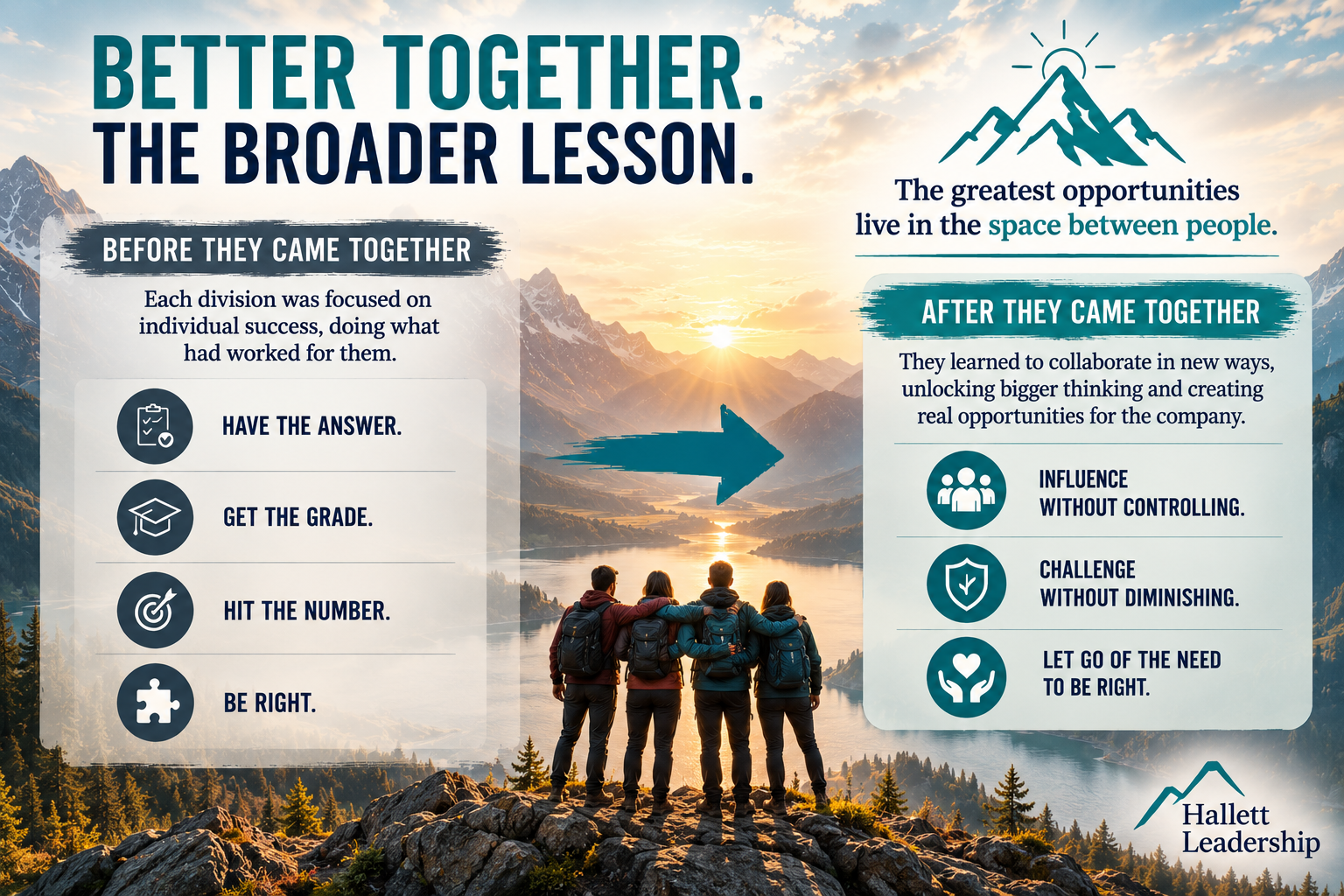
- Have the answer.
- Get the grade.
- Hit the number.
- Solve the problem.
- Be right.
But the most important challenges facing organizations today rarely fit neatly inside one person’s expertise—or one department, function, or division.
They live in the spaces between them.
And accessing the thinking that exists across those boundaries requires more than putting people in a conference room and calling them a team.
It requires trust.
It requires curiosity.
It requires people who are willing to:
- Influence without controlling.
- Challenge without diminishing.
- Listen without immediately preparing their response.
- Occasionally let go of the need to be right.
That’s when collaboration becomes something much more powerful than cooperation.
The thinking itself gets better.
One person sees something another person can’t. Someone challenges an assumption that everyone else has accepted. An idea from one part of the organization combines with an idea from somewhere else and becomes something neither group would have created independently.
That’s what happened with this organization.
Four divisions came into the program largely as separate groups of people who happened to work for the same company.
Nine months later, they weren’t simply better individual leaders.
They had begun to see what was possible when they stopped thinking as four divisions and started thinking as one company.
And perhaps that is the larger lesson.
The future of an organization is rarely sitting inside one person’s head.
It’s sitting in the collective intelligence of its people.
The challenge for leaders is creating the environment that allows that intelligence to emerge.
Because we really are better together than we are alone.