Introduction
Most CEOs have no shortage of advisors — attorneys, CFOs, board members, consultants. What they rarely have is someone whose entire job is to help them grow as a leader.
That gap matters. Decisions made at the top cascade through every layer of an organization. A blind spot in a CEO's communication style doesn't stay contained to one meeting — it shapes culture, drives away talent, and undermines strategy over time.
High-touch CEO coaching addresses this directly. It's a sustained, one-on-one relationship built to develop the leader from the inside out — through real challenges, real feedback, and consistent access to a coach who is genuinely invested in the outcome.
This article covers:
- What high-touch CEO coaching actually involves
- How it differs from standard executive coaching
- The inside-out philosophy that drives lasting change
- Who it's best suited for and what results to expect
TL;DR
- High-touch CEO coaching is one-on-one, deeply personalized, and sustained over time — built around the individual, not a curriculum
- It develops the whole leader: mindset, emotional intelligence, decision-making, and behavior under pressure
- A stronger CEO creates stronger teams and a healthier culture — the ROI compounds through the organization
- It works best for executives who are ready for self-examination, not those looking for quick fixes
- Choosing the right coach means evaluating real leadership experience, methodology, and the quality of the relationship
What Is High-Touch CEO Coaching?
High-touch CEO coaching is an intensive, one-on-one development relationship built around deep personalization, consistent coach access, and integration into the leader's actual daily work. Unlike classroom training, it meets leaders where they are — inside the real decisions and pressures they face daily.
The model is defined by a proactive coach: one who reaches out between sessions, stays available when crises or critical decisions arise, and develops deep familiarity with the leader's goals, communication patterns, and organizational context.
How It Differs from Traditional Leadership Programs
| High-Touch CEO Coaching | What It's NOT |
|---|---|
| Sustained one-on-one relationship | A leadership seminar or workshop |
| Coach adapts to evolving priorities | A fixed curriculum or syllabus |
| Real work is the coaching material | Hypothetical exercises |
| Behavioral science + experiential learning | Intuition-only advice |
| Proactive coach engagement | Waiting for the executive to initiate |
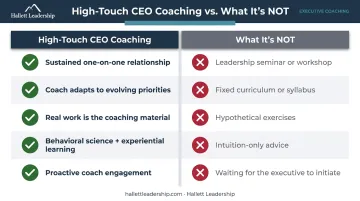
That contrast extends to the methodology. High-touch coaching draws on validated behavioral frameworks — tools like the DISC model — to help executives understand their default patterns and shift them intentionally under pressure. The result is durable behavioral change, not just in-the-moment guidance.
Who Typically Seeks It
- C-suite executives managing enterprise-level complexity
- CEO-founders scaling from operator to strategic leader
- Senior leaders navigating transitions or high-stakes organizational change
- High performers who want to close blind spots before they become real problems
The stakes at the top make generic development approaches insufficient. According to a Stanford GSB and Miles Group survey of 200+ CEOs and senior executives, nearly 66% of CEOs were not receiving outside coaching or leadership advice — despite 100% saying they were open to feedback-based change.
What Sets High-Touch Coaching Apart from Standard Executive Coaching
Proactivity as a Core Feature
In standard executive coaching, the executive drives contact between sessions. High-touch coaching inverts this. The coach checks in proactively, offers real-time support during high-stakes decisions, and remains available when a crisis or opportunity surfaces — not just at the next scheduled appointment.
At Hallett Leadership, this structure is built into the engagement model. Executives communicate directly with their coach approximately 1–2 hours per week through face-to-face or video sessions, with additional indirect communication via email or messages for roughly 1–2 hours every two weeks. Coaches are available when special opportunities or crises arise — a meaningful distinction from models where access is capped to scheduled hours.
Real Work as the Coaching Material
High-touch coaching doesn't use hypothetical scenarios. Real deals, real team conflicts, and real strategic decisions become the material. Learning happens in context, which makes it stick.
This matters because HBR has documented that leadership training consistently fails when learning is disconnected from the organizational systems leaders actually operate in. People revert to old behaviors when the development doesn't connect to their real work.
What Deep Personalization Actually Looks Like
Over time, a high-touch coach builds a detailed picture of a leader's:
- Communication patterns and emotional triggers
- Strengths, default behaviors, and blind spots
- Organizational context, team dynamics, and strategic priorities
- History with specific challenges or leadership relationships
This depth is impossible in cohort-based programs where development is shared across 15–20 participants. Group programs serve a different purpose: building horizontal collaboration and shared language across teams. One-on-one coaching addresses what only that leader needs — not what 15 people have in common.
Accountability That Tracks Behavior, Not Just Feelings
High-touch coaching doesn't rely on subjective impressions of growth. Hallett Leadership's model includes weekly goal-setting focused on personal development and high-performance results, with established checkpoints and consistent coaching through to completion. Progress shows up in team performance, decision-making quality, and organizational behavior. Self-reported confidence is a starting point, not the finish line.
The Inside-Out Approach: Developing Leaders from Within
The BE – DO – HAVE Model
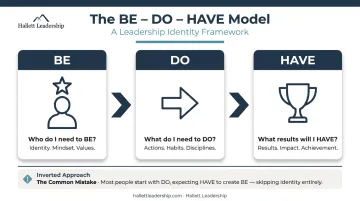
Lasting leadership change cannot be imposed through technique alone. It starts with how a leader sees themselves — which is why Hallett Leadership's mission is explicitly "to develop the individual from the inside out, following the BE – DO – HAVE model."
The model asks three questions in sequence:
- BE: Who do I need to be to accomplish this goal?
- DO: What do I need to do to accomplish it?
- HAVE: What results will I have as a result?
Most people operate on the inverse: they believe they need to do the work, have the results, and then they'll become a successful leader. The BE – DO – HAVE model reverses this — the internal identity shift comes first.
A concrete example: A process-driven CEO who withdraws from difficult conversations receives feedback that their perceived lack of communication is damaging team morale. Through coaching, they develop an affirmation: "I am an engaging, forthright communicator." That identity becomes their north star. When a difficult conversation arises, they don't avoid it — they act from who they've chosen to BE. The behavioral change follows naturally, and the organizational results follow that.
The Discovery Model and Behavioral Science
The identity shift described above doesn't happen overnight — it requires a structured path through discomfort. Hallett Leadership's Discovery Model guides leaders from unconsciousness (certainty, defensiveness, denial) through confusion toward curiosity and new competence. The DISC behavioral framework, built on Harvard psychologist Dr. William Moulton Marston's research, supports this journey by helping leaders understand their dominant behavioral style — and where it serves or limits them.
Emotional Intelligence as a Development Target
Daniel Goleman's foundational HBR research established emotional intelligence as the essential differentiator in leadership effectiveness — more predictive of success than IQ or technical skill. High-touch coaching builds EI through:
- Repeated, real-life feedback over time (not a one-time assessment)
- Coach modeling — the coach models emotional intelligence directly, accelerating the executive's development
- Interrupting automated behaviors: the coach identifies when the executive is operating from their blind spot and intervenes deliberately, using questioning or direct conversation to break the pattern
Built over months of sustained engagement, the result is a leader who can hold steady under pressure, take hard feedback without shutting down, and show up authentically when the stakes are highest.
The Cascading Effect
A CEO's development doesn't stay with the CEO. As Hallett Leadership frames it: "Every move you make influences the organization from top to bottom — whether you are aware of it or not."
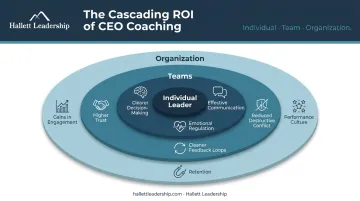
When a CEO improves how they communicate expectations, handle conflict, and model values, those shifts ripple outward. Teams align more effectively. Culture reflects the leader's growth. Retention improves. One leader's growth, compounded across every direct report, every team, and every decision they influence, is where executive coaching earns its return.
Who Is High-Touch CEO Coaching Right For?
The Mindset Required
High-touch coaching is not for executives seeking external validation or a quick fix. It works for leaders who are:
- Willing to examine their own assumptions, not just their team's behavior
- Open to candid feedback — including feedback that's uncomfortable
- Ready to take action between sessions, not just discuss ideas during them
- Genuinely committed to growth, not just performing development for stakeholders
Hallett Leadership describes the ideal client as someone with "a willingness to experience discomfort in order to do something differently."
Organizational Contexts Where It Delivers the Most Value
- High-growth companies where leadership demands are outpacing the leader's current capabilities
- Organizations facing cultural or performance challenges rooted in leadership behavior at the top
- CEO-founders shifting from hands-on operator to strategic executive
- Succession or transformation scenarios where leadership behavior carries unusually high stakes
High-touch coaching is not reserved for struggling executives. The Stanford survey found that 78% of CEOs who received coaching said it was their own idea — meaning the majority of engaged executives sought it proactively, not because someone told them they needed it.
The Stanford survey also found that 43% of CEOs ranked conflict management as their top personal development priority. Other areas executives commonly bring to coaching include:
- Delegation and letting go of operational control
- Developing internal talent and building leadership pipelines
What Results Can You Expect from High-Touch CEO Coaching?
Three Levels of Impact
Results from high-touch coaching operate at three interconnected levels:
- Individual leaders gain clearer decision-making, stronger emotional regulation, and more effective communication
- Teams develop higher trust, cleaner feedback loops, and less destructive conflict
- Organizations see measurable gains in engagement, retention, and performance culture
Realistic Timeframes
Early behavioral shifts are visible within weeks of consistent engagement. Meaningful, sustained change — the kind that holds under pressure — typically takes 3–6 months. Deeper organizational impact, including cultural shifts that affect retention and engagement, compounds over 12+ months.
Hallett Leadership's Accelerated Leadership Program runs nine months for exactly this reason: mastery requires sustained engagement, not short-cycle workshops that produce surface-level learning.
What the Research Shows
A 2023 meta-analysis published in Frontiers in Psychology examined 20 randomized controlled trials on executive coaching and found an overall weighted effect size of Hedges' g = 0.43, with behavioral outcomes peaking at g = 0.73. That's measurable change in how leaders actually behave — not just how they feel about their leadership.
Chris Parker, EVP/COO at Partners Federal Credit Union, put it plainly: "Dean's years of real-world, executive experiences at The Walt Disney Company and Fox Studios was a real differentiating factor as an executive coach. His ability to pull from his own efforts, combined with pragmatic, field-tested approaches and solutions, allowed me to really raise my leadership capabilities."
How to Choose the Right High-Touch CEO Coach
What to Evaluate
Not all coaches are equally equipped for CEO-level work. Look for:
- Real organizational leadership experience — not just coaching credentials. A coach who has held senior roles understands the actual texture of C-suite decisions, board dynamics, and enterprise-scale culture challenges
- A structured methodology — intuition-only coaching produces inconsistent results. Look for a coach with a clear, repeatable framework for behavioral change
- Proactive engagement style — ask how the coach engages between sessions and how they handle it when a client is stuck or avoidant
- Verifiable results in similar contexts — ask for specific examples, not general claims
Dean Hallett of Hallett Leadership built and ran a leadership development program at 20th Century Fox for 15 years, with documented results in culture transformation and cross-departmental collaboration. Before that, he served as EVP and CFO of The Walt Disney Studios.
That operational C-suite background, paired with a proven developmental methodology, is what Mike Terzian, EVP at Partners Federal Credit Union, described as "a unique blend of experience, thought leadership and motivational tactics" that "challenged me, supported me and inspired me to think differently."
Fit and Trust Matter More Than Credentials
A coaching relationship depends on genuine rapport, honest communication, and alignment on values between coach and leader. Treat the initial conversation as an interview — assess how the coach listens, what questions they ask, and whether their energy and approach feel right for the work you need to do.
A useful signal: a strong coach asks harder questions about you in that first conversation than you ask about them. If the conversation feels like a sales pitch, keep looking.
Frequently Asked Questions
How much does high-touch CEO coaching cost?
Investment varies widely based on coach experience, session frequency, and engagement length. The 2023 ICF Global Coaching Study reported an average fee of $244/hour globally, with executive-focused coaches commanding significantly higher rates. Evaluate cost relative to organizational ROI, not as an isolated expense.
What is the 70/30 rule in coaching?
The 70/30 rule holds that the coachee should do approximately 70% of the talking in a coaching session while the coach speaks only 30%. This reflects a core coaching principle: the coach's job is to draw out the leader's own thinking, not deliver answers. Effective coaching is generative, not prescriptive.
What is the difference between executive coaching and CEO coaching?
CEO coaching is a specialized form of executive coaching focused on the unique challenges of leading an entire organization — including board relationships, culture-setting, long-term strategy, and the particular isolation that comes with top-level accountability. The scope, stakes, and required depth of the coaching relationship are meaningfully different from work with functional leaders.
How long does it take to see results from CEO coaching?
Early behavioral shifts may appear within weeks. Meaningful, lasting change — particularly at the organizational level — typically compounds over 6 to 12+ months of consistent, high-touch engagement.
What should I look for in a high-touch executive coach?
Prioritize real leadership experience (not just credentials), a clear and proven methodology, a proactive engagement style, and the capacity to build a genuinely high-trust relationship. A strong coach surfaces blind spots and pressure-tests your thinking — that's where the real value lives.
Is CEO coaching worth the investment?
The value lies in the organizational multiplier effect: a more effective CEO drives better team performance, stronger culture, and higher retention. The Manchester Review found executive coaching ROI averaging 5.7 times the initial investment — a return that grows as cultural improvements take hold across the organization.