Introduction
You can hire a CFO who's run billion-dollar budgets, a CMO with a track record of building iconic brands, and a CRO who consistently exceeds quota. Put them all in a room together, and what do you get?
Often: brilliant individuals who guard their own turf, compete for budget, and report upward in parallel — never quite functioning as a single team.
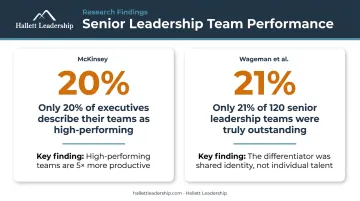
McKinsey reports that only 20% of executives describe their teams as high-performing — yet high-performing teams are five times more productive than average ones. That gap doesn't close on its own. It closes through deliberate team development — which is exactly where most CEOs underinvest.
Developing an executive leadership team is one of the hardest responsibilities of the CEO role. Most failures aren't about individual talent. They're about how the team is built, aligned, and developed over time.
This guide covers:
- What separates functional executive teams from dysfunctional ones
- The foundational work that must happen before development begins
- A practical process for building team effectiveness
- The most common mistakes CEOs make along the way
Key Takeaways
- Building an executive team takes deliberate formation, ongoing development, and shared identity — not just strong individual hires.
- Executives must identify as members of the team first, not just leaders of their own function.
- The CEO's own behavior and willingness to invest in the team are among the strongest predictors of success.
- The most common failure points: skipping team formation, tolerating silos, and treating development as a one-time event.
Why Most Executive Leadership Teams Struggle: The Identity Problem
Most leadership literature focuses on individual executive performance. The harder problem gets far less attention: team identity.
Ask most executives where their primary loyalty sits, and the honest answer is their function. The CFO is protecting the balance sheet. The CMO is defending the marketing budget. The Head of Product is pushing their roadmap. Everyone is doing their job—but no one is leading the company together.
This plays out in predictable ways:
- Leadership meetings become status updates, not strategy sessions
- Functional priorities crowd out enterprise priorities
- Resources get allocated through political negotiation rather than collective judgment
- Problems that cross functional lines fall into the gaps between them
In their research across 120 senior leadership teams, Wageman, Nunes, Burruss, and Hackman found only 21% were truly outstanding. The recurring differentiator wasn't individual talent—it was whether teams operated with genuine shared identity, mutual dependence, and accountability to outcomes beyond their own function.
Before any development strategy can take hold, the CEO must close this gap. That means creating structures, rituals, and expectations that make the message unambiguous: this team is your primary team, not a secondary obligation.
What You Need Before Developing Your Executive Team
Development cannot begin without two things in place: CEO readiness and organizational clarity.
CEO Readiness First
HBS research on senior leadership team effectiveness states directly that top-team failure often stems from leaders who lack the desire or skills to lead a highly interdependent group—or who are unwilling to develop those skills.
This requires honest self-assessment. Ask yourself:
- Do I genuinely want my executives functioning as an interdependent team, or do I prefer managing each of them individually?
- Am I willing to model the transparency, vulnerability, and conflict tolerance I expect from them?
- Do I have the facilitation skills to surface disagreement productively rather than suppress it?
A 2015 study of 105 privately held firms found that CEO humility was associated with greater executive team integration, information sharing, joint decision-making, and shared vision. In other words, the CEO's character sets the upper limit of what the team can become.
Organizational Clarity Before Team Roles
Without a clear strategic direction, role clarity is impossible. Executives cannot align their functions to a collective destination that hasn't been defined.
Before structuring your team, establish:
- Strategic priorities: What are the 3-5 outcomes the organization must achieve in the next 12-24 months?
- Functional interdependence: Which executives must coordinate closely, and where are those relationships currently breaking down?
A new product launch, for example, requires tight coordination across sales, marketing, product, and operations. If those relationships are already strained, that's the first bottleneck to address before any formal development work begins.
This is precisely why structured engagement starts with diagnosis, not prescription. Hallett Leadership's initial process assesses the values and behaviors currently in play, maps how each executive functions within the leadership structure, and establishes clear goals before any coaching begins.
How to Develop Your Executive Leadership Team
Step 1: Establish Team Identity and Shared Purpose
Don't assume team identity forms automatically. It needs to be built deliberately.
Bring the executive team together for an explicit conversation about what membership means: shared accountability for company outcomes, not just functional deliverables. This isn't a values exercise—it's a structural commitment.
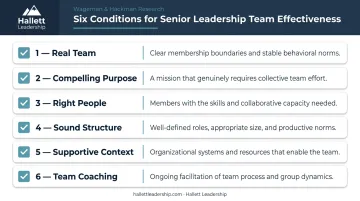
The six conditions that Wageman and Hackman's research links to senior leadership team effectiveness are worth using as a formation checklist:
- Real team – clear membership, stable enough to develop norms
- Compelling purpose – a mission that requires the team to exist
- Right people – the right mix of skills and collaborative capacity
- Sound structure – roles, size, and norms that enable work
- Supportive context – systems and resources that enable the team
- Team coaching – ongoing support for team process, not just individual performance
Reinforce team identity through language, meeting design, and decision-making. If every conversation starts with "my team" (meaning the function), the executive team hasn't truly formed.
Step 2: Define Roles, Decision Rights, and Accountabilities
Role clarity at the executive level goes far beyond job descriptions. The real work is clarifying who owns which decisions.
Bain's RAPID framework is useful here—it distinguishes between who Recommends, who Agrees, who Performs the work, who provides Input, and who ultimately Decides.
For each major category of decision, your team should be able to answer:
- Who owns this decision outright?
- Who must be consulted before it's made?
- Who needs to be informed after?
- What triggers escalation to the full executive team?
HBS research recommends that executive teams pre-agree on how agendas are set, how decisions get made, and how disagreements get resolved—before the pressure of a live disagreement arrives.
Hallett Leadership's High Performance Workshops address this directly: two-day intensive sessions that help senior teams break out of functional silos, align around a shared vision, and establish clear collaborative frameworks for moving forward together.
Step 3: Invest in Trust and Psychological Safety
Trust at the executive level isn't built through a team retreat. It's built through consistent behavior over time.
Edmondson's foundational research on 51 work teams found that psychological safety—the shared belief that it's safe to take interpersonal risks—predicted learning behavior, which in turn predicted team performance. Senior teams are no exception.
What psychological safety looks like in practice:
- Executives surface problems early rather than waiting until they're disasters
- Leaders say "I don't know" without it being perceived as weakness
- Disagreement happens openly in the room, not in hallway conversations afterward
- Feedback flows in multiple directions, including upward
The mechanics that build this over time include regular CEO-to-executive one-on-ones, peer feedback loops, and team retrospectives that examine how the team is functioning, not just what it's delivering.
Hallett Leadership's coaching approach treats vulnerability as foundational—not as a soft skill but as what they describe as "the courage to be authentically human." When CEOs model this first, it creates the conditions for the team to follow.
Step 4: Improve Communication Structures
Good executive teams communicate through formal channels and informal ones. Both matter.
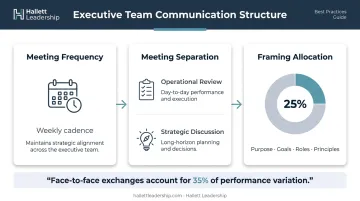
Research on team communication found that energy and engagement outside formal meetings explained one-third of productivity variation in high-performing teams—and face-to-face exchanges alone accounted for 35% of performance variation.
For formal communication, optimize your meeting cadence:
- Meet at least weekly for strategic alignment — strategy shifts stall when leaders change their thinking but don't share it with peers
- Separate operational reviews from strategic discussions — different purposes require different participants and different preparation
- Allocate 25% of meeting time to framing — establishing purpose, goals, roles, and operating principles before diving into content (a practice grounded in Harvard research and central to Hallett Leadership's approach)
The most common meeting failure at the executive level isn't poor facilitation. It's the absence of framing, which leaves every participant working from a different assumption about what the meeting is trying to accomplish.
Step 5: Develop Individual Leaders Within the Team
Team effectiveness has a ceiling set by the individuals on it. An executive team can be well-structured and still underperform if individual leaders lack the self-awareness, emotional intelligence, or adaptability to function at that level.
Personalized development matters here. Each executive brings different strengths, blind spots, and behavioral patterns, and their growth needs are distinct. What works for the CFO likely doesn't address what's holding back the Chief People Officer.
Hallett Leadership's Discovery Model addresses this directly. Using behavioral assessments including DISC, 16 Types, and the Enneagram, the coaching process creates tailored development plans for each executive, focusing on how they relate to peers of different behavioral styles, not just how they perform within their own function.
The underlying framework is the BE–DO–HAVE model: rather than waiting for external circumstances to validate leadership identity, executives begin by developing clarity on who they are being and build outward from there. New behaviors become integrated through affirmations, practice, feedback, and consistent coaching support.
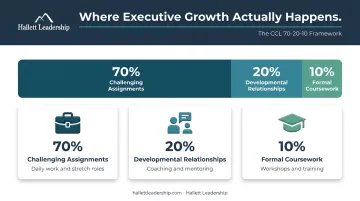
CCL frames leadership development as 70% challenging assignments, 20% developmental relationships, and 10% coursework. The implication: most executive growth happens through experience and coaching, not workshops alone. That's why Hallett Leadership's nine-month Accelerated Leadership Program embeds learning into participants' daily work rather than treating development as an off-site event.
Step 6: Drive Accountability and Measure Progress
Individual growth and team development only compound when there's a clear accountability structure around them.
Build this into how the team operates:
- Set performance expectations at the team level, not just the functional level
- Create regular check-ins that assess team dynamics alongside business results
- Ask explicitly: Are we making decisions well? Are conflicts getting resolved? Are all voices being heard? Is the team aligned on priorities?
- Celebrate collective wins; treat collective failures as problems the team owns together
Hallett Leadership's coaching engagements build accountability through weekly goal-setting sessions, regular coach check-ins (approximately 1–2 hours per week), and structured progress reviews tied to tangible work outcomes—not abstract development milestones.
Key Pillars of a High-Performing Executive Leadership Team
These aren't steps. They're ongoing conditions the CEO must actively maintain.
Collective Vision Over Individual Agendas
High-performing executive teams operate with a "we before I" mentality. Individual functional success is measured in service of company objectives—not separate from them.
This shows up most clearly during resource allocation. In low-trust teams, budget discussions become political negotiations. In high-trust ones, executives advocate for what the company needs, even when it means their own function gets less.
Productive Conflict, Not Polite Agreement
Executive teams that never disagree are a warning sign, not a strength. Groupthink and risk-aversion are the predictable results of a team built around avoiding friction.
The nuance matters: research distinguishes between task conflict (which can improve decision quality) and relationship conflict (which destroys trust). A 2003 meta-analysis of 30 studies found both types correlated negatively with team performance when unmanaged.
The goal isn't more conflict — it's structured dissent within a foundation of trust.
Conflict becomes productive when:
- It stays focused on the issue, not the person
- The team has enough psychological safety to disagree in the room
- There's a pre-agreed process for resolving disagreements that persist
Commitment to Continuous Development
Executive team effectiveness naturally declines without ongoing investment. Composition changes, business conditions shift, and individual leaders plateau without coaching and challenge.
The 15-year program Dean Hallett built at 20th Century Fox demonstrates what sustained development produces — not a single retreat, but embedded learning that compounds across years of practice and feedback. As Ted Russell, EVP at Fox, noted: executives grew immeasurably and the company benefited enormously from their contributions.
The CEO as Role Model
The CEO cannot expect behaviors from their executive team that they don't personally model.
When a CEO withholds information, sidesteps hard conversations, or rewards individual heroics over collective results, the team mirrors it — regardless of what the values statement says. The behaviors that go unaddressed at the top set the actual standard.
This is where Hallett Leadership focuses much of its CEO coaching: helping executives develop the self-awareness and behavioral consistency that give their teams permission to lead the same way. Modeling isn't a soft skill — it's the most direct lever a CEO has on team culture.
Common Mistakes CEOs Make When Developing Their Executive Team
Skipping team formation: Adding new executives or restructuring the team without any identity-building process, then wondering why the group never gels. Research on team membership change consistently shows this disrupts performance—a new reporting structure doesn't create a functioning team.
Promoting based on individual performance alone: The highest-performing functional leader is not automatically the best executive team member. Collaborative leadership capacity—openness to change, willingness to set aside functional ego, and the ability to drive results through others—matters as much as any track record. Outstanding individual performance simply doesn't predict executive team effectiveness.
Treating development as a one-time event: A single offsite doesn't change behavior. Without sustained coaching, structured feedback, and regular assessment, teams revert to default patterns under pressure. Development has to be ongoing and embedded in how the team actually operates.
Conclusion
Developing an executive leadership team may be the most consequential work a CEO does—and the most consistently underprioritized.
The failures that show up most often—silos, misalignment, eroded trust, poor decision-making—aren't inevitable. They're the predictable result of skipping the foundational work: team identity, role clarity, psychological safety, and sustained individual development.
CEOs who invest in their team's development, and in their own growth as a team leader, build something that no strategy document alone can replicate. Hiring the right people gets you talent. Developing them into a cohesive team is what turns talent into results that hold.
Frequently Asked Questions
What are the 5 stages of team development?
Tuckman's model identifies Forming, Storming, Norming, Performing, and Adjourning. For CEOs, knowing these stages helps identify where the executive team currently sits—and what it actually needs to progress, rather than forcing development that's premature.
What are the 4 C's of team development?
CCL's Team Effectiveness Framework covers four areas: Core (shared purpose), Collective Mindset (shared values), Cohesive Relationships (trust), and Connection (links to the broader organization). Each one maps to a specific gap CEOs typically encounter when building a functional executive team.
What are the 5 C's of leadership development?
Common frameworks reference Competence, Confidence, Character, Communication, and Commitment. At the executive level, character and communication are typically the most underdeveloped. They also carry the most weight in how a senior leader shapes peers and the broader organization.
What is the 70-20-10 rule for leaders?
CCL frames it as 70% challenging assignments, 20% developmental relationships (coaching and mentoring), and 10% formal coursework. This explains why executive retreats alone rarely change behavior. Most leadership development happens through experience and coaching, not classroom learning.
What is the difference between a leadership team and a management team?
Leadership centers on setting vision, inspiring direction, and long-term thinking; management focuses on executing processes and achieving short-term results. Executive teams must do both—but the most common failure is defaulting entirely to management mode, leaving strategic alignment gaps that widen until a full strategic reset becomes necessary.
How often should a CEO meet with their executive leadership team?
HBS research recommends at least weekly for senior teams, since strategy shifts stall when leaders change their thinking without sharing it with peers. Frequency matters less than meeting quality: differentiate between operational reviews and strategic discussions rather than running every meeting the same way.