: A Complete Guide](https://file-host.link/website/hallettleadership-w4i8xu/assets/refined-images/1780914675067000_16d056593b994982a45356077402f383/360.webp)
Introduction: Why Business Transformation Starts With Leadership
Organizations pour resources into strategy, technology, and restructuring — yet BCG's 2024 analysis found that only 1 in 4 transformations deliver value-creating, enduring change. The strategy isn't usually the problem. The people executing it are.
McKinsey's research tells a sharper story: transformation success is 5.3 times more likely when senior leaders visibly role-model the behavioral changes they expect from others. When line managers and frontline employees aren't engaged, the success rate drops to just 3%.
The missing variable is almost always leadership behavior — how executives communicate under pressure, how managers translate strategy into daily action, how decisions get made when ambiguity is high. Executive coaching targets exactly these gaps — developing the leadership behaviors that determine whether a transformation succeeds or stalls.
This guide breaks down what executive coaching for business transformation actually looks like, how it works at both the individual and organizational level, and what separates effective coaching from the kind that produces no lasting change.
Key Takeaways
- Only 1 in 4 transformations succeed — leadership behavior, not strategy, is typically the deciding factor
- Transformation coaching operates at the level of mindset and belief systems, not just skills
- The BE-DO-HAVE model holds that who a leader is drives what they do — and what the organization ultimately achieves
- Mid-level managers are often the most critical — and most under-coached — recipients of transformation work
- Define success metrics before the work starts — the engagements that do this consistently outperform those that don't
What Is Executive Coaching for Business Transformation?
Executive coaching for business transformation is a structured, one-on-one development process that helps senior leaders and mid-level managers identify and shift the behavioral patterns, mindsets, and leadership habits that either enable or obstruct organizational change.
"Transformation" here means something specific. It's not about incremental improvement or skill refinement. It refers to fundamental shifts in how leaders think, communicate, make decisions, and influence others. Those shifts ripple outward and reshape how entire organizations operate.
The Inside-Out Model
Most organizations try to change from the outside in: new processes, new org charts, new KPIs. Transformation coaching works from the inside out.
Hallett Leadership's foundational framework captures this well. The BE-DO-HAVE model asks three questions in a deliberate sequence:
- Who do I need to BE to accomplish this goal?
- What do I need to DO once I know who I'm being?
- What will I HAVE as a result?
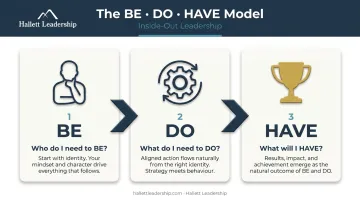
Most leaders jump straight to doing — tactics, action plans, new behaviors — without first examining the identity and assumptions driving those behaviors. Coaching starts with being, because it's who a leader is, not what they have or what they do, that drives lasting influence.
Who Benefits Most
Transformation coaching isn't reserved for the executive suite. The leaders who benefit most include:
- C-Suite executives navigating large-scale change, cross-departmental alignment, and high-stakes decisions
- Mid-level managers who carry executive vision down to team behavior — often the most overlooked layer in transformation
- Emerging leaders building the self-awareness and adaptability needed for greater responsibility
The common thread across all three groups: fixed beliefs and ingrained behaviors that were once effective but have become obstacles to growth.
How Executive Coaching Drives Business Transformation
Building Behavioral Intelligence
Transformation requires leaders who can recognize their own stress responses, communication patterns, and decision-making biases, then consciously adapt in real time. This isn't a soft skill. It's the mechanism through which change either propagates or stalls.
A 2023 workplace coaching meta-analysis found measurable effects across leader skills (Hedges g = 0.72) and overall workplace outcomes (g = 0.43). Behavioral outcomes specifically showed stronger effects than attitudinal ones — meaning coaching changes what leaders actually do, not just how they feel about their work.
Hallett Leadership's Discovery Model approaches this through a three-step behavioral framework: STOP automatic responses, LOOK at all available options, then CHOOSE the best course of action and, critically, who you want to be in the moment. This creates a pause between stimulus and response: the space where new leadership behavior gets built.
That foundation at the individual level is only the starting point. Lasting transformation requires connecting that personal growth to what the organization actually needs.
Aligning Individual Growth With Organizational Priorities
The best coaching engagements connect individual development directly to organizational objectives. That means clarifying decision rights, strengthening accountability, and building a shared leadership language that gives teams a common framework for working together.
Hallett Leadership structures this through weekly goal-setting tied to high-performance results, regular check-ins, and progress tracking against specific work-related outcomes. The engagement begins at the individual level, then deliberately expands outward to the leader's influence on their team and organization.
Once leaders start operating differently, that shift rarely stays contained to one person. It moves.
How Culture Change Actually Spreads
When executives model new behaviors — transparent decisions, accountability without blame — those behaviors ripple outward.
Every action a C-Suite leader takes influences the organization from top to bottom, whether they're aware of it or not. Middle management then becomes the link, translating executive behavior into the daily experience of frontline employees.
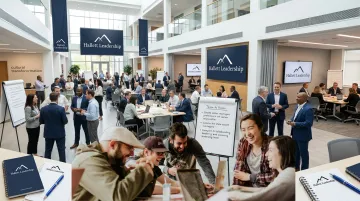
This is exactly what Hallett Leadership's Accelerated Leadership Program demonstrated at 20th Century Fox. Over 15 years, the program developed leaders who became culture champions, not just better individual performers. It worked 1,100 people through a 9-month process that shifted Fox from siloed, semi-independent divisions into a collaborative, high-performance culture.
That scale of cultural shift requires sustained coaching under real pressure — not a one-time training event, but repeated reinforcement until new behaviors become the default.
Transformational Coaching vs. Traditional Business Coaching
The distinction matters because organizations often purchase the wrong thing.
| Dimension | Traditional Coaching | Transformational Coaching |
|---|---|---|
| Focus | Specific skills: communication, time management, goal-setting | Mindset, belief systems, cultural behavior |
| Duration | Shorter engagements, often weeks to a few months | Extended, through the arc of organizational change |
| Unit of change | Individual performance | Organizational culture and outcomes |
| What success looks like | Improved individual metrics | Retention, team cohesion, culture shift, profitability |
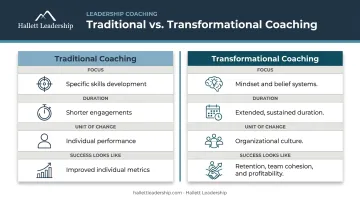
A traditional business coach might help a leader run better meetings or structure clearer feedback conversations. A transformational coach examines whether the leader's fundamental approach to authority, trust, and conflict is aligned with where the organization needs to go, then works to shift it at the root.
As Hallett Leadership puts it: "True transformation begins when those patterns are questioned and replaced with new ways of seeing and leading." That's a fundamentally different engagement than handing someone a checklist of habits to practice — and the research supports the distinction.
A 2023 meta-analysis found that neither the number of sessions nor total coaching hours significantly predicted outcomes. Depth, structure, and fit matter far more than duration.
Key Skills Executive Coaching Builds for Transformation
Emotional Intelligence and Self-Regulation
Emotional intelligence (understanding and managing your own emotions while reading others accurately) is the foundation of transformational leadership. Research across nearly 200 large global companies found that EI consistently distinguished effective leaders from others at the same technical skill level.
The practical challenge: leaders who can't self-regulate under pressure become bottlenecks rather than catalysts. They either make reactive decisions, shut down dialogue, or create environments where people manage up rather than perform.
Coaching builds EQ through:
- Structured reflection on recurring stress responses
- Real-time feedback on how behavior lands with others
- Practice with the STOP-LOOK-CHOOSE framework before high-stakes situations
- Values-based prompts that reinforce a leader's intended identity under pressure
The research also confirms EI is developable in adults, not fixed — which means investing in it produces real returns.
Strategic Communication and Influence
Transformation fails when leaders can't communicate a compelling vision, or when their message doesn't translate across organizational levels. A CEO's framing that resonates in the boardroom often lands differently on the floor.
Coaching builds the ability to:
- Translate strategic intent into language that connects at every level
- Adapt tone, pacing, and approach for different audiences
- Listen actively — a skill chronically undervalued in senior leaders
- Create psychological safety that enables honest, productive dialogue
At Hallett Leadership, communication development is embedded in the weekly coaching structure, with real-time feedback on how leaders show up in actual conversations — not just practice scenarios.
Change Management and Resilience
Communication alone won't carry a transformation. Leaders also need to manage the human cost of change itself. Gartner research shows employee willingness to support enterprise change dropped from 74% in 2016 to 43% in 2022. The workforce is exhausted — and that makes guiding teams through uncertainty harder than most leaders expect.
Coaching addresses this by helping leaders:
- Understand the emotional journey employees experience during transformation
- Anticipate and work with resistance rather than dismiss it
- Distinguish between productive friction and genuine derailment
Resilience here means recovering quickly and continuing to lead when plans hit friction — not simply absorbing pressure. Coached practice builds that capacity, though durability requires ongoing reinforcement rather than one-time training.
Accountability and Decision-Making Under Ambiguity
Most transformation environments share a common condition: incomplete information, high stakes, and urgency. Leaders who default to indecision or over-delegation create drag on the entire change effort.
Coaching sharpens judgment through:
- Examining personal decision-making patterns and where they break down
- Building values-aligned criteria for navigating ambiguity
- External accountability structures — weekly check-ins, honest feedback, goal tracking — that close the gap between stated intentions and actual behavior
The accountability component is where many leaders find coaching most confronting. The coach's job isn't to validate — it's to hold up an honest mirror. At Hallett Leadership, this includes feedback on how a leader's behavior is being perceived, which creates new options for making different choices.
How to Choose the Right Executive Coach for Business Transformation
Not all executive coaches are equipped for transformation work. The market has grown significantly — the coaching industry reached $5.34 billion in global revenue in 2025, with over 122,000 practitioners — and fewer than a third hold recognized professional credentials.
Evaluate prospective coaches against these criteria:
Organizational change experience: Ask coaches to describe culture shifts or measurable business outcomes they've contributed to directly. Individual performance improvement is a different skill set than transformation support. A background like Dean Hallett's — developing Fox's Accelerated Leadership Program over 15 years, then bringing that methodology to clients across industries — reflects the kind of senior-level corporate experience that makes transformation coaching credible rather than theoretical.
Methodology depth: Strong approaches combine behavioral science, experiential learning, and real-time feedback. Be skeptical of coaches who apply off-the-shelf frameworks uniformly — every organization's transformation has a different context, and the methodology should flex accordingly.
Honest feedback capability: A coach who validates rather than challenges creates dependency, not growth. Look for demonstrated willingness to deliver clear-sighted, constructive feedback even when it's uncomfortable.
Cultural fit: Transformation requires deep trust. A technically skilled coach who doesn't connect with the organization's culture will struggle to build the psychological safety that real development demands.
Defined success metrics: A strong transformation coach should help establish measurable benchmarks before the engagement begins — specific behavioral indicators, team cohesion measures, retention data, or productivity targets tied to the work.
What to Expect From an Executive Coaching Engagement
The Typical Arc
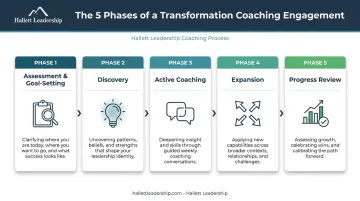
A transformation-focused coaching engagement generally moves through these phases:
- Assessment and goal-setting — Information gathering, job shadowing, identification of behavioral patterns and leadership strengths
- Discovery phase — Structured examination of fixed beliefs and behaviors limiting growth; establishing the leader's vision for who they want to be
- Active coaching — Weekly sessions focused on real challenges; goal-setting, feedback integration, and practice with new approaches
- Expansion — Gradual shift from individual focus to the leader's influence on team and organizational dynamics
- Progress review — Regular evaluation of work-related results, behavioral change, and organizational impact
Time and Commitment
Hallett Leadership's engagements typically involve direct coaching contact of 1-2 hours per week, with additional communication between sessions. Most transformation-focused programs run several months, with deeper work extending to a year or more.
Research is clear that session count alone doesn't predict outcomes. What drives results is the quality of engagement, the leader's willingness to apply insights in real work situations, and whether the coaching ties directly to specific organizational objectives. That quality depends heavily on what the leader brings to the process.
What the Leader Must Bring
Transformation coaching is active, not passive. The leader needs to:
- Accept honest feedback without becoming defensive
- Examine assumptions they may have held for years without questioning
- Apply insights in actual work situations — not just reflect on them in sessions
- Commit to the discomfort of behaving differently under pressure
Coaching provides the structure, the tools, and an experienced outside perspective. Whether transformation happens depends on the leader's willingness to act on those insights when real pressure hits — in the meeting, the difficult conversation, the high-stakes decision.
Frequently Asked Questions
What is the difference between executive coaching and transformational coaching?
Executive coaching is a broad category covering any structured leadership development delivered one-on-one. Transformational coaching is a deeper engagement that targets mindset, belief systems, and cultural behavior — not just skills or performance metrics. The goal is fundamental change in how a leader leads, not incremental improvement.
How long does executive coaching for business transformation typically take?
Meaningful transformation coaching usually spans six months to a year or more, depending on the complexity of the change and the leader's starting point. Shorter engagements of a few weeks to months may address specific skill gaps, but sustained behavioral change requires time, repetition, and real-world reinforcement.
Can executive coaching benefit mid-level managers, or is it only for C-Suite executives?
Mid-level managers are often the most critical recipients of transformation coaching — they're the bridge between strategy and execution. The most effective programs develop leaders at multiple organizational levels simultaneously, since cultural change requires alignment from the top down and the middle out.
How do you measure the ROI of executive coaching for business transformation?
Both qualitative and quantitative indicators matter. Qualitative signs include improved communication, stronger team cohesion, and cultural shifts; quantitative measures include retention rates, productivity metrics, and leadership effectiveness scores. The strongest engagements define success metrics before the work begins and track progress against them throughout.
What should I look for when hiring an executive coach for business transformation?
Prioritize relevant transformation experience, an evidence-based methodology, the ability to deliver honest feedback, and a track record of measurable outcomes. Credentials matter, but the quality of the coach-client relationship is the single most important factor in whether coaching produces results.
How does executive coaching address company culture change?
Culture change happens through leadership behavior. When executives shift how they communicate, make decisions, and hold others accountable, those patterns spread through management layers and reshape the day-to-day experience of the entire organization. Coaching individual leaders is the most direct path to cultural transformation — the impact doesn't stay contained to the individual.