Introduction: The Costly Assumption Behind Most Leadership Development Budgets
Here's a scenario that plays out in organizations every day: an executive finishes a transformational coaching engagement, experiences real growth, and wants to share it with their team. So they ask their coach to run a workshop.
The team attends, finds it inspiring — and six months later, almost nothing has changed.
The problem isn't the coach. It isn't the team's motivation. The problem is a structural assumption that systematically drains leadership development budgets: the belief that what works for an executive will naturally benefit the entire organization if you just deliver it downward.
According to McKinsey's 2023 research, only 20% of managers strongly agree their organizations set them up to succeed as people managers. That gap isn't accidental — it's the predictable result of building leadership development strategies around the top of the org chart while leaving everyone else with whatever's left over.
This post breaks down why executive coaching and front-line management development are distinct disciplines, why workshops alone can't close this gap, and what a more effective approach actually looks like.
Key Takeaways
- Executive coaching focuses on strategy, vision, and stakeholder influence — skills that don't translate to the daily relational demands of front-line management
- 57% of employees have left a job because of their direct manager, not the organization
- Single-day workshops don't produce lasting behavior change — the format itself is the problem
- Front-line managers need ongoing, role-specific development grounded in relational skills and on-the-job accountability
- Effective organizations treat executive and front-line development as separate investments built for each role
The Trickle-Down Myth: Why Executives Assume Their Coaching Benefits the Whole Org
The intent behind trickle-down leadership development is genuine. An executive experiences coaching as transformational, concludes that their team would benefit, and asks the coach to run a group session. The workshop happens. The room is energized. People leave with new language and fresh perspective.
Then work resumes.
Ask those same participants six months later what they retained and actually applied, and the honest answer is: not much. This isn't cynicism — it's a predictable outcome baked into the format.
The underlying belief driving this pattern is that developing executives develops the culture. If the leader grows, the organization grows with them. This logic leads companies to concentrate resources heavily at the top while offering lower-level leaders minimal, infrequent development — often described internally as "training" rather than "development."
The numbers reflect this gap precisely:
- Bersin by Deloitte found that first-level leaders receive an average of $2,600 in development investment per person — 34% less than emerging leaders and half the amount allocated to mid-level leaders.
- DDI's Frontline Leader Project found that people first become leaders at age 36 on average but don't receive their first formal leadership development until age 40 — a four-year gap that often covers the most formative stretch of someone's management career.
The investment gap is only half the problem. When executives do extend development to their teams, they typically share what worked for them — tools and approaches built for strategy-level roles — rather than what front-line managers actually need. The result is development that feels relevant in the workshop room and evaporates in the daily grind.
Executive vs. Front-Line Leadership: A Fundamental Role Mismatch
Two Different Jobs
The distinction matters more than most organizations acknowledge.
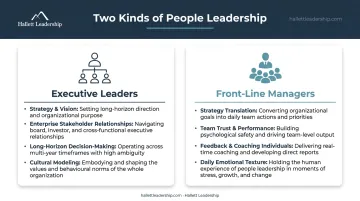
Executive leaders are primarily responsible for:
- Setting organizational strategy and vision
- Navigating stakeholder relationships at the enterprise level
- Making high-stakes decisions with long time horizons
- Modeling and sustaining organizational culture from the top
Front-line and mid-level managers are primarily responsible for:
- Translating that strategy into daily work activities
- Building trust and performance within individual teams
- Delivering feedback, managing underperformance, and coaching individuals
- Handling the daily emotional texture of people leadership
These are not the same job. Executive coaching typically addresses mindset, organizational influence, strategic clarity, and stakeholder navigation. None of those competencies directly answer the question a front-line manager faces on a Tuesday morning: how do I have a difficult conversation with someone whose performance is slipping?
The Translation Problem
MIT Sloan Management Review research across 4,012 respondents found that only 28% of executives and middle managers responsible for executing strategy could list three of their company's strategic priorities. The same research found that top teams consistently overestimate how well strategic alignment extends through the organization.
Executive development, however effective at the top, doesn't automatically translate downward. The people closest to individual contributors often received development built for a different job entirely — and the cultural consequences of that gap show up every day.
The Cultural Cost
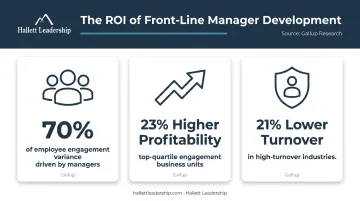
Front-line managers have far more daily contact with employees than any executive does. They set the actual lived culture of a team — through how they give feedback, how they show up under pressure, how they handle conflict. Gallup research found that managers account for at least 70% of the variance in employee engagement scores across business units.
DDI's research makes the stakes concrete: 57% of employees have left a job because of their manager, not the organization itself. Under-developing front-line managers creates both a skills gap and a retention crisis.
The Learning Science Problem: Why Workshops Don't Create Lasting Change
What the Research Says About Skill Acquisition
Josh Kaufman's framework in The First 20 Hours argues that reaching basic proficiency in a new skill requires roughly 20 hours of focused, deliberate practice. That's proficiency — not habit, not fluency. Habit formation takes considerably longer: research published in the European Journal of Social Psychology by Lally and colleagues found an average of 66 days to reach automaticity, with a range from 18 to 254 days depending on the behavior and the individual.
A one-day workshop provides perhaps six to eight hours of engagement, most of which is lecture-based rather than practiced. Even a two-day workshop falls well short of the threshold for proficiency, let alone habit change.
The Format Cannot Carry the Outcome
Executive coaching works because it has what workshops lack:
- Consistent cadence — weekly or bi-weekly sessions over months
- Ongoing accountability — progress is tracked, goals are reset, blind spots are named
- Real-time feedback — the coach is available when actual challenges arise
- Integration with real work — development happens in context, not in isolation
A workshop delivers none of these. The content may be solid and the facilitator skilled — but without cadence, accountability, and real-world integration, the learning rarely sticks beyond the following Monday.
The Compounding Problem at the Front Line
Front-line managers in workshops adapted from executive coaching aren't just getting insufficient time — they're getting the wrong frameworks. Executive models of strategic thinking and stakeholder influence don't map cleanly onto the relational, operational challenges of managing a team of five or eight people.
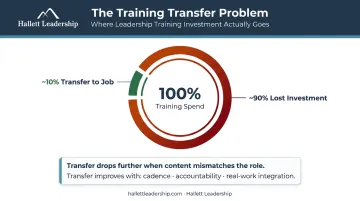
Baldwin and Ford's research on training transfer estimated that no more than 10% of training expenditures result in actual transfer to the job — and that figure reflects content that's reasonably well-matched to the role. When the frameworks are borrowed from a different management tier entirely, that number almost certainly falls lower. The implication isn't just inefficiency. It's that organizations are investing training budgets in interventions that structurally cannot work for front-line managers.
What Front-Line Managers Actually Need to Develop
The developmental needs of front-line managers are specific, relational, and largely absent from executive coaching curricula.
Core competency gaps identified across organizations:
- Giving individualized, constructive feedback — named as the top weakness of front-line managers by senior leaders in DDI's research
- Coaching individuals toward growth rather than simply directing task completion
- Managing underperformance with care and consistency
- Building trust within a team over time
- Navigating conflict without escalating or avoiding
- Motivating people whose needs, values, and drivers differ
These skills don't develop from a framework delivered in a workshop. They develop through practice, reflection, accountability, and repetition — over time, in the actual context of work. That's precisely the kind of structure most training programs don't provide.
A Different Methodology for a Different Job
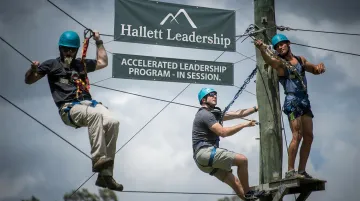
Hallett Leadership's Accelerated Leadership Program was built around that requirement. Rather than a standalone training event, it's a nine-month cohort program that integrates development directly into participants' daily work. Participants apply new skills in real time while remaining in their roles — so learning happens in context, not in a room removed from the actual situations where these skills get tested.
Dean Hallett's Discovery Model, built on behavioral science and experiential learning, addresses one of the core reasons workshops fail: most behavior operates from unconscious habit. The model moves participants through a structured progression — from automatic, unexamined responses to genuine awareness and intentional choice.
The DISC and Myers-Briggs assessments used in the program serve that same purpose. Both tools build the self-awareness that makes relational leadership possible — understanding how your default style lands with others, and how to adapt it.
The approach includes structured feedback exchanges, peer accountability within the cohort, and ongoing coaching throughout the nine months. Sustained behavior change requires repetition, feedback, and time — and the program is structured to deliver all three.
Building a Two-Tier Leadership Development Strategy
The solution isn't choosing between executive coaching and front-line development — it's treating them as separate, purpose-built investments rather than versions of the same program.
What Each Tier Looks Like
| Development Tier | Focus | Format |
|---|---|---|
| Executive Coaching | Strategy, vision, stakeholder influence, enterprise decision-making | 1:1 coaching, weekly/bi-weekly cadence, months-long engagement |
| Front-Line/Mid-Level | Relational leadership, team culture, feedback, execution skills | Ongoing cohort programs, spaced practice, real-work integration |
Organizations that separate these tiers see stronger cultural cohesion and better execution — because the people translating strategy into daily work are finally getting development designed for that specific job.
This Doesn't Require Doubling the Budget
The goal is redirection, not addition. Bersin by Deloitte's research shows that first-level leaders consistently receive the lowest per-person investment — not because organizations can't afford more, but because budget allocation follows assumptions about where leadership development matters most. Shifting some of that concentration downward, toward purpose-built programs, doesn't require new spending — it requires smarter deployment of what's already there.
The numbers make the case. Gallup's Q12 Meta-Analysis of more than 100,000 teams found that top-quartile engagement business units deliver 23% higher profitability and 21% lower turnover in high-turnover industries. Since front-line managers account for most of the variance in those engagement scores, developing them well is a direct financial decision — not a cultural add-on.
Hallett Leadership works with organizations at both tiers simultaneously — executive coaching builds leadership capacity at the top, while the Accelerated Leadership Program develops execution capability in the middle. When both run with clear intent and role-specific design, the gap between vision and daily culture starts to close.
Frequently Asked Questions
What are the 5 C's of coaching?
The 5 C's vary by framework, but commonly include Clarity, Communication, Collaboration, Commitment, and Consistency. Hallett Leadership's 7 C's model extends this to Composure, Connection, Charisma, Confidence, Credibility, Clarity, and Conciseness. Which C's take priority depends on whether coaching targets executive presence or front-line relational leadership.
What are the 4 C's of executive presence?
Sylvia Ann Hewlett's widely cited model identifies gravitas, communication, and appearance as the core dimensions. Hallett Leadership's 7 C's framework defines presence as a set of trainable behaviors, distinct from the relational skills that front-line managers most need to develop.
Why doesn't executive coaching trickle down to front-line teams?
Executive coaching is designed for strategy-level roles — mindset, organizational influence, and high-stakes decision-making. These are different competencies from the relational, daily execution skills front-line managers need. One-time workshops adapted from executive content don't address the right skills and can't produce lasting change regardless of quality.
What type of development is most effective for mid-level managers?
Ongoing, role-specific development delivered with consistent cadence and accountability. The format matters as much as the content: programs that integrate into real work over months, with structured feedback and peer accountability, produce the behavioral change that single-event training cannot.
Can organizations provide both executive coaching and front-line development without doubling their L&D spend?
Yes — the goal is strategic redirection of existing investment, not new spending. First-level leaders currently receive significantly less per-person investment than senior leaders. Shifting that allocation toward purpose-built, level-appropriate programs tends to produce stronger outcomes per dollar than concentrating development at the top.