What separates leaders who resolve conflict from those who make it worse isn't authority, experience, or even good intentions. It's how they manage themselves and others in the moment. That's where emotional intelligence (EI) becomes the deciding factor.
Most leaders understand that EI matters. Far fewer know how to apply it deliberately when a conversation turns difficult, when emotions are running high, or when the same argument keeps resurfacing. This article gives you a practical, sequenced approach to doing exactly that.
Key Takeaways
- EI is a set of learnable skills — empathy, self-regulation, and relationship management — that determine how leaders handle conflict.
- Effective EI application follows a clear sequence: regulate yourself first, then create safety before moving toward resolution.
- The type of conflict (task, relationship, or value-based) determines which EI skills to lead with.
- The most common EI mistake is treating emotional suppression as self-regulation, or using empathy to sidestep accountability.
- For persistent or structural conflict, EI works best when paired with formal processes and professional coaching.
What Emotional Intelligence Actually Means When Conflict Hits
EI Is Not About Being Nice
Daniel Goleman's HBR framework defines emotional intelligence as five competencies: self-awareness, self-regulation, motivation, empathy, and social skill. His research found that for senior leaders, nearly 90% of the difference between star performers and average performers was attributable to EI factors — not technical expertise or IQ.
In conflict, EI matters because pressure exposes how people are wired. Understanding what drives your own behavior — and the other person's — is what allows a leader to respond deliberately rather than react instinctively.
How Each EI Component Shows Up in Conflict
Each of Goleman's five components plays a specific role when tension surfaces:
- Self-awareness keeps you from being blindsided by your own triggers — you recognize when you're reactive before it shapes the conversation
- Self-regulation prevents escalation — you choose how to express what you feel rather than letting it spill unfiltered
- Empathy de-centers blame — you become genuinely curious about what's driving the other person's behavior, not just what they said
- Motivation keeps everyone at the table — it sustains the belief that resolution is worth working toward, even when it's uncomfortable
- Relationship management rebuilds trust after tension breaks — this is what determines whether conflict leaves a team stronger or more fractured
Three Types of Conflict, Three EI Demands
Not all conflict is the same. Harvard's Program on Negotiation identifies three distinct types:
| Conflict Type | What It Involves | Primary EI Demand |
|---|---|---|
| Task | Disagreements over work, process, or decisions | Self-regulation, structured dialogue |
| Relationship | Clashing personalities, communication styles, or interpersonal friction | Empathy, sustained relationship management |
| Value | Fundamental differences in ethics, beliefs, or identity | Deep empathy, tolerance for ambiguity, clear boundaries |
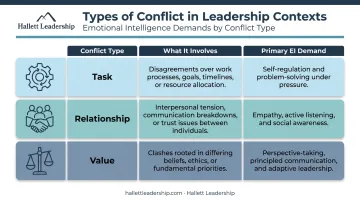
Identifying the type early matters because the same EI approach that resolves a task conflict can backfire in a values conflict. The intervention needs to match what's actually at stake.
How to Resolve Workplace Conflict Using Emotional Intelligence
Sequence matters here. Skipping directly to "fixing the problem" before managing your own state or establishing safety almost always makes conflict worse. Follow this order deliberately.
Step 1: Regulate Yourself Before Entering the Conversation
A leader's emotional state is contagious. If you walk into a conflict conversation feeling defensive, already certain of who's wrong, or carrying unprocessed frustration from the last meeting, those emotions will shape the entire interaction before anyone says a word.
Self-regulation starts before the conversation. Practical techniques include:
- Pause — give yourself a brief window between the triggering event and the response
- Name the emotion internally — "I'm feeling defensive about this" reduces its intensity
- Breathe deliberately — slowing your breath activates the parasympathetic nervous system and reduces the fight-or-flight response
- Journal briefly — writing down your assumptions about the situation before the meeting helps surface and challenge them
One critical distinction: self-regulation is not suppression. Research by Torrence and Connelly (2019) found that cognitive reappraisal — genuinely reframing how you interpret a situation — positively predicted leadership performance, while suppression negatively predicted leadership emergence. Bottling up emotion and pretending neutrality is not the same thing as processing it. Leaders who confuse the two model exactly what they don't want to see from others.
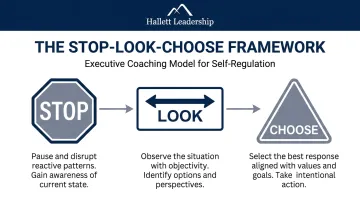
At Hallett Leadership, this concept is embedded in the STOP-LOOK-CHOOSE framework — interrupt the automatic response, survey all available options, then consciously choose how to show up. That deliberate pause is where emotional intelligence becomes observable behavior, not just a concept.
Step 2: Create a Psychologically Safe Environment
Amy Edmondson's foundational research defines psychological safety as "a shared belief held by members of a team that the team is safe for interpersonal risk taking." Without it, people manage impressions instead of telling the truth — which means the actual conflict never gets addressed.
Practical steps for creating safety before and during the conversation:
- Choose the setting — private, neutral territory, no audience
- Control the logistics — phones away, no interruptions, enough time
- Watch your opening tone — the first 60 seconds signal whether this is a genuine conversation or a performance review
- State your intent explicitly — "I want to understand what's happening, not assign blame" goes further than most leaders realize
Body language matters as much as words here. Crossed arms, a tight jaw, or rapid-fire questions all undermine psychological safety regardless of what you say.
Step 3: Listen to Understand, Not to Respond
Active listening in conflict is a deliberate skill, not a passive one. Most people in conflict listen to accumulate evidence, not to understand. The distinction shows immediately in how questions get asked.
Behaviors that signal genuine listening:
- Ask open questions: "What's been your experience of this situation?" not "Did you actually say that?"
- Reflect back what you heard before moving on: "So what I'm hearing is that you felt excluded from the decision — is that right?"
- Resist the urge to correct, clarify, or defend while someone is still speaking
- Tolerate silence — it usually means someone is still processing, not done
Empathy is what makes this step work. The goal is not to agree with both parties — it's to ensure each person feels genuinely heard before anyone moves to problem-solving. Skipping this step and going straight to solutions is the most common reason conflicts resurface.
Step 4: Name the Real Issue With Precision
Conflict almost always gets stuck on surface behavior — what someone said, who took credit for what. Underneath, the real issue is usually an unmet expectation, a perceived lack of respect, or a values misalignment neither party has named aloud.
Leaders who apply EI help shift the language from accusation to experience:
- From: "You never include me in decisions."
- To: "I felt sidelined when the decision was made without my input, and I'm not sure what my role is supposed to be."
The second framing reduces defensiveness and opens dialogue. Leaders should model this language themselves, not just coach others to use it. When you say "I felt frustrated when the timeline changed without notice" instead of "you dropped the ball," you demonstrate the behavior while moving the conversation forward.

Step 5: Build Toward Resolution With Relationship Management
With the real issue on the table, the leader's job is to facilitate a collaborative agreement — specific behavior changes with clear accountability — not a vague split-the-difference compromise.
Resolution requires more than one conversation. Effective follow-through includes:
- A clear, specific agreement on behavior changes (not vague commitments to "communicate better")
- Defined check-in points — two weeks, one month
- Continued emotional attentiveness from the leader, not just process monitoring
Leaders who want to build this capacity consistently often benefit most from structured, ongoing coaching. Hallett Leadership's one-on-one executive coaching is designed to develop exactly these EI competencies — not through a training event, but through real-world application over time, with accountability built into the process.
Key EI Factors That Shape Whether Conflict Gets Resolved
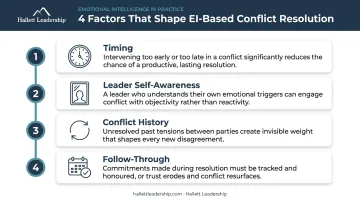
Even when a leader follows the right steps, outcomes vary. Four variables determine how much EI alone can accomplish:
Timing. Conflict addressed when tension is still behavioral resolves with EI skills alone. Once it has hardened into resentment, gone public, or repeated itself over months, more structured intervention and longer recovery are required.
The leader's own self-awareness. You cannot facilitate emotional clarity for others if you lack it yourself. Tasha Eurich's research, published in HBR, found that 95% of people believe they are self-aware, while only 10–15% actually are. Leaders who overestimate their self-awareness tend to miss their own role in the dynamic they're trying to resolve — a costly blind spot in conflict situations.
Conflict history. A first-time task disagreement responds well to a single structured conversation. A recurring conflict between the same parties signals a deeper pattern. One well-facilitated conversation won't change it.
Follow-through. Leaders who reach a resolution and then disappear signal that the agreement was hollow. Reinforcing agreed behaviors through check-ins, visible attention, and accountability is itself an EI skill — one tied directly to relationship management.
Common Mistakes Leaders Make When Applying EI to Conflict
Even well-intentioned leaders undermine their own EI in conflict situations. These four patterns show up repeatedly — and each one is worth recognizing before your next difficult conversation.
Confusing suppression with self-regulation. Many leaders believe they're "staying professional" by not expressing emotion. What they're actually doing is creating a cold, disconnected conversation that implicitly asks others to be open while modeling the opposite. Suppression is avoidance, not regulation.
Using empathy to sidestep accountability. Listening well to both sides and then failing to name consequences or hold anyone to a behavioral standard isn't empathy — it's conflict avoidance with better technique. When emotion is acknowledged but nothing changes, teams lose trust in the process.
Rushing to solutions before processing the emotional charge. When leaders skip past emotional content to get to "what do we do now," that unprocessed emotion resurfaces — and it's worse the second time. Staying in the listening phase longer than feels comfortable is nearly always the more efficient path.
Treating one conversation as the resolution. Leaders who check the box after a single mediated conversation often face the same conflict within weeks. Resolution is a process. The conversation opens the door; follow-through is what walks through it.
When Emotional Intelligence Alone Isn't Enough
EI is a powerful first-response tool, but it has clear limits.
When conflict involves harassment, discrimination, repeated policy violations, or toxic behavior patterns, EI-based conversation must be paired with formal HR and legal processes. Leading with empathy in these situations without appropriate process can create liability or signal that harmful behavior is tolerated. SHRM's conflict management guidance is explicit: serious legal matters require legal counsel or outside expertise, not just better listening.
Some conflict is rooted in structural issues — role ambiguity, resource scarcity, unclear accountability. The interpersonal tension is real, but the underlying cause is organizational. EI helps leaders navigate the human side of these situations, but resolution ultimately requires structural change.
Leaders who consistently struggle to regulate themselves in conflict — or whose teams face recurring, unresolved tension — benefit most from dedicated EI coaching. Developing emotional intelligence under pressure is an ongoing, inside-out process. It takes expert guidance, real-world application, and sustained accountability over time.
Hallett Leadership's executive coaching engagements are built around exactly that kind of sustained development, helping leaders build the self-awareness and regulation skills that hold up when conflict is at its most difficult.
Frequently Asked Questions
What is the relationship between emotional intelligence and conflict resolution?
EI gives leaders the tools to understand what's emotionally driving a conflict, manage their own reactions in the moment, and facilitate a resolution that addresses root causes rather than surface behaviors. Without it, leaders often address the symptom and miss the actual issue.
Can emotional intelligence be learned, or is it a fixed trait?
EI is a learnable set of skills. A meta-analysis of 58 studies found a moderate positive training effect on EI development. With intentional practice, coaching, and feedback, leaders can measurably improve self-awareness, empathy, and relationship management over time.
What should a leader do if their own emotions are triggered during a conflict?
Pause, name the emotion internally, and use a self-regulation technique (stepping away briefly, breathing deliberately, or grounding yourself) before re-engaging. Re-entering the conversation once you can respond rather than react is itself a visible act of EI leadership.
How is EI-based conflict resolution different from standard HR mediation?
HR mediation is a formal process centered on policy compliance and documentation; EI-based resolution targets the emotional drivers beneath the dispute. Both matter in serious cases, but EI approaches work best for interpersonal and team-level conflicts before they reach that threshold.
What if one person involved in the conflict has low emotional intelligence?
A leader cannot control others' EI, but regulated, empathetic behavior often shifts the emotional tone of the entire conversation. When someone's patterns are persistent or disruptive, that's a signal the situation may need sustained coaching or a structural intervention rather than a single conversation.
How long does it take to develop emotional intelligence skills for conflict situations?
Basic techniques can be applied right away, but building consistent competency under pressure takes months of coaching and feedback. Early goals like self-awareness and identifying blind spots show progress within weeks — lasting behavioral change takes longer, which is why ongoing coaching outperforms a single training event.