
John Maxwell's 5 Levels of Leadership offers that architecture. Originally published in 2011 and updated in a 10th Anniversary Edition in 2021, the framework gives HR leaders, coaches, and organizational development practitioners a common language and a sequential model they can actually build a workshop around.
This guide is written for practitioners who want to move beyond explaining the model and start using it. You'll find a breakdown of each level's behavioral markers, a workshop design structure, and self-assessment guidance that makes the learning stick.
Key Takeaways
- Maxwell's five levels — Position, Permission, Production, People Development, and Pinnacle — form a cumulative model where each level builds on the one before it.
- Influence, not title, is the true measure of leadership in this framework.
- Each level demands a distinct mindset shift, from compliance-based authority to legacy-driven mentorship.
- Effective workshops combine self-assessment, experiential exercises, and coaching conversations rather than passive lecture.
- The hardest transition is Level 3 to Level 4: from high performer to developer of others.
What Are the 5 Levels of Leadership?
The 5 Levels of Leadership is a framework developed by John C. Maxwell — a #1 New York Times bestselling author whose organization has trained over 5 million leaders in 180 countries. The book has sold nearly 450,000 copies and remains one of the most widely used models in organizational leadership development.
The model's central premise is straightforward: leadership isn't something you're granted by a title. It's something you earn through relationships, results, and the growth of others. The five levels represent a progression from authority-based compliance to legacy-driven respect.
Here's the framework at a glance:
Position → Permission → Production → People Development → Pinnacle
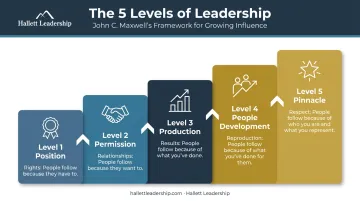
What makes this model especially effective in a workshop setting is the shared language it creates. Participants from any industry, any function, and any seniority level can locate themselves on the same map — without judgment. That non-threatening starting point is where real development conversations begin.
The 5 Levels Explained: Behavioral Markers for Each Stage
This section is a practical reference. For each level, the question isn't just "what is this?" — it's "what does this actually look like in a real meeting, a real conversation, a real decision?"
Level 1: Position (Authority)
People follow because they have to. The leader relies on their title, role, or org chart standing to get compliance. This is the appropriate entry point for any new leader — not a character flaw, just a starting point.
The real work at this level is self-awareness. Leaders at Level 1 need to:
- Build credibility through consistent behavior rather than rank
- Communicate genuine appreciation to team members
- Recognize that positional authority alone is fragile
Gallup's research shows managers account for 70% of the variance in team engagement — which exposes exactly how much is at stake when leaders never move past Level 1.
Level 2: Permission (Relationships)
People follow because they want to. The leader has invested in knowing their people — their motivations, pressures, and strengths — and team members respond with cooperation rather than mere compliance.
What separates good from great here is genuine curiosity: holding people accountable with care, creating psychological safety, and learning what makes each person tick.
One caution: leaders who stop here — strong on relationships, light on results — often lose credibility over time. Warm without productive is not enough.
Level 3: Production (Results)
People follow because of what the leader has delivered for the organization. The leader earns credibility through performance, models high standards, and energizes the team around measurable goals.
The developmental task is connecting results to people, not just to processes. There's a real risk at this level: teams can become overdependent on a high-performing leader. When the leader is the engine, the organization doesn't scale.
Level 4: People Development (Reproduction)
People follow because of what the leader has done for them personally. The primary focus shifts from the leader's own output to growing others' capabilities — through delegation, coaching, and identifying emerging leaders.
The challenge most leaders face here is letting go of the need to be the top performer. Maxwell notes that Level 4 leaders spend the majority of their time developing others — this is where organizations build real bench strength.
The data backs the urgency: according to the ATD's 2025 State of the Industry report, 48% of talent development professionals identified major skills gaps among managers and supervisors. That makes Level 4 not just a leadership aspiration but an organizational necessity.
Level 5: Pinnacle (Legacy)
People follow because of who the leader is and what they represent. Influence extends beyond the immediate team and often beyond the organization. These leaders are defined more by character than credentials.
Growth at this stage requires sustaining humility and resisting complacency. In practical terms, that means actively creating conditions for other Level 4 and 5 leaders to emerge — not protecting status, but multiplying it. The leaders who reach this level are typically more focused on the room they're leaving better than the one they walked into.
Why the Levels Build on Each Other
Think of the model like floors of a building. You don't get to the third floor by bypassing the second. The skills at each level don't get replaced — they compound. Each floor expands what came before it; nothing below disappears.
What that looks like in practice:
- A Level 3 leader still relies on the relationship skills built at Level 2
- A Level 4 leader still needs to deliver results, not just develop people
- A Level 5 leader draws on every layer — position, relationships, results, and development — simultaneously
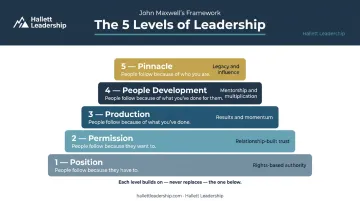
The most common mistake organizations make is expecting leaders to perform at Level 4 or 5 without having done the earlier work. What you get is fragile leadership — people may admire the outcomes but don't trust the person. Followers sense when the relationships and results aren't there to support the people-development stance.
The sequencing isn't arbitrary. Trust accumulates in a specific order — and you can't shortcut the sequence without people noticing the gaps.
How to Design a 5 Levels of Leadership Workshop
The goal of a 5 Levels workshop isn't to teach participants a framework. It's to help them recognize where they actually are, feel the motivation to grow, and leave with a specific next step. That requires design choices that favor experience and reflection over content delivery.
A 2017 meta-analysis of 335 samples and 26,573 participants found leadership training that includes needs analysis, practice, feedback, and spaced delivery produces significantly better transfer than one-time content events. The design principles below reflect that evidence.
Pre-Workshop Phase
Before anyone walks into the room, have participants complete a self-assessment (covered in the next section). Gather the data anonymously and use it to shape the emphasis of the day. If most participants cluster at Levels 2 and 3, don't spend half the session explaining Level 1 — direct energy toward where the real developmental work is.
Session Design by Level Focus
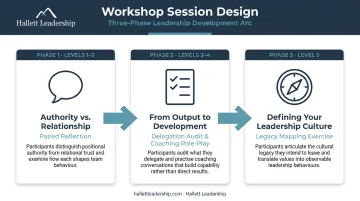
Levels 1–2 (Position and Permission): Use paired reflection exercises. Ask participants to recall a time they relied purely on their title to get compliance and a time they relied on a relationship instead. Debrief the emotional difference for both them and their team. The insight that typically surfaces: authority without relationship is exhausting, and people can tell the difference.
Levels 3–4 (Production and People Development): Introduce a delegation audit. Have leaders map their current workload and identify tasks they're holding that could develop someone else. Follow it with a role-play coaching conversation where the leader gives meaningful responsibility and feedback rather than instructions.
In most cohorts, this is where mid-level managers have the biggest shift in perspective: from "I need to deliver this" to "I need to grow someone who can deliver this."
Hallett Leadership's programs build this into the exercise directly: participants practice inviting team members into desired outcomes and empowering them as partners, not just assigning tasks with instructions attached. The behavioral difference is immediately visible in the role-play debrief.
Level 5 (Pinnacle): Use a legacy-mapping exercise. Ask participants to write a brief statement describing the leadership culture they want to leave behind specifically how people will describe working with them years later, not their job title. Facilitate a group discussion on what it would take to close the gap between that vision and today's reality.
Facilitation Principles That Make It Work
Across all five levels, three principles matter most:
- Create psychological safety first. Participants need to feel safe being honest about where they actually are, not where they want to appear. Hallett Leadership's programs address this directly by establishing at the outset that openness and even vulnerability are prerequisites for growth — and that at least being "1% open" is enough to start.
- Use participants' real scenarios. Generic case studies flatten the learning. When coaching conversations are built around the actual challenges in the room, transfer improves significantly.
- Prioritize depth over coverage. Rushing through all five levels in a single day defeats the purpose. Spend more time on the levels most relevant to the cohort and less on those that don't apply.
Closing the Workshop
End with two concrete commitments:
- Each participant writes one specific action for the next 30 days tied to the level they've identified.
- Pair participants in accountability partnerships before they leave.
A follow-up coaching session 30 days later, individual or small group, reinforces those commitments and works through the real obstacles that have surfaced since the workshop. Skipping this step consistently undermines the gains made on workshop day.
How to Self-Assess Your Leadership Level Before the Workshop
Self-assessment before a workshop does two things: it primes participants for honest reflection, and it reduces defensiveness in the room. Most leaders also overestimate their level, particularly confusing strong Level 2 relationships for Level 4 development behavior.
Key Reflection Questions
Encourage participants to sit with these before the session:
- Do people follow me because they have to or because they want to?
- Am I spending more time on my own output or on growing my team's capabilities?
- Do I regularly create situations where others lead, or am I still the center of most decisions?
- If I asked my direct reports to describe my leadership, would their answers match mine?

That last question matters. Research on self-other rating agreement consistently shows that how leaders see themselves and how their teams experience them can diverge significantly.
Hallett Leadership's programs work directly on this gap using the Johari Window framework, specifically the "blind spot" quadrant, where behaviors are visible to others but invisible to the leader. Structured peer feedback exchanges — where participants hear specific observations from colleagues — are among the most impactful elements of their programs, often surfacing gaps that self-reflection alone never reaches.
A Practical Tip for Facilitators
Run a 3–5 question anonymous pre-workshop survey. Review the results before the session and use them to anchor your opening remarks with honest, grounded context. If the majority of participants self-identify at Level 2 or 3, say so — and design the session around the Level 3-to-4 transition, which is typically where the highest leverage and the most resistance live.
Frequently Asked Questions
What are the 5 levels of leadership?
The five levels are Position, Permission, Production, People Development, and Pinnacle, as defined by John Maxwell. Each represents a different basis for influence, progressing from authority-based compliance at Level 1 to legacy-driven respect at Level 5.
Can a leader be at different levels with different people or teams?
Yes. Level is relational and contextual. A leader may have earned Level 4 influence with a long-tenured team while still operating at Level 1 with a new group where trust hasn't been established. The framework applies relationship by relationship, not globally.
Is it possible to skip a level in Maxwell's framework?
The model is cumulative: each level builds on the skills and trust developed before it. Leaders who try to operate at higher levels without earning the lower ones typically create fragile influence that followers eventually see through.
How long does it take to move from one level to the next?
There's no fixed timeline. Progression depends on intentional effort, feedback, coaching, and the organizational environment. With deliberate development, some leaders advance meaningfully in months; without targeted support, others stay at one level for years.
What is the most difficult transition in the 5 Levels framework?
Level 3 to Level 4. It requires high-performing leaders to shift their identity from individual achievers to developers of others, which means redefining how they measure their own success. Many resist it precisely because they've been rewarded for personal performance their entire careers.
How can organizations use this framework in leadership training?
The 5 Levels model works well as the backbone of a workshop, coaching curriculum, or ongoing development program. It gives leaders a shared language, a non-judgmental starting point, and a clear developmental roadmap. Results deepen when paired with self-assessment, peer feedback, and structured follow-up — the approach Hallett Leadership uses to embed the framework into real behavioral change.