Introduction
Fortune reported in 2016, citing an Inc. Magazine and Kauffman Foundation study, that roughly two-thirds of companies on the Inc. 5000 fastest-growing list had shrunk, been sold at a disadvantage, or gone out of business within five to eight years of their listing. Read that again: two-thirds.
Fast growth doesn't guarantee survival. In many cases, it accelerates failure.
The reason is rarely the market or the product. It's leadership. The instincts, behaviors, and hands-on style that build a company to $10M often become the exact barriers to reaching $50M.
Founders who thrived as chief-everything-officers suddenly find themselves the bottleneck in organizations that need systems, clear delegation, and strategic direction — not more hustle from the top.
This guide covers what leadership coaching actually does in a fast-growth context, the specific competencies it builds, and how to choose and get the most from a coaching program before the gaps become crises.
Key Takeaways
- Two-thirds of fast-growing companies eventually shrink, fail, or sell unfavorably — leadership gaps are a primary cause
- What launches a company rarely scales it; founders must evolve from hands-on executor to strategic leader
- Leadership coaching builds behavioral change, not just tactical knowledge
- Mid-level managers are the most neglected, highest-leverage coaching audience during rapid scale
- Proactive coaching investment consistently outperforms reactive crisis management
Why Fast-Growth Companies Face a Leadership Crisis
Revenue climbs. Headcount doubles. Complexity multiplies. But the leadership behaviors that got a company to this point rarely evolve fast enough to handle what comes next.
The Control Trap
Founders and early executives who were hands-on in every decision rarely relinquish control as their teams grow. What worked at 15 people becomes a liability at 80.
The pattern is predictable: the founder's instinct is to jump in, correct course, and maintain quality. But at scale, that instinct creates bottlenecks, stifles employee development, and layers frustration into the organization. As Harvard Business Review's Noam Wasserman documented in "The Founder's Dilemma", founders who want to scale must cede control — and most find that harder than any business challenge they've faced.
Hallett Leadership sees this pattern consistently in its work with CEO-founders: the survival instincts and hands-on behaviors that built the company start working against it. Past certain growth thresholds, the coaching challenge stops being about skills. It becomes about identity.
The Accidental Manager Problem
Fast-growth companies promote from within constantly. That's not a flaw — it's a natural consequence of speed. The problem is what happens next.
A high-performing individual contributor gets promoted into management, then promoted again, often without any formal development in between. According to the Center for Creative Leadership, nearly 60% of new managers say they never received training when transitioning into their first leadership role. Twenty percent were rated poor by their direct reports. Fifty percent were rated as ineffective overall.
Now multiply that across a fast-growth company's entire management layer.
The Leadership Identity Shift
Underneath the tactical gaps sits a harder problem: the identity shift that fast growth demands.
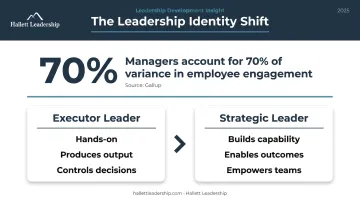
A leader who thrived as an executor, a problem-solver, a person who got things done personally, now needs to build capability in others. That transition isn't a skills upgrade. It requires a fundamental change in how leaders define their own value — from output they produce to outcomes they enable in their teams.
Gallup research puts the stakes in concrete terms: managers account for at least 70% of the variance in employee engagement across business units. In a fast-growth company adding headcount every quarter, weak management doesn't just slow things down — it actively drives talent out the door.
What Leadership Coaching Actually Does for Fast-Growth Teams
The How-to-Be vs. What-to-Do Distinction
Most training programs focus on what-to-do competencies — frameworks for better meetings, delegation matrices, communication templates. These have value. But they rarely stick when the underlying leadership identity hasn't shifted.
Hallett Leadership's foundational approach addresses this directly through the BE – DO – HAVE model: who a leader needs to be must come before what they need to do. The "be" question — the state of awareness, the internal landscape — drives influence in ways that tactics alone cannot replicate.
The Discovery Model, developed and refined through 15 years at 20th Century Fox, puts into practice this. It draws on cognitive neuroscience research showing that 95% of decisions and behaviors run on autopilot — unconscious patterns shaped over years of experience. The Discovery Model interrupts those patterns, moving leaders from unconscious default behaviors to conscious, intentional choices.
In practice, participants learn to:
- Stop automatic responses in high-stakes moments
- Look at all available options before acting
- Choose the best course of action, and how they want to show up
Coaching vs. Training
Training transfers knowledge. Coaching changes behavior.
That distinction matters enormously in a fast-growth context, where the environment shifts weekly and leaders need to adapt in real time — not apply a fixed playbook from a seminar they attended six months ago.
Hallett Leadership's executive coaching structure reflects this. Executives work with their coach weekly (1–2 hours per session), with additional check-ins between sessions. Goals are set each week, tied directly to personal development and measurable business outcomes. Coaching continues until objectives are demonstrably met, not until a calendar date expires.
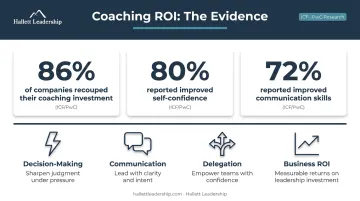
The evidence for coaching outcomes is concrete. The ICF/PwC Global Coaching Client Study found that 86% of companies that calculated ROI made back at least their investment. Separately, 80% of individual clients reported improved self-confidence and 72% reported improved communication skills. A 2023 peer-reviewed meta-analysis of executive coaching studies found an overall positive effect of Hedges' g = 0.43, with the strongest results on observable leadership behaviors.
Key outcomes companies report from structured coaching engagements:
- Faster, more confident decision-making under pressure
- Reduced communication breakdowns across teams and departments
- Stronger delegation, freeing senior leaders for higher-leverage work
- Measurable ROI tied to business goals, not subjective satisfaction scores
In fast-growth companies, those improvements have real dollar value. Poor delegation and communication failures aren't inconveniences — they slow hiring decisions, stall product launches, and cost top performers who leave.
The Leadership Competencies Most Critical During Rapid Scale
Strategic Delegation and Team Empowerment
The ability to delegate strategically — not just push work down, but match tasks to strengths and create genuine accountability — is one of the highest-leverage skills a leader in a scaling company can develop.
Hallett Leadership's coaching methodology builds what it calls collaborative delegation: leaders invite dialogue about projects, express willingness to let employees find their own paths, and coach through challenges by asking questions rather than providing answers. When an employee hits a wall, the instinct is to take back control. The coaching builds a different reflex — asking: What are your options? How are you thinking about this?
That approach, repeated across a management layer, makes the entire organization more capable, not just the individual who was delegated to.
Communication and Culture Under Pressure
Rapid growth strains communication in predictable ways. Information silos form. Cultural norms erode as new people join faster than they can be socialized. Alignment breaks down between teams and geographies.
PMI's research found that organizations risk $75 million of every $1 billion spent on projects due to ineffective communications. At scale, the cost of communication failure isn't a rounding error — it's a strategic liability.
Coaching helps leaders develop intentional communication habits: framing expectations clearly, modeling the culture they're building, and listening in ways that give teams genuine confidence during uncertainty. Hallett Leadership uses a Culture Flywheel framework to sustain alignment across three interdependent dimensions: organizational architecture, management processes, and personal leadership characteristics.
Developing Mid-Level Leaders as a Growth Multiplier
Mid-level managers are both the most overlooked and the highest-impact leadership layer during fast growth. When coaching stops at the C-suite, leadership capability stays concentrated at the top — while the managers who directly supervise most of the workforce carry on without development. Their daily habits shape culture far more than any executive all-hands ever will.
Hallett Leadership's Accelerated Leadership Program was built with this reality in mind. Refined over 15 years running at 20th Century Fox — where 1,100 people completed a rigorous nine-month program — the ALP targets high-potential individuals and middle managers specifically. The curriculum integrates directly into participants' daily work, so leadership development happens during the growth phase, not alongside it.

One participant's assessment: "ALP is one of the most impactful, innovative leadership programs I've seen. Employees that go through the program contribute at a more strategic level, have a greater perspective on contributing across the enterprise and quite simply are just more confident leaders."
Emotional Intelligence and High-Stakes Decision-Making
Building capable mid-level managers addresses the structural side of scale. The personal side is harder to fix — and just as consequential. Fast growth compresses timelines and amplifies pressure, and that environment surfaces a leader's emotional defaults: reactive behavior, avoidance of hard conversations, poor listening when the stakes are highest.
Hallett Leadership builds emotional intelligence through a structured approach: leaders identify their affirmations (who they intend to be as a leader), practice the STOP–LOOK–CHOOSE sequence in real situations, and receive feedback from peers about blind spots they can't see themselves.
The coaching relationship itself is designed to interrupt those defaults. As Hallett Leadership describes it: "Coaching IS interruption" — deliberately breaking automated patterns so leaders can see their own blind spots before those blind spots cost them a key player or a critical decision.
How to Choose the Right Leadership Coach for a Fast-Growth Business
Not every coaching credential translates to fast-growth context competence. Here's what actually matters when evaluating coaches and programs:
- Scaling experience, not just executive tenure. Fast-growth environments have specific dynamics — speed, ambiguity, role expansion, culture preservation under pressure — that require a coach who has navigated them firsthand. Dean Hallett's work at 20th Century Fox and Disney involved exactly these conditions: no formal leadership infrastructure, rapid cultural change, and building alignment across fragmented divisions at scale.
- A methodology tied to measurable outcomes. Ask coaches directly how their work connects to retention, team performance, and decision-making quality. Vague answers about personal growth are a warning sign. Hallett Leadership's Discovery Model, for instance, links inside-out behavioral development to tangible organizational results.
- Coaching embedded in the work, not scheduled around it. The best coaching relationships don't live in a monthly call disconnected from daily business reality. Look for coaches who are proactive, available between sessions, and structure engagements around the leader's actual live challenges — not a fixed curriculum.
- Chemistry beyond credentials. A coach who challenges your assumptions respectfully, holds accountability without judgment, and understands your industry context will outperform a more credentialed coach who doesn't connect with how you think.
How to Maximize the ROI of Your Leadership Coaching Investment
Start Before the Crisis
Most fast-growth companies engage coaches reactively — after a key leader burns out, after team conflict escalates, or after attrition spikes. The best returns come from the opposite approach: coaching leaders while growth is happening, building capacity before gaps become costly.
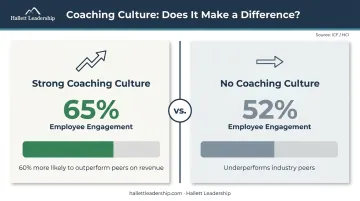
ICF/HCI research found that organizations with strong coaching cultures reported 65% employee engagement compared to 52% at organizations without. They were also 60% more likely to outperform their industry peers on revenue — a gap that reflects years of consistent, proactive investment, not a single program.
Integrate Coaching into Real Work
The highest-impact coaching sessions don't stay theoretical. Leaders bring live challenges into the room — real decisions, real team friction, real problems happening that week. Frameworks get tested on work in progress, not hypothetical scenarios.
Hallett Leadership builds this into its program design: the Accelerated Leadership Program integrates knowledge into daily work activities, so leaders practice during the growth phase, not after it ends.
Build a Coaching Culture
The most durable ROI from leadership coaching comes when executives model coaching behaviors with their own teams. That shift looks like:
- Asking questions instead of issuing answers
- Giving developmental feedback, not just performance directives
- Creating psychological safety so teams surface problems early
The result: leadership capacity grows across the organization, not just among the individuals formally enrolled. One program reaches far beyond its original participants.
Hallett Leadership designs for this directly — executives become better coaches themselves by practicing the same methods they experience, carrying that impact from sessions into their teams' daily work.
Frequently Asked Questions
What are the best strategies for a leader of a fast-growing company?
Focus on mastering delegation, investing in mid-level management development, maintaining clear communication as headcount grows, and beginning leadership development proactively — before visible gaps emerge. The leaders who scale best are the ones who build the leadership capacity around them rather than trying to carry more themselves.
What are the 5 C's of leadership?
The 5 C's are commonly referenced as Clarity, Communication, Collaboration, Commitment, and Coaching, though variations exist across frameworks. Each becomes a pressure point in fast-growth environments, where clarity erodes, silos form, and coaching tends to get deprioritized exactly when it matters most.
What is the 80/20 rule in coaching?
In coaching practice, the 80/20 principle typically means the coach speaks roughly 20% of the time while the client speaks 80%. The emphasis is on the leader's own reflection, problem-solving, and self-discovery — not on the coach delivering answers. This is what makes coaching different from consulting.
How is leadership coaching different from management training?
Management training delivers knowledge and frameworks in a structured, often one-time format. Coaching is an ongoing, personalized process focused on sustained behavioral change, accountability, and direct application to the leader's real-world challenges — changing not just what you know, but how you lead.
When should a fast-growth company invest in leadership coaching?
Ideally, when growth begins accelerating — not after visible failures, burnout, or attrition signal that development is overdue. Coaching during growth builds the leadership capacity to handle the next stage. Coaching after a crisis is damage control.
How long does leadership coaching typically take to show results?
Some behavioral shifts are observable within weeks, but most substantive programs run three to six months or longer. Duration matters less than the quality of engagement: goal clarity, consistent feedback loops, and behavioral accountability drive results more than hours logged.