

Introduction
Every senior leader knows the moment: a high-stakes decision lands on your desk, the team is waiting, and the path forward isn't obvious. The pressure is real — and according to McKinsey research, managers spend 37% of their time on decisions, yet 58% of that time is used ineffectively. For a typical Fortune 500 company, that translates to more than 530,000 lost working days annually.
Most executives aren't short on intelligence or experience. What's missing is a repeatable process for high-stakes choices. Without one, leaders default to instinct — and instinct alone isn't a reliable system at the executive level.
This article walks through a 3-step framework for executive decision-making: clarify the problem, gather the right information and people, then decide with conviction. Each step is grounded in research and designed to hold up under the ambiguity that comes with senior-level responsibility.
Key Takeaways
- Executive decision-making is a learnable, structured skill — not a talent reserved for a few naturally gifted leaders.
- The 3 steps: Clarify the Problem, Gather the Right Information and People, Decide with Conviction.
- Cognitive biases undermine even experienced executives; recognizing the most common ones is essential to better decisions.
- Involving the right stakeholders early improves both decision quality and execution buy-in.
- Reviewing major decisions honestly afterward builds sharper judgment with each cycle.
What Is Executive Decision Making?
Executive decision-making is the structured process by which senior leaders evaluate complex, high-stakes options that shape an organization's strategic direction. That separates it from the operational decisions managers handle every day.
McKinsey distinguishes three organizational decision types:
- Big-bet decisions — alter the company's trajectory; made infrequently but carry outsized consequences
- Cross-cutting decisions — span multiple functions and business units, requiring coordinated input
- Delegated decisions — frequent and narrower in scope; handled without senior escalation by design
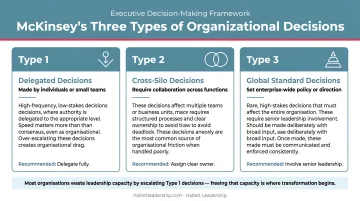
Executive decisions fall into the first two categories. What sets them apart:
- Broader organizational impact across multiple departments or markets
- Longer time horizons, often with effects felt over years
- Multiple stakeholders with competing interests
- Higher cost of being wrong — or being too slow
Those characteristics show up clearly in practice. Entering a new market, restructuring a division, pursuing a merger, reallocating significant capital — these are executive decisions. Scheduling, vendor selection, and task delegation are legitimate management work, but they belong in a different category.
The distinction matters because conflating the two leads to one of the most common executive pitfalls: applying heavy analytical process to decisions that don't need it, while under-processing the ones that do.
Step 1: Clarify the Problem and Define the Objective
This is the step most executives skip — and it's the most expensive mistake in strategic decision-making.
A survey of 106 C-suite executives across 91 companies in 17 countries found that 85% agreed their organizations were bad at problem diagnosis, and 87% said this flaw carried significant costs. Jumping to solutions before fully understanding the problem doesn't save time — it wastes it.
Distinguish the Problem from the Symptom
Most presenting issues are symptoms. Declining revenue, high turnover, missed targets: these are signals pointing to an underlying cause. Before evaluating options, ask "why" at each step until you reach the root issue.
The ASQ's Five Whys method formalizes this — push the inquiry deeper at each answer until the actual driver becomes clear.
A market share problem might look like a pricing issue on the surface. Ask why five times and you might discover it's actually a product positioning problem — or a sales team structure problem. The solution looks completely different depending on which answer is true.
Define What a Good Outcome Looks Like
Before analyzing options, write down what success actually means for this specific decision. What gets measured? What changes? What remains unchanged? Without this definition, even rigorous analysis leads to misaligned execution — teams optimize for different things because no one agreed on the target.
Apply the Reversibility Test
Jeff Bezos formalized this distinction in Amazon's 2015 shareholder letter: Type 1 decisions are consequential and irreversible — one-way doors. Type 2 decisions are changeable and reversible — two-way doors. Bezos argued that Type 2 decisions can and should be made quickly by high-judgment individuals, while Type 1 decisions warrant deliberate, methodical process.
Calibrating your process depth to reversibility is itself an executive skill — and it connects directly to a deeper question: what values are actually driving this choice?
Ground the Decision in Values and Vision
The best executive decisions connect back to organizational values and long-term vision. At Hallett Leadership, the coaching process begins with establishing a clear "North Star" vision before any strategic goal-setting — because decisions made from this foundation are executed with more consistency and commitment across the whole team. When leaders can articulate why a decision fits who the organization is, teams align faster and execution stalls less.
Step 2: Gather the Right Information and Involve the Right People
Once the problem is defined clearly, the next challenge is knowing when you have enough information to act — and resisting the urge to keep gathering more.
Use the 40/70 Rule
General Colin Powell's decision-making principle: act when you have between 40% and 70% of the information you need. Below 40% is guessing. Above 70% is stalling — and stalling has its own cost. The goal isn't certainty; it's informed confidence.
This principle directly counters analysis paralysis, which is one of the most expensive hidden risks in executive leadership (more on that in the pitfalls section).
Match Data Type to Decision Type
Not all data is equally relevant to every decision. Focus your information-gathering on the categories that actually matter for the decision at hand:
- Financial metrics — impact on margins, capital requirements, ROI projections
- Market signals — competitive dynamics, customer behavior, demand trends
- Operational constraints — capacity, capability, timeline feasibility
- Stakeholder impact — who is affected, how, and what their concerns are
Define what information would actually change your answer, then go get that. Pulling in everything available creates noise, not clarity.
Involve the Right People — Not Everyone
Broad consensus-seeking wastes time and diffuses accountability. But involving the right stakeholders early creates two real advantages: better information and organizational buy-in before the decision is announced.
PMI research notes that stakeholder influence is most potent early in a project, when flexibility is high and the cost of changes is low. Executives who consult affected parties after deciding — rather than before — consistently face more implementation friction than those who build alignment into the process.
Counter the Three Most Dangerous Cognitive Biases
Biases shape which information feels relevant and which options seem viable — often without any conscious awareness. The three most common in executive decision-making:
- Confirmation bias — Counter it by assigning someone to argue the opposing case and actively testing alternative explanations.
- Anchoring bias — Counter it by reviewing data from multiple sources and deliberately approaching the problem from different angles before locking in assumptions.
- Overconfidence bias — Counter it by examining how similar decisions played out in comparable organizations — what Kahneman and Lovallo call the "outside view."
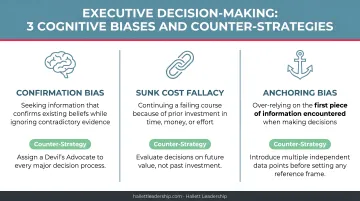
Recognizing bias patterns in real time is a skill, not a trait — and it develops through practice and honest feedback. Hallett Leadership's one-on-one executive coaching builds the self-awareness habits that help senior leaders catch their own blind spots, while creating the psychological safety on their teams that generates genuine input rather than polished agreement.
Step 3: Decide with Conviction and Commit to the Outcome
Once you've defined the problem and gathered enough information, hesitation becomes a problem in itself.
McKinsey's organizational health research found that organizations emphasizing decisive leadership are 4.2 times more likely to be healthy and 2.5 times more likely to use leadership effectively to shape people's behavior. Decisiveness isn't just a personal trait. It shapes how teams move, how culture forms, and how quickly organizations recover from uncertainty.
Communicate the Decision Clearly and Purposefully
How a decision gets announced matters as much as the decision itself. Effective communication includes:
- The decision and its rationale
- The trade-offs that were considered (and why this path was chosen)
- What changes immediately and what doesn't
- How progress will be measured
Acknowledging trade-offs builds credibility. Teams trust leaders who show they thought through the costs, not just the benefits.
Assign Clear Ownership and a Deadline
Decisions without a single owner and a specific "by when" tend to stall, get relitigated, or fail quietly in execution. Naming one owner and one deadline turns a decision into a commitment.
Build in a Post-Decision Review
Great executives don't just make decisions — they learn from them. Set a specific review point before execution begins: a quarterly check-in, a project milestone, or a defined metric threshold. The goal isn't to second-guess prematurely; it's to catch drift and course-correct without abandoning the decision entirely.
Research by Tannenbaum and Cerasoli across 46 samples found that structured debriefs improved team and individual effectiveness with an average effect size of d = .67 — a result consistent across industries and team types. Structured post-decision reviews operate the same way: they convert experience into usable insight.
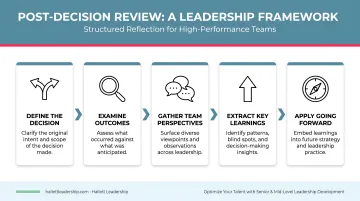
Each decision reviewed honestly becomes a source of pattern recognition. Over time, that reflection compounds — producing the kind of judgment that separates executives who consistently get it right from those who simply get lucky.
Common Decision-Making Pitfalls Executives Must Avoid
Even with a solid framework, three pitfalls derail executive decisions with reliable consistency.
Analysis paralysis is decision avoidance in disguise. McKinsey's research places the cost of ineffective decision-making time at roughly $250 million in wasted labor annually for a typical Fortune 500 company. The 40/70 rule exists precisely to give leaders a principled off-ramp from endless analysis.
Skipping stakeholder alignment turns implementation into a battle. The objections, workarounds, and quiet non-compliance that surface after a decision was announced were often visible beforehand to someone who simply wasn't asked.
Applying the same process to every decision exhausts teams unnecessarily. Not every high-impact choice deserves a six-week deliberation cycle — treating reversible decisions with the same weight as irreversible ones trains people to see the process as bureaucratic overhead. Matching process depth to reversibility, urgency, and stakes is where executive judgment actually shows up.
Frequently Asked Questions
What does executive decision-making mean?
Executive decision-making is the structured process senior leaders use to evaluate complex, high-stakes choices that shape organizational direction. Unlike routine operational decisions — which managers can typically handle independently — executive decisions involve broader impact, longer time horizons, and higher consequences for error or delay.
What are the 3 C's of decision-making?
The 3 C's framework generally refers to Clarify, Consider, and Choose — defining the problem clearly, evaluating available options, and committing to a course of action. It's a useful shorthand for building a systematic approach to decisions at any level of an organization.
What is the 40/70 rule in decision-making?
Attributed to General Colin Powell, the rule advises acting once you have between 40% and 70% of the information you need. Less than 40% is guessing; more than 70% risks stalling. It helps executives balance speed with thoughtfulness without waiting for certainty that rarely arrives.
What is the difference between executive decisions and daily operational decisions?
Executive decisions carry longer time horizons, broader organizational impact, and higher stakes — think market expansion, restructuring, or major capital allocation. Daily operational decisions like scheduling, task assignment, and vendor management stay at the management level and rarely require senior escalation.
How can executive coaching improve decision-making skills?
Working with an executive coach helps leaders identify cognitive biases, build self-awareness, and develop the communication habits needed to gather honest input from their teams. Hallett Leadership's one-on-one coaching works directly on the steady judgment and clear thinking that high-stakes decisions demand.
What are the most common cognitive biases that affect executive decisions?
Confirmation bias, overconfidence bias, and anchoring bias appear most frequently in research on executive decision-making. Each operates below conscious awareness — which is why awareness of these patterns is the essential first step toward countering them in practice.