Introduction
Organizational change used to be a periodic event—a restructuring here, a system migration there. That era is over. According to the Evanta/Gartner C-Suite Community Pulse on Change Management, 80% of C-level executives report their organization is currently engaged in change management, with another 8% planning future initiatives. That's nearly every major organization navigating change right now, simultaneously.
The problem is that most change efforts don't hold. Fewer than one in eight transformations yield lasting results, according to HBR's 2024 research on business transformation. The gap between launching a change initiative and actually embedding it into the organization is where most executives lose ground.
Closing that gap requires more than a well-crafted rollout plan. It demands clear executive ownership, the right cultural conditions, and a disciplined approach to making change last.
Key Takeaways
- 80% of C-level executives are currently engaged in change management, making it a top-level strategic responsibility
- Executive sponsorship is the single biggest predictor of change success, cited by 39% of C-suite leaders in the Evanta/Gartner survey
- Change fatigue is a structural threat, not just a morale issue—executives must actively manage both the pace and volume of change
- Building a change-ready culture starts with behavioral modeling at the top
Why Change Management Demands C-Suite Attention
The Sponsorship Gap Is Costing Organizations
The Evanta/Gartner survey of 825 C-level executives is unambiguous: 39% of respondents name executive leadership or sponsorship as the single biggest factor in change success—ahead of communication (22%), employee engagement (17%), and resource investment (16%).
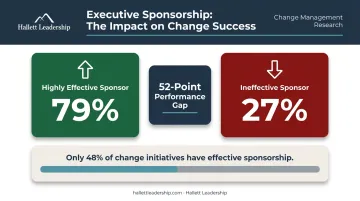
Prosci's research puts numbers to what that gap actually costs. Projects with extremely effective sponsors achieve their objectives 79% of the time. Projects with extremely ineffective sponsors? Just 27%. A 52-point performance gap separates effective sponsorship from ineffective—enough to determine whether an initiative succeeds or quietly stalls.
Yet only 48% of participants in Prosci's Best Practices research reported having effective or very effective sponsors. That means in roughly half of all change initiatives, the single most important success factor is already compromised before execution begins.
What Happens When Executives Step Back
When C-suite leaders treat change as something to authorize rather than lead, the effects follow a familiar pattern:
- Change ownership diffuses across management layers
- Middle managers receive mixed signals and conflicting priorities
- Urgency fades as employees read executive distance as a signal that the initiative isn't critical
- Accountability disappears without visible reinforcement from the top
The challenge is compounded by the volume of simultaneous change. Most organizations are running several major initiatives at once: digital transformation, AI integration, structural reorganization, and more. Prosci defines this condition as change saturation: when the cumulative volume of change exceeds an organization's capacity to absorb it. Without active portfolio management from the C-suite, saturation becomes the default state.
The C-Suite's Core Responsibilities in Change Management
The Evanta/Gartner data provides a clear breakdown of how C-level executives report their actual involvement:
| Responsibility | % of C-Suite Executives |
|---|---|
| Providing strategic direction | 74% |
| Engaging with stakeholders | 69% |
| Leading and championing initiatives | 61% |
| Minimal involvement | <10% |
These numbers confirm that most executives are engaged—but engagement and effectiveness are not the same thing.
Active Sponsorship vs. Passive Endorsement
Signing off on a change plan is not sponsorship. Active sponsorship means:
- Being visibly present at key milestones and communications
- Regularly articulating why the change matters, not just what is changing
- Coaching the leaders beneath them through resistance and uncertainty
- Holding people accountable when behaviors don't align with stated priorities
The distinction matters because passive endorsement creates permission without momentum. Employees interpret executive distance as ambivalence, and that ambivalence moves through an organization faster than any formal communication.
Managing the Change Portfolio
Most executives focus on individual initiatives. Fewer manage the totality of change across the organization. This is a critical gap.
Before launching a new initiative, C-suite leaders should assess:
- Current organizational capacity for additional change
- Which existing initiatives are competing for the same management attention and resources
- Whether the sequencing of changes creates compounding stress on any particular function or team
Prosci found that the percentage of participants actively managing a portfolio of changes grew from 38% to 43%: progress, but still a minority practice. That gap in portfolio oversight is precisely where cross-functional misalignment begins.
Cross-Functional Alignment
HBR research reports that 67% of collaboration failures stem from organizational silos. During transformation, those silos become fault lines. Technology and operations misalign. Finance and marketing pursue contradictory timelines.
C-suite executives need structured dialogue with their peers (not just about their own initiatives, but about how each function's change priorities intersect with others). Without that coordination, separate functions end up pulling transformation in opposite directions.
Communication Is a Continuous Obligation
Under-communication is one of the most reliable predictors of change failure. Executives need to repeat the why behind change consistently — across channels, formats, and stakeholder groups. That means tailoring the message:
- Board and investors: Frame change around risk mitigation, competitive position, and financial outcomes
- Senior leaders: Emphasize strategic alignment and their role in driving adoption
- Frontline teams: Connect the change to day-to-day work and what it means for them personally
The rationale that lands in a board room will fall flat on a factory floor. Effective executive communicators don't just repeat the message — they translate it.
Key Change Management Principles for Executive Leaders
Principle 1 — Align Change to Strategic Vision First
Change initiatives without a clear line to business strategy read as operational disruption. Before launching anything significant, executives must be able to answer plainly: How does this initiative advance our strategic objectives? If that answer isn't crisp, the initiative isn't ready.
Principle 2 — Sequence and Prioritize Deliberately
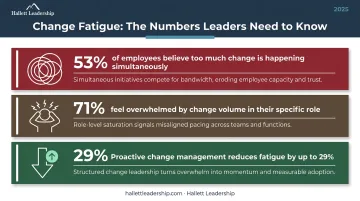
Gartner defines change fatigue as negative employee responses—apathy, burnout, frustration—that harm organizational outcomes. The data on prevalence is striking: 53% of employees believe too much change is happening simultaneously, and 71% feel overwhelmed by the volume of change in their specific roles.
Executives must make deliberate decisions about which changes get priority, in what order, and at what pace. Proactive change management can reduce employee fatigue by up to 29%. That reduction comes not from doing less, but from sequencing changes in a way people can actually absorb.
Principle 3 — Model the Behaviors You Expect
McKinsey found that transformations are 5.3 times more likely to succeed when senior leaders actively role model the behavior changes they're asking of others. This isn't a soft principle. It's the mechanism by which culture actually shifts.
Hallett Leadership's BE-DO-HAVE model captures this precisely. Rather than waiting to have authority or results before behaving like a confident, adaptive leader, executives are asked to start with who they need to be. The sequence (BE, then DO, then HAVE) inverts the conventional approach. It's the foundation of what Dean Hallett calls inside-out leadership: you achieve it only when you embody it yourself.
Skipping their development doesn't just slow change — it creates the primary failure point.
Hallett Leadership's Accelerated Leadership Program addresses this directly. The nine-month program is built around developing mid-level leaders' capacity to translate C-suite strategy into daily execution, with a focus on horizontal communication, cross-functional collaboration, and the shift from individual performance to leading through teams.
Principle 5 — Measure What's Changing
Prosci's metrics research is decisive: among organizations that measured compliance with change, 76% met or exceeded their objectives. Among those that didn't measure, only 24% did. The gap between those two numbers is the difference between managing change and hoping it happens.
Executives should push for metrics that go beyond operational outputs: adoption rates, engagement indicators, and business performance outcomes. Measurement also enables course correction before failures compound.
Overcoming the Biggest Change Management Challenges
Resistance to Change
Resistance is rarely irrational. Prosci identifies the core drivers as fear of the unknown, lack of clarity about business rationale, and an unanswered what's in it for me question at each level of the organization.
The executive's job is to anticipate these concerns and address them proactively—not to dismiss resistance as noise. Some dissent contains signal worth hearing. Deciding what to manage versus what to incorporate into decision-making is a judgment call that falls squarely to senior leadership.
Effective communication strategies answer the personal-impact question explicitly for every major stakeholder group—before implementation begins. The three most common points of resistance to address upfront:
- Fear of job loss or role disruption
- Uncertainty about new processes or reporting structures
- Skepticism about whether leadership will follow through
Change Fatigue
Gartner's research offers a concrete lever: manager-created psychological safety can reduce change fatigue by up to 46%. This puts pressure back on the C-suite to prepare and support their managers, not just the frontline.
Practical strategies for managing fatigue at the executive level:
- Actively monitor the pace and cumulative volume of change across the organization
- Make sequencing decisions visible and transparent so employees understand why certain things are coming before others
- Acknowledge progress explicitly—teams that don't see their effort recognized lose motivation to sustain it
Lack of Stakeholder Alignment
40% of respondents in Prosci's metrics research identified lack of alignment on goals and objectives as the main reason change success wasn't even defined. You cannot measure progress against a target no one agreed on.
Before large-scale implementation, C-suite executives need to map key stakeholders—board, investors, senior managers, frontline employees—and develop engagement plans tailored to each group. Getting every stakeholder to agree on every decision isn't realistic. What matters is shared clarity on the destination and each group's role in reaching it.
Building a Change-Ready Culture from the Top Down
The most effective organizations don't respond to change—they're structured to absorb it. Prosci's Change Management Maturity Model describes a five-level progression from ad hoc change responses to full organizational competency. Most companies operate at levels two or three. The organizations that reach level five treat change capability the same way they treat financial controls or quality standards: as a structural expectation, not an emergency response.
Gartner research makes the business case plainly. Organizations with above-average change adoption show measurable separation from their peers:
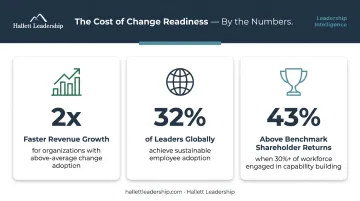
- Companies with above-average adoption grow revenue 2x faster year-over-year than those with below-average adoption
- Only 32% of leaders globally succeed in getting employees to adopt changes in a sustainable way
- McKinsey found that capability-building programs engaging 30%+ of the workforce produced shareholder returns 43% above benchmarks after 18 months
The gap between that 32% and the companies achieving 2x growth is a competitive advantage waiting to be captured.
Culture follows behavior, and behavior at the top must shift first. When C-suite executives visibly work on their own development—through coaching, feedback, and behavioral modeling—they create organizational permission for everyone else to do the same.
This is the core of Hallett Leadership's inside-out approach: sustainable culture change starts with the leader's own transformation, not a mandate issued from above.
The Discovery Model that underpins Hallett Leadership's executive coaching process is built precisely for this. It moves executives from fixed, automatic responses toward deliberate choice—stopping habitual behavior, surveying available options, and choosing the action most aligned with where the organization needs to go. For C-suite leaders navigating complex change, that self-awareness is what separates executives who lead transformation from those who merely announce it.
Frequently Asked Questions
What are the key change management principles C-suite executives should consider?
The most critical principles are: align change to strategic vision before launching, sequence initiatives deliberately to prevent fatigue, model the behaviors you expect from others, invest in middle management as your primary change delivery layer, and measure adoption and compliance consistently. Prosci data shows organizations that measure change compliance meet their objectives at more than three times the rate of those that don't.
What are the responsibilities of C-suite executives in change management?
Core responsibilities include active sponsorship, providing strategic direction, engaging stakeholders at every level, and managing the organization's total change capacity. The Evanta/Gartner survey shows 74% of C-level executives provide strategic direction—but far fewer actively manage the portfolio of simultaneous change initiatives.
How do C-suite executives manage change fatigue in their organizations?
Start by monitoring the cumulative volume and pace of change, then make sequencing decisions explicit and visible to the organization. Gartner research shows proactive change management can reduce fatigue by up to 29%, and manager-created psychological safety can reduce it by up to 46%. Transparency about why certain changes are prioritized over others goes further than most executives expect.
How can executives build employee buy-in during organizational change?
Communicate the why continuously—not just at launch, but throughout the initiative. Address the personal-impact question for each stakeholder group: what does this change mean for their role, their team, their daily work? Involving employees before the plan is finalized increases ownership and reduces resistance more than any announcement can.
What is the role of executive sponsorship in change management success?
Executive sponsorship is the top predictor of change success. Prosci's research shows projects with highly effective sponsors succeed 79% of the time versus 27% for those with ineffective sponsors. Active, visible leadership throughout the initiative—not just a kickoff endorsement—is what keeps change moving through the organization with urgency.