Introduction
Assembling talented people doesn't guarantee a high-performing team. Most leaders learn this firsthand: a room full of skilled individuals can still produce mediocre results when trust is absent, purpose is unclear, or leadership is underdeveloped.
Gallup research across 183,806 business units found that top-quartile engaged teams deliver 23% higher profitability than bottom-quartile units. Talent doesn't close that gap. How teams are led and developed does.
What separates high-performing teams from merely functional ones comes down to intentional practice: psychological safety, shared purpose, mutual accountability, and leaders who prioritize their own development alongside their team's.
This article covers all of it: what defines a genuinely high-performing team, the characteristics that drive sustained performance, why leadership is the critical foundation, and five strategies any leader can apply today.
Key Takeaways
- High-performing teams consistently exceed expectations because of trust, shared accountability, and role clarity — not raw talent alone
- Psychological safety is the single most important driver of team effectiveness, per Google's Project Aristotle
- 70% of variance in team engagement is attributable to management quality (Gallup)
- Leadership development, starting with self-awareness and emotional intelligence, must come before team-building efforts
- Sustaining high performance demands continuous feedback, deliberate development, and leaders who actively coach their teams
What Sets a High-Performing Team Apart?
A high-performing team isn't simply one that meets deadlines. It's a unit that consistently exceeds expectations, surfaces and solves problems before they escalate, and actively improves its own processes over time.
The distinction matters. A functional team completes assigned work. A high-performing team takes ownership of outcomes.
The Business Case
The numbers make this worth prioritizing:
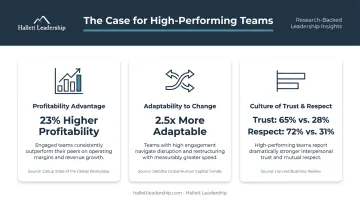
- 23% higher profitability in top-quartile engaged business units vs. bottom-quartile (Gallup Q12 Meta-Analysis)
- Deloitte research found high-performing teams are 2.5x more likely to quickly change direction and support each other during change
- High-performing teams report mutual respect at 72% vs. 31% for other teams, and trust at 65% vs. 28%
What Separates High-Performing from Merely Competent
Four qualities distinguish these teams — and none of them happen by accident:
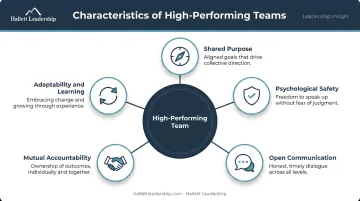
- Psychological safety — members speak up, challenge ideas, and admit mistakes without fear
- Mutual accountability — ownership is shared, not policed from above
- Growth mindset — failure is a data point, not a verdict
- Intrinsic motivation — people care about the work, not just compliance
These qualities are developed intentionally through leadership — and that development requires deliberate structure, not good intentions alone. The question worth asking isn't whether your team has potential. It's whether your leaders are building the conditions for that potential to show up.
The Core Characteristics of High-Performing Teams
Shared Purpose and Goal Clarity
Every member of a high-performing team understands the mission, knows how their role contributes to it, and can connect daily work to broader organizational priorities. McKinsey research found that 70% of employees define their sense of purpose through their work — and those whose purpose is fulfilled report significantly stronger outcomes.
Without that clarity, even talented teams lose direction — and performance suffers before anyone names the problem.
Trust and Psychological Safety
Google's Project Aristotle studied 180 teams and identified psychological safety as the single most important factor in team effectiveness — more important than individual talent or team composition.
Teams with high psychological safety produced measurable results: members were less likely to leave, more likely to leverage diverse ideas, and rated as effective twice as often by executives.
Psychological safety must be modeled from the top. Leaders who punish mistakes or dismiss dissent quietly erode it — and by the time the damage is visible, rebuilding trust takes far longer than protecting it would have.
Open Communication and Feedback
High-performing teams communicate proactively, not reactively. The qualities that distinguish their communication:
- Active listening — genuinely hearing, not just waiting to respond
- Transparent information sharing — no one operates on incomplete data
- Willingness to have difficult conversations — issues surface early, not late
- Two-way feedback — direction doesn't only flow downward
When feedback flows consistently in both directions, it becomes a source of accountability — which is where the next characteristic takes hold.
Defined Roles with Mutual Accountability
Each member knows what they own. More importantly, they trust that their teammates will hold up their end.
Mutual accountability differs fundamentally from top-down performance monitoring. It creates shared ownership — people invest in outcomes because they care about the team, not because someone is watching.
Adaptability and Continuous Learning
High-performing teams treat disruption as information. They reflect on what went wrong, extract what they can use, and adjust.
The LinkedIn Workplace Learning Report found that 68% of employees say learning helps them adapt during change — up from 49% in 2022. Teams embedded in learning cultures don't just survive change; they use it.
Why Leadership Is the Foundation of Team Performance
The Inside-Out Principle
A leader cannot build a high-performing team without first developing themselves. Their self-awareness, emotional habits, communication patterns, and default behaviors set the ceiling for what their team can become.
This is what Hallett Leadership calls the inside-out approach — built around the BE-DO-HAVE model. Rather than working toward outcomes first, leaders begin by defining who they need to be. They develop affirmations that describe their leadership at its best, then bring that version of themselves into difficult conversations, critical decisions, and high-stakes moments.
The result is behavioral change that comes from within — durable because it's rooted in identity, not just circumstance.
The Leader-as-Coach Model
Gallup data shows that 70% of the variance in team engagement is attributable to management. That one statistic reframes what leadership development is actually for.
Leaders who develop coaching skills create environments where team members grow, take ownership, and self-correct. The difference between managing for compliance and coaching for capability:
- Compliance-focused management produces predictable outputs, but those results depend entirely on the manager's presence
- Capability-focused coaching produces people who can solve problems, make decisions, and lead others
Hallett Leadership's Accelerated Leadership Program (ALP) teaches this transition through a nine-month experiential curriculum that integrates directly into participants' daily work. Leaders practice a deliberate pattern: STOP automatic responses, LOOK at available options, and CHOOSE intentionally. Over time, that habit replaces reactive management with real coaching capability.
Emotional Intelligence as a Leadership Prerequisite
A leader's emotional intelligence shapes everything their team experiences: how safe people feel to speak up, how conflicts resolve, how trust builds or erodes.
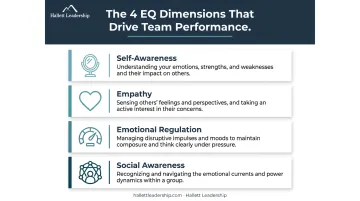
The EQ dimensions that matter most for team performance:
- Self-awareness — recognizing your own patterns before they become everyone else's problem
- Empathy — understanding what team members actually experience, not what you assume they do
- Emotional regulation — choosing how to respond under pressure rather than reacting
- Social awareness — reading group dynamics to know when to push, when to listen, and when to step back
Hallett Leadership develops these through the Discovery Model — a process that helps leaders identify blind spots, surface unconscious behaviors, and build new habits through behavioral science and structured experiential exercises. Tools like DISC assessments help leaders recognize patterns in themselves and others, creating the self-knowledge that underpins genuine EQ.
When leaders build this foundation, the effect radiates outward — most visibly through the managers closest to their teams every day.
Middle Management as the Linchpin
Mid-level managers have a disproportionate impact on day-to-day team performance. They translate strategy into action, model culture in real time, and represent the primary relationship for most team members.
Hallett Leadership's work consistently shows that middle management is where organizations get the highest ROI on development investment. When Dean Hallett built the leadership program at 20th Century Fox, focusing on mid-level leaders produced results that cascaded across the entire organization: 1,100 people trained over 15 years, with measurable gains in collaboration, innovation, and retention.
Neglecting middle management development while investing only at the top is one of the most common and costly leadership mistakes organizations make.
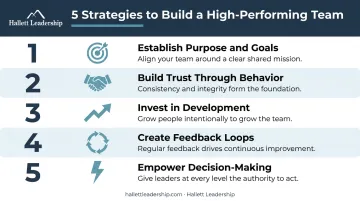
Five Strategies to Build a High-Performing Team
1. Establish Clarity of Purpose and Aligned Goals
Purpose co-created with a team generates commitment. Purpose handed down from above generates compliance.
Practical steps:
- Facilitate a session where the team defines its own mission in relation to organizational priorities
- Translate high-level goals into individual priorities that every member can articulate
- Revisit goals regularly — static goals create static teams
Goal clarity is one of Gallup's Q12 engagement predictors. "I know what is expected of me at work" is simple — and consistently underdelivered.
2. Build Trust Through Consistent, Courageous Behavior
Trust isn't declared. It's accumulated through action over time.
The behaviors that build it:
- Following through on commitments, every time
- Acknowledging uncertainty rather than projecting false confidence
- Demonstrating vulnerability — saying "I don't know, what do you think?" is a leadership behavior, not a weakness
- Addressing conflict directly rather than allowing it to fester
As Brené Brown defines it, vulnerability is "the courage to show up and be seen when we have no control over the outcome." At Hallett Leadership, that principle shapes how leaders are developed — because leaders who model it create permission for their teams to do the same.
3. Invest in Individual and Team Development
Development isn't a benefit — it's a retention and performance strategy. LinkedIn's 2025 Workplace Learning Report identified learning opportunities as the number one retention strategy, with 88% of organizations expressing concern about keeping top talent.
What effective development looks like in practice:
- Regular coaching conversations, not just annual reviews
- Stretch assignments that push capability
- Peer learning structures where cohort members challenge each other
- Formalized assessment tools (DISC, Myers-Briggs, and related assessments) that build self-knowledge
Despite 71% of organizations offering leadership training, only 15% of employees say their manager helped them build a career plan in the past six months. The gap between what organizations offer and what individuals actually receive is where development efforts fail.
4. Create Feedback Loops and Recognition Rituals
Structured feedback and consistent recognition aren't nice-to-haves — they're the mechanics that keep high-performing teams running.
Feedback practices that work:
- Regular one-on-ones with a consistent format
- Peer feedback exchanges using structured sentence stems (e.g., "What I admire about how you lead is..." / "What would make you even more effective is...")
- Team retrospectives after significant projects
On recognition: Only one in three US workers strongly agrees they received recognition for good work in the past seven days (Gallup). And the consequences are real — well-recognized employees are 45% less likely to turn over within two years.
Recognition doesn't require ceremony. Consistent, specific acknowledgment of desired behaviors is often more powerful than milestone awards.
5. Empower Decision-Making and Encourage Risk-Taking
McKinsey research found that organizations whose leaders empower employees through coaching and safe-to-fail environments are 3.9x more likely to be top performers. Yet in a separate survey, only 20% of organizations reported excelling at decision-making.
The gap is authority without structure. Leaders can close it by:
- Clarifying who owns which decisions — explicitly, not by assumption
- Removing punishment for thoughtful failures
- Celebrating creative attempts even when they fall short
- Progressively expanding autonomy as capability is demonstrated
The teams that move fastest are usually the ones whose leaders have been most deliberate about where authority actually lives.
How to Sustain High Performance Over Time
High-performing teams don't stay that way automatically. Three specific threats undermine sustained performance:
The complacency trap. When goals stop challenging, norms go unexamined, and development plateaus, teams coast. Leaders must continuously revisit purpose, refresh goals, and recalibrate expectations — not just when performance drops.
Single-point dependency is equally dangerous. Teams that rely entirely on one strong leader are fragile. Building leadership capacity at every level — creating informal leaders who carry culture and capability forward — protects performance through personnel changes.
Internal blind spots are the hardest to catch precisely because they're invisible from the inside. Organizations often lack the external perspective to see what they've normalized. Honest, independent feedback is what separates genuine progress from managed decline.
That external perspective is exactly what structured development partnerships provide — something internal programs rarely replicate. Dean Hallett spent 15 years building and running the Accelerated Leadership Program at 20th Century Fox — not as a consultant, but embedded in the organization, producing results across 1,100 leaders. That sustained, inside-out approach creates the accountability and honest insight that internal efforts alone rarely achieve.
Frequently Asked Questions
What is a high-performing team?
A high-performing team is a group that consistently exceeds expectations by channeling diverse strengths toward shared goals, sustained by trust, mutual accountability, and a commitment to continuous improvement. What separates it from a functional team is that members actively raise the standard, not simply meet it.
What are the most important characteristics of a high-performing team?
The five core characteristics are shared purpose, psychological safety, open communication, mutual accountability, and adaptability. Each one requires deliberate cultivation through consistent leadership behavior and structured team practice.
What is the biggest obstacle to building a high-performing team?
Underdeveloped leadership is the most common barrier, specifically leaders who prioritize structures and processes before developing their own self-awareness, emotional intelligence, and coaching skills. The team reflects its leadership, including its limitations.
How does leadership development improve team performance?
Leaders who invest in their own growth, particularly in emotional intelligence, coaching, and clear communication, create the psychological safety that allows teams to operate at full capacity. Gallup's data is direct: 70% of the variance in team engagement traces back to the manager.
How long does it take to build a high-performing team?
There's no fixed timeline, but teams with strong leadership, clear goals, and consistent development investment typically show meaningful progress within months. Sustaining that performance is a different challenge. It requires ongoing effort, regular feedback loops, and leadership that continues to develop alongside the team.
What is the role of middle managers in building high-performing teams?
Mid-level managers have the greatest day-to-day influence on team culture and performance. They translate strategy into action and model culture in real time. Developing them is one of the highest-return investments an organization can make, yet it remains consistently underprioritized.