Self-employed workers average 49 hours per week compared to 43 hours for full-time employees — and that extra time rarely goes toward developing leadership capability. It goes toward staying afloat.
Strong leadership doesn't develop by default. This guide covers what leadership coaching is, why it matters specifically for small business owners, the core skills it builds, how to choose the right coach, and what to realistically expect from the process.
Key Takeaways
- Leadership coaching is a personalized development process focused on how you lead, not just what your business produces
- Develops core skills: communication, strategic thinking, emotional intelligence, and delegation
- Gallup research shows managers account for 70% of variance in team engagement — making owner development directly tied to team performance
- When selecting a coach, prioritize proven methodology and measurable outcomes over credentials alone
- Expect early clarity gains within the first few sessions — lasting behavioral change takes 6–12 months
What Is Leadership Coaching for Small Business Owners?
Leadership coaching is a structured, one-on-one development process focused on the person leading the business — not the business itself. Business coaching targets operations, growth strategy, financial planning, and systems. Leadership coaching works on something different: how you think, communicate, decide, and inspire the people around you.
Why the Small Business Context Is Different
In a large organization, leadership gaps get absorbed. There are management layers, HR teams, and institutional structures that buffer the impact of any one person's blind spots.
In a small business, none of that exists. Every leadership behavior is amplified directly:
- A communication breakdown doesn't get mediated — it damages a relationship or derails a project
- A culture problem doesn't stay in one department — it spreads through the whole team
- A blind spot in the owner doesn't get coached by a manager above them — it just persists
Hallett Leadership's approach addresses this directly. The BE-DO-HAVE model starts by defining who a leader needs to be — their values, communication style, self-awareness — before addressing what they do or have. That sequence matters because behavior built on identity sticks, while behavior built on tactics doesn't.
Why Small Business Owners Need Leadership Coaching
The Hidden Leadership Pressures of Running a Small Business
Most small business owners don't have a peer who fully understands their situation. There's no boss to give feedback, no leadership team to pressure-test decisions, and no HR partner to flag cultural problems. That isolation is the norm, not the exception.
At the same time, the owner typically covers operations, sales, customer service, and hiring — often simultaneously. Wearing all those hats creates leadership gaps that go unaddressed for months or years. Without external support, those gaps steadily erode team trust, culture, and the ability to grow.
A 2022 survey of 1,000 small business owners reported by Forbes found 42% had experienced burnout in the past month. Burnout doesn't just affect the owner — it shapes how they show up for their team every day.
Coaching Converts Leadership Into a Competitive Advantage
Small businesses can't out-resource larger competitors. But they can out-lead them.
When the owner develops stronger leadership skills, the effect cascades through the entire organization. Gallup's research on manager quality found clear differences between top- and bottom-quartile managers:
- Employee engagement: 50% vs. 36%
- 2-year retention intent: 54% vs. 39%
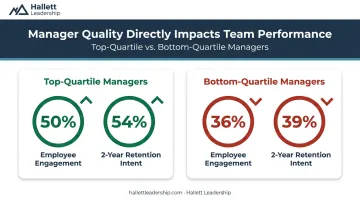
For a small business, that gap isn't just a performance statistic. It's the difference between retaining your best people and replacing them — at a cost that Gallup estimates can reach 80–200% of the departing employee's salary.
That replacement cost is also an argument for timing. Owners who invest in coaching before a crisis hits build the leadership muscle they need before they're forced to use it — when there's still room to grow deliberately rather than reactively.
Core Leadership Skills That Coaching Develops
Communication and Team Alignment
Poor communication in a small business doesn't stay contained. One unclear expectation, one avoided conversation, one piece of feedback poorly delivered — and suddenly a key employee is disengaged or a project is off the rails.
Coaching sharpens how owners communicate expectations, deliver feedback, and create psychological safety. Hallett Leadership's approach specifically addresses transparency and accountability as foundational to team alignment — helping leaders model the behavior they want the culture to reflect.
Strategic Thinking and Decision-Making
Most small business owners spend their days reacting. The urgent crowds out the important, and long-term planning rarely happens because there's always something on fire.
Coaching builds frameworks for stepping back. Leaders learn to:
- Assess risk without defaulting to gut reaction
- Weigh options under uncertainty rather than delay decisions
- Distinguish between what needs their attention and what can be delegated or deprioritized
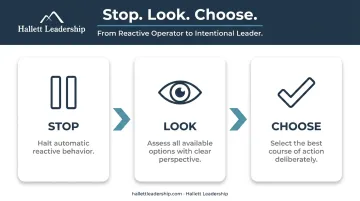
The Discovery Model uses a Stop-Look-Choose framework: stop automatic behavior, look at all available options, then choose the best course of action deliberately. Applied consistently, this shifts owners from reactive operators to intentional leaders.
Emotional Intelligence and Self-Awareness
HBR research found that roughly 95% of people believe they're self-aware, but only 10–15% actually are. The gap between perceived and actual self-awareness is one of the most consistent leadership liabilities — and it's invisible to the person who has it.
Coaching surfaces blind spots through structured feedback, behavioral assessments, and guided reflection. Hallett Leadership uses tools like DISC, the Enneagram, and 16 Types to give leaders a clear picture of how their style affects their team — and where it creates friction they may not recognize.
A cross-cultural meta-analysis found that leader emotional intelligence directly predicts subordinate task performance and organizational citizenship behavior. For a small business where every team member counts, EQ isn't a soft skill — it's a performance driver.
Delegation and People Development
The instinct to just handle it yourself is understandable — it's faster, it's familiar, and handing off work feels risky. But that habit caps the business's growth.
Gallup's research on Inc. 500 CEOs found that those with high delegation talent generated 33% greater revenue than those with low delegation talent.
Hallett Leadership's coaching addresses delegation through collaborative delegating — not just handing off tasks, but:
- Inviting dialogue to align on goals before work begins
- Asking questions ("What are your options? How are you thinking about it?") rather than prescribing solutions
- Allowing employees to find their own path, while staying available for redirection
Over time, this approach builds capable contributors and reduces the business's dependency on the owner.
How to Choose the Right Leadership Coach
Not all coaching is equal. Here's what to look for:
- Customized approach: Good coaching adapts to your leadership stage, your team's dynamics, and your industry's specific pressures — not a one-size program recycled across every client.
- Proven methodology: Coaches who combine behavioral science with experiential, applied learning produce lasting behavioral change. Dean Hallett's Discovery Model, developed over 15 years at 20th Century Fox, integrates all three: behavioral science, experiential exercises, and one-on-one coaching.
- Measurable outcomes: The best engagements connect leadership development to tangible results — improved team performance, stronger retention, better communication. Hallett Leadership ties progress to weekly goal-setting, established checkpoints, and observable behavioral change, not just self-reported satisfaction.
- Real-world experience: Coaches who have held senior leadership roles bring practical credibility that credentials alone can't match. Dean Hallett's background as CFO of The Walt Disney Studios and architect of Fox's leadership programs directly informs how he coaches.
What to Expect From the Leadership Coaching Process
Timeline and Early Wins
Meaningful leadership development isn't a quick fix. ICF data shows the average coaching engagement runs roughly 12–13 months, with 70% of clients reporting improved work performance and 72% reporting improved communication skills.
Early sessions typically produce faster gains in clarity and self-awareness — owners often describe seeing their own patterns more clearly within the first few sessions. Deeper behavioral change, the kind that reshapes how a team operates, takes longer: usually 6–12 months of consistent work.
How the Engagement Progresses
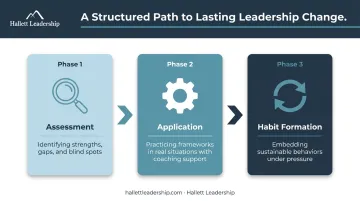
A well-structured coaching engagement moves through distinct phases:
- Assessment phase — Identifying leadership strengths, gaps, and blind spots using behavioral tools and honest conversation
- Application phase — Practicing new frameworks in real situations, with coaching support between sessions
- Habit formation phase — Embedding sustainable behaviors so progress doesn't regress when pressure spikes
At Hallett Leadership, sessions typically run weekly or bi-weekly via video or in person, with additional touchpoints via email for accountability between sessions.
The Owner's Role
Coaching works in direct proportion to what the owner puts in. The process is collaborative, not passive. Owners who consistently see the strongest results tend to share a few common traits:
- Apply insights between sessions rather than waiting for the next meeting
- Stay open to candid feedback, even when it's uncomfortable
- Treat development as an ongoing practice, not a one-time event
That last point matters more than most owners expect. The leaders who grow fastest aren't the ones who come in with all the answers — they're the ones willing to question the habits that got them here.
Frequently Asked Questions
How much does small business leadership coaching cost?
Pricing varies based on coach experience, engagement length, session frequency, and level of customization. There's no reliable public benchmark for small business leadership coaching specifically, so the better approach is to ask for a proposal tied to your goals and evaluate the cost against the expected business impact.
What is the 70/20/10 rule in leadership development?
The 70-20-10 model describes how leadership learning is distributed: 70% from on-the-job experience, 20% from developmental relationships like coaching, and 10% from formal training. Coaching strengthens the 20% layer while helping leaders extract more value from the 70%.
What is the 80/20 rule in leadership coaching?
Applied to coaching, the Pareto Principle suggests that 80% of a leader's results come from focusing on the 20% of behaviors or skills with the greatest impact. Good coaches help clients identify and prioritize that high-leverage 20% rather than trying to develop everything at once.
What are the core competencies in leadership coaching?
ICF's 2025 Core Competencies, developed from analysis of over 3,000 coaches worldwide, are organized across four domains: Foundation, Co-Creating the Relationship, Communicating Effectively, and Cultivating Learning and Growth. These offer a useful benchmark when evaluating a coach's methodology.
How long does it take to see results from leadership coaching?
Early improvements in clarity and self-awareness often appear within the first few sessions. Sustainable behavioral change and visible team-level impact typically develop over a 6–12 month engagement.
What is the difference between leadership coaching and business coaching?
Leadership coaching focuses on developing the individual leader — mindset, emotional intelligence, communication, and self-awareness. Business coaching focuses on operational strategy, systems, financial planning, and overall business performance. Many owners benefit from both, but they address different problems.