Introduction
Picture a Marine Corps platoon commander receiving conflicting reports mid-mission. The situation is deteriorating. Two subordinates are visibly rattled. The intelligence is incomplete. Every instinct says act — but act how?
Technical training covers tactics, weapons, and communication protocols. It does not cover what happens when a leader's own fear, frustration, or overconfidence bleeds into the decisions that follow. That gap is where emotional intelligence lives, and where missions are won or lost.
More than 70% of air crashes involve human error, according to APA's review of crew resource management research, with NASA linking many of those errors to leadership, coordination, and decision-making failures, not mechanical faults.
That human-error pattern points directly to emotional intelligence (EQ). In high-stakes environments, EQ is the capacity to regulate your own nervous system, read your team's emotional climate, and make clear decisions under pressure. The military and aviation sectors have learned this the hard way, and both are now building EQ into leadership doctrine.
What follows examines how they are doing it, and what the lessons mean for leaders in any high-pressure field.
Key Takeaways
- EQ is operationally critical — aviation research ties most air accidents to communication and leadership failures, not technical ones
- A 2021 Marine Corps University thesis finds self-awareness and relationship management missing from official leadership doctrine
- Military EQ training works — the Six Seconds Navy/Marine Corps program produced a 58% increase in a key self-rated competency after one year
- Gallup reports managers account for 70% of variance in employee engagement — making middle managers the highest-leverage EQ investment
- EQ is trainable: sustained, experiential development produces measurable behavioral change; one-day workshops rarely do
Why High-Stakes Environments Demand EQ
When Authority Alone Is Not Enough
Military leadership has long prized rank, technical mastery, and decisiveness — all legitimate assets. But great-power competition, joint-force operations, and evolving threats have complicated the picture. Modern commanders manage diverse teams across cultural, generational, and functional lines. They lead through ambiguity, rapid change, and sustained psychological stress. When the pressure peaks, technical skill alone doesn't hold a team together.
Low-EQ leadership does not just create friction — it degrades readiness. Army University Press reports that a 2009 study found 24% of soldiers planned to leave the Army due to toxic leadership and perceived mistreatment, with more than 80% of Army leaders directly observing a toxic leader in the previous year. Attrition driven by leadership quality is a force readiness problem, not a personnel problem.
The Doctrine Gap
That attrition data points to a deeper structural gap — one the Marine Corps has begun to formally acknowledge. In 2021, Maj. Daniel P. Chamberlin's Marine Corps University thesis identified a gap in MCWP 6-10 Leading Marines — the Corps' foundational leadership publication — across four specific domains: self-awareness, self-management, social awareness, and relationship management. These are the same four EQ domains identified by the Goleman-Boyatzis emotional and social competency model used across leading civilian leadership frameworks.
Chamberlin's recommendation: integrate these domains directly into official doctrine. That recommendation has not been formally implemented, but its existence signals something important — one of the most doctrine-driven military institutions in the world is beginning to ask whether emotional intelligence belongs in the same conversation as tactical proficiency.
The Corporate Parallel
Those same conditions don't stay inside the military. The structural factors that make EQ indispensable — ambiguity, pressure, diverse teams, high accountability — show up in virtually every complex corporate environment. Healthcare leaders navigate life-and-death decisions through interdisciplinary teams. Finance executives manage systemic risk under regulatory scrutiny. Technology leaders drive rapid change through constantly shifting talent landscapes.
The specific pressures vary. The underlying leadership challenge — managing human behavior under stress — stays constant across all of them.
The Four Pillars of EQ — and How Military Leaders Apply Them
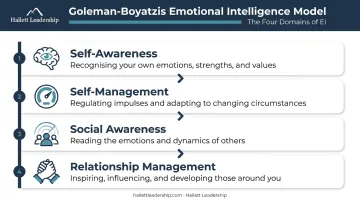
The Goleman-Boyatzis model organizes emotional intelligence into four domains. Each one maps directly onto observable leadership behaviors in military and aviation contexts.
Self-Awareness
Self-awareness means accurately recognizing your emotional state and understanding how it shapes your decisions and behavior. Done well, it functions as a tactical asset, not a therapeutic exercise.
At DLA Aviation's June 2025 Supervisor Development Series, Brig. Gen. Chad Ellsworth used Eisenhower as a leadership example, describing the internal self-questioning effective leaders engage in before high-stakes moments: "I'm not sure why I've been given this opportunity. I want to do well. I'm nervous. I don't want to mess this up." Naming the emotion before it drives behavior — that is self-awareness in practice.
Hallett Leadership frames this similarly: EQ begins with the ability to "regulate one's own nervous system and retain the capacity to choose how to respond to a given situation." That is a precise leadership competency, not a soft-skills afterthought.
Self-Management
Self-management is emotional regulation under pressure. It is the difference between the leader who "takes chaos and stays calm" and the one who "pings and goes straight to the ceiling" — a contrast cited in Air Force EQ research as affecting unit cohesion and mission outcomes.
For aviation leaders managing split-second decisions with advanced weapons systems, mental health pressures, and remote warfare realities, emotional reactivity becomes a measurable safety risk, not just a character flaw. Self-management training addresses that risk directly.
Social Awareness
Social awareness means reading the emotional climate of a team, a unit, or a single distressed individual — and responding appropriately rather than reflexively.
DLA Aviation's Supervisor Development Series documented a specific guidance scenario for working with a visibly distressed subordinate. The prescribed behaviors are straightforward:
- Stop looking at email or your watch
- Make direct eye contact
- Listen to understand, not just respond
- Ensure the person knows they have been heard
This isn't therapy. It's the foundational behavior that maintains psychological safety and unit trust.
Relationship Management
Reading a team's emotional climate matters only if you act on what you read. Relationship management is that action — the ability to build trust, navigate conflict, guide change, and influence others without relying purely on authority.
In the Six Seconds Navy and Marine Corps program, this domain was the central focus. The program equipped Navy Chaplain Corps leaders to manage the human and emotional dynamics of major organizational transformation. When structural change creates uncertainty, relationship management is what keeps teams cohesive.
How the Military Is Training EQ — Programs and Results
The Six Seconds Navy and Marine Corps Program
In one of the most documented military EQ interventions on record, Six Seconds delivered an Inside Path to Change workshop to senior Navy and Marine Corps officers and religious program specialists. A customized one-day version reached approximately 1,000 chaplains, RPs, and staff.
The framework — the EQ Change MAP (Engage, Activate, Reflect) — positioned emotional intelligence as the engine behind successful organizational change, not a separate "people skills" topic.
One-year follow-up survey results showed:
- 39% increase in awareness of the emotional dynamics of change
- 43% increase in processes and tools for working through change dynamics
- 58% increase in tools for teaching emotional intelligence
- 43% increase in readiness to cope with organizational transformation complexities
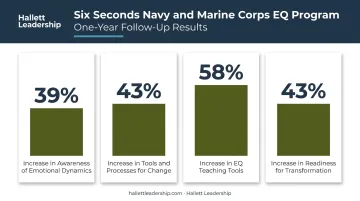
These are self-rated outcomes, and that context matters. Still, sustaining measurable growth across all four areas for a full year — in a culture that once treated EQ as irrelevant to mission readiness — signals something worth paying attention to.
DLA Aviation's Supervisor Development Series
DLA Aviation takes a different approach: instead of a standalone workshop, EQ development is embedded into a monthly Supervisor Development Series for new leaders. The June 2025 session — hosted by the Leadership Working Group — provided tools and mentorship for managing people and teams, with sessions scheduled through October 2025.
This recurring structure reflects a hard-won insight: EQ development cannot be compressed into a single event. It requires repeated exposure, practice, and feedback across time — the kind of reinforcement that most one-off leadership seminars simply don't provide.
What These Programs Have in Common
Both initiatives share three design principles that distinguish effective EQ training from ineffective training:
- Extended engagement — multi-day or recurring programs rather than one-off seminars
- Experiential methods — case studies, exercises, and real scenarios rather than passive instruction
- Follow-up mechanisms — measurement and reinforcement after the initial training ends
Translating Military EQ Lessons to Corporate Leadership
The Leverage Point: Middle Managers
The military concentrates EQ development on front-line commanders, the leaders who directly shape unit culture and morale every day. Corporate organizations have an equivalent: middle managers.
Gallup's research shows managers account for at least 70% of variance in employee engagement scores. McKinsey identifies middle managers as an underused strategic resource. Yet most organizations prioritize senior leadership development and leave the middle tier underdeveloped — which limits the reach of any culture initiative.
Hallett Leadership's philosophy makes this explicit: the best ROI on leadership development comes from targeting the middle tier of management, the functional link between C-suite vision and frontline execution. As Hallett Leadership describes it, "positive transformation of the company culture can occur from the bottom up" when mid-level leaders are developed — a more durable strategy than top-down mandates.
Embedded Development, Not One-Day Events
The military's most effective EQ programs are not seminars: they are sustained development systems. The same principle applies in corporate contexts.
Hallett Leadership's Accelerated Leadership Program mirrors this design. The nine-month cohort-based program includes:
- Weekly experiential exercises grounded in real workplace challenges
- Real-time feedback that surfaces blind spots as they emerge
- Individual coaching sessions integrated into daily work activities
- The Discovery Model — behavioral science combined with experiential learning
This progression takes participants from unconscious fixed patterns through confusion and curiosity into genuine new competence. The logic mirrors how the military approaches behavioral change: emotional regulation isn't built through a slide deck. It's built through repeated practice under pressure, with feedback that creates new habits over time.
From the Inside Out
Where military EQ training often relies on structured external frameworks, Hallett Leadership starts from a different premise: the capacity for emotional intelligence already exists in each leader. The work is development and activation, not installation.
Dean Hallett's experience at 20th Century Fox and The Walt Disney Company shaped this directly. At Disney, siloed top-down culture created real barriers to collaboration. At Fox, he used self-awareness and interpersonal skill to actively reshape how people worked together. Both experiences pointed to the same conclusion: lasting culture change comes from developing leaders' internal capacity — not handing them a new behavioral script to follow.
Practical Ways to Build EQ in Your Own Leadership Practice
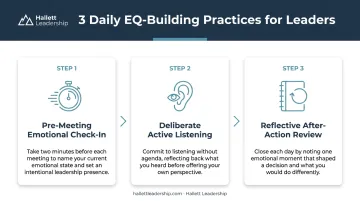
You do not need a military-grade training program to start building emotional intelligence. Three practices produce results when applied consistently:
1. Pre-meeting emotional check-ins Before entering a high-stakes conversation, take 60 seconds to identify your current emotional state. Are you frustrated? Anxious? Overconfident? Naming the emotion is the first step to managing it, rather than letting it manage the conversation.
2. Deliberate active listening Phone down. Eye contact. No interruptions. When a team member is distressed or presenting a concern, your job is to understand before you respond — not to solve. The DLA Aviation guidance is direct: make sure the person knows they have been heard. That single shift changes what people are willing to tell you.
3. Reflective practice with an emotional dimension After-action reviews typically focus on tactical outcomes: what worked, what didn't, what to do differently. Add the emotional layer: what was the team's energy going in, what contributed to conflict or hesitation, and where did your own state affect the outcome. That analysis is where behavioral change actually takes root.
These habits build a foundation, but self-directed practice has a ceiling. At some point, you cannot see your own patterns clearly enough to change them — and that's where individualized coaching accelerates the work. One-on-one coaching gives you specific, honest feedback tied to your actual leadership behavior, not a generalized framework. It addresses the gaps that group training rarely reaches.
Frequently Asked Questions
What are the four pillars of emotional intelligence?
The four pillars are self-awareness, self-management, social awareness, and relationship management, as defined by the Goleman-Boyatzis emotional and social competency model. Together, they describe how effective leaders perceive and regulate their own emotions, read others, and build productive relationships under pressure.
Why is emotional intelligence important in military leadership?
Military leaders operate in environments where poor emotional regulation can erode unit trust, impair decision-making, and compromise mission outcomes. Research shows toxic leadership directly drives soldier attrition, and aviation data links most crashes to human factors — communication, coordination, and leadership — rather than technical failures.
Can emotional intelligence be trained and developed?
Yes. The Six Seconds Navy and Marine Corps program produced gains of up to 58% in self-rated EQ competencies after one year of follow-up. Development is most effective through sustained, experiential programs with consistent feedback — not single-day workshops.
How does emotional intelligence improve team performance in high-stakes environments?
EQ-competent leaders build greater psychological safety and trust, reduce reactive conflict, and maintain cohesion under pressure. The result is stronger collaborative performance, faster decision-making, and lower attrition in both military and corporate settings.
What is the difference between EQ and IQ in leadership effectiveness?
IQ predicts technical competence. EQ predicts how well a leader navigates relationships, manages stress, and influences others. Research by Rosete and Ciarrochi found that executives higher in EQ were more likely to achieve business outcomes and be rated as effective leaders — making EQ a stronger predictor of leadership success than cognitive ability alone.