
The problem isn't a lack of training. McKinsey's research across more than 2,500 business leaders found that only 25% said their leaders genuinely inspire employees — and 40% cited a lack of incentives to change behavior as the core barrier. Training that focuses on knowledge transfer without addressing behavior at the team level rarely sticks.
This guide explains how to harness team leadership coaching in practice — from building the right foundation, to running effective coaching sequences, to sustaining a coaching culture after the formal program ends.
Key Takeaways
- Team leadership coaching develops how leaders build, communicate, and elevate their teams — collectively, not just individually.
- Prerequisites matter: leadership buy-in, psychological safety, and a baseline diagnostic must precede coaching.
- Effective implementation follows five stages: assess, set goals, initiate conversations, embed into daily work, and evaluate.
- The strategies that produce real change combine strengths-based development, emotional intelligence, and continuous feedback.
- ROI is trackable through behavioral assessments, engagement scores, retention rates, and promotion data.
What Is Team Leadership Coaching and When Does a Team Need It?
The International Coaching Federation defines team coaching as "partnering in a co-creative and reflective process with a team and its dynamics and relationships in a way that maximizes its abilities and potential." That distinction matters. Team leadership coaching isn't about developing a leader in isolation — it's about improving how a leader builds communication, decision-making, and performance across their entire team.
Individual vs. Team Coaching
Individual executive coaching focuses on the leader's personal capabilities — blind spots, communication style, decision-making under pressure. Team leadership coaching addresses what happens when that leader is in the room with their people: how they run meetings, resolve conflict, give feedback, and set direction.
Both are valuable. But organizations that invest only in individual coaching often develop stronger leaders who return to unchanged team dynamics.
When Team Leadership Coaching Is the Right Intervention
Team coaching is well-suited for situations including:
- Collaboration keeps breaking down even when individual contributors are strong
- A new leader is inheriting an established team, or a team is newly forming around a leader
- Technically competent teams plateau because behavioral dynamics — not skills — are the real bottleneck
- The team operates in ways that contradict the organization's stated values
Where it's often misapplied: as a reactive fix after a single conflict or HR incident. Coaching works best as a proactive, ongoing investment — one that builds team capacity before problems become entrenched.
That investment also looks different depending on where a leader sits in the organization. Hallett Leadership structures coaching engagements for C-suite executives, mid-level managers, and emerging leaders differently, calibrating intensity and scope to match each level's real-world demands.
What to Have in Place Before You Begin
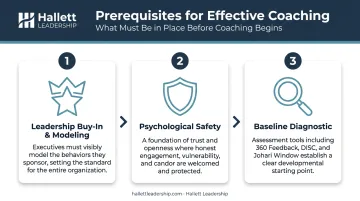
Skipping the groundwork is the most common reason coaching programs underdeliver. Before the work begins, three conditions need to be in place.
Leadership Buy-In and Modeling
Coaching fails when senior leaders champion it for their teams but don't participate themselves. The organizations that see the deepest results are those where executives model the behaviors they're asking others to develop.
Hallett Leadership builds this directly into its executive coaching model: an explicit benefit of the program is that executives become better coaches themselves by internalizing the methods used during their own engagement. When leaders at the top demonstrate the coaching behaviors they're sponsoring, the impact multiplies downward through every layer of the organization.
Psychological Safety
That modeling only works when people feel safe enough to engage honestly — which is why psychological safety is the second prerequisite, not an afterthought. Google's Project Aristotle research found that psychological safety was the single most important factor in team effectiveness — and that teams with higher psychological safety bring in more revenue and are rated effective twice as often by executives.
Before coaching begins, leaders need to assess whether people on their teams feel safe enough to be honest. If that foundation isn't present, building it becomes the first coaching objective.
A Baseline Diagnostic
Coaching without a clear starting point produces generic results. A structured baseline — using tools like 360-degree feedback, DISC assessments, behavioral interviews, or frameworks like the Johari Window — gives both the coach and the leader an honest picture of where the gaps actually are.
Hallett Leadership's Discovery Model applies this principle directly: behavioral science and experiential assessment come first, before any coaching intervention begins. The goal is to ensure the work connects to each leader's real starting point — not a generic competency checklist.
How to Implement Team Leadership Coaching Step by Step
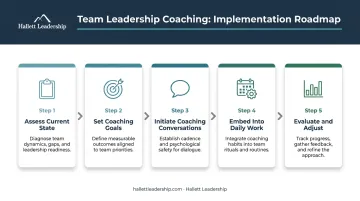
Team leadership coaching produces the most durable results when it follows a deliberate sequence. Skipping phases — especially assessment — leads to coaching goals that feel disconnected from real team dynamics.
Step 1: Assess the Team's Current State
Conduct a structured diagnostic before setting any goals. Useful inputs include:
- 360-degree feedback from direct reports, peers, and senior leaders
- Behavioral assessments (DISC, Enneagram, or similar tools)
- Structured interviews or team surveys to surface collaboration friction
- Frameworks like the Johari Window to identify leadership blind spots
Hallett Leadership uses peer feedback exchanges as a particularly high-impact diagnostic tool — participants consistently report these as some of the most revealing experiences in the program because they surface how others perceive behaviors the leader isn't aware of.
Step 2: Set Coaching Goals Tied to Organizational Outcomes
Assessment findings only matter if they're translated into specific, measurable goals. Effective coaching goals operate at two levels simultaneously:
- Individual development goals: improving self-regulation, communication style, feedback quality
- Team performance goals: reducing decision-making bottlenecks, improving cross-functional collaboration, increasing engagement scores
Hallett Leadership uses a Vision–Goals–Strategies sequence: vision defines the desired future state, goals are the measurable markers on the path there. In practice, this might mean establishing psychological safety for feedback, or shifting decisions from departmental self-interest to an enterprise-wide lens.
Step 3: Initiate Coaching Conversations
Effective coaching conversations are structured but not scripted. Key principles:
- Establish the agenda collaboratively, not unilaterally
- Use open-ended questions that surface the leader's or team member's own insights
- Avoid defaulting to advice-giving — the coach's job is to expand awareness, not prescribe answers
Conversations take three forms in a team coaching program: one-on-one between leader and coach, leader-to-team-member, or facilitated group sessions. Match the format to what the moment actually requires.
Step 4: Embed Coaching Into Daily Work
Scheduled sessions build awareness. Embedding coaching into daily work is what drives actual behavior change.
Leaders should practice coaching behaviors in real contexts — team meetings, project debriefs, one-on-ones, and real-time feedback conversations. Hallett Leadership's Accelerated Leadership Program integrates development into participants' daily activities throughout the nine-month program, not as a separate exercise after it concludes.
When leaders apply a new behavior, reflect on what happened, and adjust, that loop accelerates growth far beyond what classroom instruction produces alone.
Step 5: Evaluate Progress and Adjust
Build structured check-ins into the program — monthly or quarterly reviews where progress against goals is assessed and the coaching plan is updated based on what's actually changing (or not) in team behavior.
Hallett Leadership's executive coaching engagements include weekly goal-setting checkpoints with direct coach communication, plus coach availability when unexpected challenges or opportunities arise. That flexibility is what keeps the plan grounded in what's actually happening — not just what looked good on paper at month one.
Key Strategies That Make Team Leadership Coaching Work
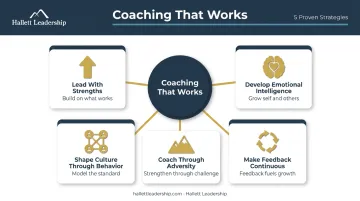
The difference between coaching that shifts culture and coaching that produces a few nice conversations comes down to these five strategies.
Lead With Strengths, Then Address Gaps
Coaching that starts with deficits creates defensiveness. Starting with what the team already does well builds psychological investment and early momentum. Gallup's strengths-based meta-analysis across 1.2 million employees found that organizations using strengths-based development reported 9–15% higher employee engagement and up to 72% lower turnover in high-turnover environments.
Build from the team's foundation — then use that confidence to approach harder behavioral work.
Develop Emotional Intelligence as a Team Capability
EQ isn't just an individual trait — it's a collective dynamic. A 2023 review of 104 peer-reviewed articles confirmed positive links between emotional intelligence, leadership effectiveness, and team outcomes.
Hallett Leadership addresses this through several methods:
- STOP-LOOK-CHOOSE: Leaders practice interrupting automatic emotional responses, surveying available options, and choosing how to show up rather than reacting
- Personal affirmations: Leaders develop statements that anchor their best leadership behaviors in high-pressure moments
- Peer feedback exchanges: Groups surface how individual emotional responses affect the broader team
When leaders develop self-regulation under pressure, the entire team's psychological safety strengthens.
Make Feedback Continuous, Not Periodic
Annual reviews bottleneck behavioral development. Gallup research found that 80% of employees who received meaningful feedback in the past week were fully engaged — a stark contrast to teams relying on once-a-year performance conversations.
Coaching cultures normalize feedback as an ongoing conversation during the work itself. Leaders need to give specific, behavioral feedback in real time — not accumulate observations for a scheduled review.
Coach Through Adversity, Not Around It
The most important coaching moments happen when things go wrong. Hallett Leadership's Discovery Model treats confusion as a signal worth following — the discomfort of a setback is where lasting behavioral change actually begins.
Research backs this up: a randomized controlled study of 41 executives found that four coaching sessions over 10 weeks measurably increased goal attainment, resilience, and workplace well-being compared to a control group. Structured coaching through difficulty accelerates the development that comfortable conditions never produce.
Shape Culture Through Behavior, Not Declarations
Team culture is what leaders consistently do, not what they say they value. When executives model the coaching behaviors they sponsor — asking questions instead of giving answers, receiving feedback without defensiveness, acknowledging their own development areas — that behavior becomes the cultural norm.
This is what makes Hallett Leadership's approach self-reinforcing: coached executives become better coaches themselves. Leadership practices spread through every layer of the organization, rather than staying concentrated at the top.
How to Measure Progress and Sustain a Coaching Culture
Measuring ROI: What to Track
A study hosted in the ICF Research Portal examined 100 executives receiving coaching. Among the 43 who estimated ROI, the conservative average was nearly $100,000 per executive, or 5.7x the initial investment — with reported improvements including 53% higher productivity, 77% improved relationships with direct reports, and 67% better teamwork.
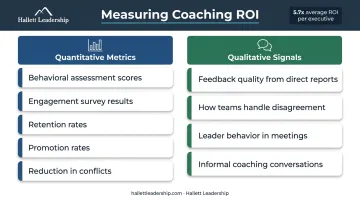
Track both quantitative and qualitative indicators:
Quantitative metrics:
- Pre- and post-coaching behavioral assessment scores
- Team engagement survey results
- Retention rates of high-potential employees
- Promotion rates of coached leaders
- Reduction in escalated conflicts
Qualitative signals:
- Feedback quality from direct reports
- Shift in how teams handle disagreement
- Leader behavior in actual meetings (observed, not self-reported)
- Whether coaching conversations are happening outside of formal sessions
Sustaining a Coaching Culture Beyond the Program
When a formal coaching engagement wraps up, the real test begins. ICF research identifies six elements of a strong coaching culture, including: leaders at all levels value coaching, coaching has a dedicated budget, and coaching practitioners receive accredited training.
Sustaining that culture requires three structural commitments:
- Evaluate leaders on coaching behaviors, not just business results — accountability reinforces the habit
- Embed feedback quality and development conversations into performance management, not as an add-on but as a core criterion
- Reduce reliance on external programs over time by building internal coaches who carry the culture forward
Organizations that see lasting results treat the initial program as a starting point, not a solution. The goal is a self-reinforcing system where coached leaders develop the next generation — without needing a formal program to prompt them.
Frequently Asked Questions
What are the 5 C's of team leadership development?
The 5 C's are Communication, Collaboration, Commitment, Competence, and Coaching. Together, they form a diagnostic lens for identifying where a team's development is strong and where gaps are limiting collective performance.
What are the 7 C's of team leadership?
The 7 C's framework includes Clarity, Communication, Collaboration, Commitment, Coaching, Conflict Resolution, and Culture. Leaders use these seven dimensions to assess team health and determine which areas most need attention in a coaching program.
What is the 70/30 rule in team leadership coaching?
The 70-20-10 model holds that roughly 70% of leadership development comes from on-the-job challenges, 20% from developmental relationships, and 10% from formal training. Developed at the Center for Creative Leadership, it makes the case for embedding coaching into daily work rather than relying on classroom programs alone.
What is the difference between individual leadership coaching and team leadership coaching?
Individual coaching develops the leader's personal capabilities — their self-awareness, communication style, and decision-making. Team leadership coaching focuses on how that leader builds collective performance, shapes team communication, and creates a culture where the whole group can develop and deliver together.
How long does it take to see results from team leadership coaching?
Meaningful behavioral changes typically emerge within a few months of consistent coaching, including a controlled study of 41 executives that saw measurable improvements in goal attainment and resilience after just 10 weeks. Broader cultural shifts generally require sustained engagement over a year or longer.
How do you measure the ROI of team leadership coaching?
The most reliable approach combines hard metrics — retention rates, engagement scores, promotion rates, productivity — with qualitative signals like improved feedback quality, reduced escalations, and stronger cross-team collaboration. Neither alone gives a complete picture of whether the investment is producing real change.