Key Takeaways
- Strategic leadership is a learnable skill set — not a fixed personality trait — that can be developed at every organizational level
- Weak strategic leadership surfaces first as firefighting, disengagement, and talent loss — long before the financial damage becomes visible
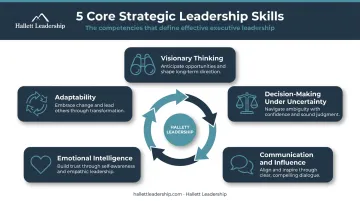
- Five core skills separate reactive managers from strategic leaders: visionary thinking, decision-making under uncertainty, communication and influence, emotional intelligence, and adaptability
- Sustainable strategic leadership begins with mindset: who a leader is shapes every decision they make
- Coaching, feedback, and experiential practice drive deeper behavioral change than frameworks or theory alone
What Is Strategic Leadership?
Strategic leadership is the ability to guide an organization toward long-term success while managing short-term demands. It means setting a compelling direction, making decisions that align with that direction, and building the adaptability that keeps teams competitive as conditions change.
Think of it like chess: strategic leaders see several moves ahead, making deliberate decisions based on pattern recognition and foresight rather than reacting to whatever lands on their desk today.
Strategic Leadership vs. Day-to-Day Management
The distinction matters more than most organizations acknowledge:
- Managers solve today's problems, allocate this week's resources, and keep operations running
- Strategic leaders anticipate tomorrow's challenges, shape conditions for sustained performance, and connect daily work to long-term goals
Neither role is lesser. The problem is when organizations expect managers to lead strategically without developing that capability in them.
Why Every Level Needs It
Strategic leadership isn't a C-suite privilege. HBR's research with 20,000+ executives identifies six behavioral skills — anticipate, challenge, interpret, decide, align, and learn — that operate across organizational levels. In fast-shifting, high-stakes environments, organizations need strategic thinkers translating vision into execution at every tier — not just at the top.
McKinsey has identified middle managers as the critical link between strategy and execution. When that link is underdeveloped, even well-designed strategies stall before they reach the front line.
Why Strategic Leadership Matters for Long-Term Performance
The business case isn't abstract. McKinsey's 2024 research across 1,800+ companies found that organizations focused on both people and performance were 4.2x more likely to outperform peers, with 30% higher revenue growth and attrition running 5 percentage points lower.
What Weak Strategic Leadership Actually Costs
Most organizations feel the symptoms before they diagnose the cause. Common warning signs include:
- Leaders spending more time fighting internal battles than executing against competitive priorities
- Teams losing sight of how their work connects to broader organizational goals
- Mid-level managers promoted into roles with no development support, then struggling visibly
- High performers leaving because they don't see growth or don't trust leadership direction
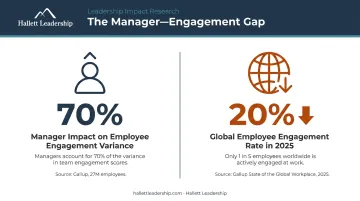
Gallup research across 27 million employees and 2.5 million work units found managers account for at least 70% of the variance in employee engagement. Global engagement dropped to 20% in 2025. The numbers point to a leadership capability problem, not a culture problem.
The Competitive Upside
The gap between those numbers and what's possible is where strategic leadership development makes its case. Organizations with strong strategic leadership at multiple levels execute faster, adapt when markets shift, and build cultures that retain high performers.
One Hallett Leadership client, a major film studio, saw concrete gains after targeted leadership development — stronger cross-departmental communication, improved efficiency, and stronger team cohesion. The root cause wasn't the film business; it was siloed leadership that the development work directly addressed.
The Five Essential Skills of Strategic Leaders
Visionary Thinking and Big-Picture Perspective
Strategic leaders regularly step back from operations to see the larger patterns shaping their industry. In practice, this means:
- Analyzing market trends and driving forces, not just quarterly performance
- Connecting individual team efforts to organizational goals
- Anticipating second- and third-order consequences of today's decisions
Hallett Leadership's Discovery Model develops this skill by breaking leaders out of automatic behavior — guiding them to stop reactive responses, look at available options, and choose the best course of action. Over nine months in the Accelerated Leadership Program (ALP), that pattern becomes embedded habit — something leaders apply in real decisions, not just training scenarios.
Effective Decision-Making Under Uncertainty
Strategic leaders make decisions with incomplete information. That's the job. The skill is in how they do it:
- Gathering intelligence from multiple sources before committing
- Weighing long-term impact over short-term comfort
- Acting decisively while staying genuinely open to course correction
Analysis paralysis is a real risk. McKinsey found executives spend nearly 40% of their time making decisions and believe much of that time is poorly used. The fix isn't faster decisions — it's clearer decision rights and sharper judgment about what type of uncertainty you're actually facing.
Communication, Active Listening, and Influence
Strategic thinking without communication is just private contemplation. Strategic leaders translate vision into direction their teams can act on, and they create genuine two-way dialogue — not just top-down broadcasting.
Hallett Leadership builds this through:
- Structured feedback exchanges within peer cohorts
- Impromptu speaking exercises that sharpen real-time clarity
- Coaching on communication blind spots leaders rarely self-identify
Participants consistently describe the peer feedback process as one of the most impactful parts of the program — it surfaces reactive communication habits that are invisible without an outside perspective.
Emotional Intelligence and Relationship Management
Daniel Goleman's foundational HBR research across 188 companies found emotional intelligence — self-awareness, empathy, emotional regulation — to be the differentiating factor in leadership effectiveness, not IQ or technical skills alone.
For strategic leadership specifically, EQ matters because it enables leaders to:
- Build the trust required for honest information flow
- Navigate conflict without destroying relationships
- Maintain team morale through disruption and uncertainty
- Influence without relying solely on positional authority
Adaptability and Change Management
Adaptability is an active strategic skill, not just a personality trait. The leaders who keep their organizations competitive when conditions shift tend to share a few specific behaviors:
- Monitoring leading indicators rather than waiting for lagging ones
- Revisiting assumptions without treating it as an admission of failure
- Guiding transitions with transparency so teams stay aligned, not anxious
Leaders who struggle most during change are usually the ones whose identity is tied too tightly to how things used to work.
Strategic Leadership Starts from the Inside Out
Skills without the right foundation don't hold. A leader can know every strategic framework — SWOT analysis, scenario planning, stakeholder mapping — and still default to reactive, ego-driven decision-making under pressure. Conventional development programs that teach frameworks without addressing the person using them consistently fall short at that gap.
The BE-DO-HAVE Model
Hallett Leadership's core philosophy reverses the conventional achievement sequence. Most people operate on DO-HAVE-BE: do the work, get the results, then be successful. The BE-DO-HAVE model starts differently: Who do I need to be to accomplish this goal? Asked first, that question reshapes the decisions, behaviors, and relationships that follow.
This inside-out approach means developing emotional intelligence and leadership capacity that already exists within each person, rather than layering on external frameworks. As Dean Hallett puts it, it's about drawing out what's already there, not installing something new.
The Self-Awareness Gap
HBR research found 95% of people believe they are self-aware — but only 10–15% actually meet the criteria. That gap has direct consequences: leaders who don't know their own behavioral patterns, emotional triggers, and default decision-making tendencies can't lead with intention. They lead by reaction, and strategy suffers.
Hallett Leadership addresses this through DISC assessments, structured peer feedback, and coaching that makes blind spots visible. Participants often describe learning what others observe in them — the strengths they underestimate alongside the patterns quietly undermining their effectiveness — as the most clarifying moment in the entire program.
Why Applied Development Outperforms Frameworks
A 2017 meta-analysis of 335 independent leadership development studies found the strongest effects on transfer — meaning behavior actually changed in real work contexts. A separate 2023 meta-analysis of executive coaching RCTs found behavioral effects (Hedges' g = 0.73) stronger than attitudinal ones.
The practical implication is direct:
- Workshops that teach frameworks without practicing them in live business contexts produce limited behavioral change
- Programs that embed development into daily work over months — not isolated training events — are where real behavior shifts occur
- Hallett Leadership's nine-month structure is built around this principle
Practical Ways to Build Strategic Leadership Capability
Carve Out Time for Strategic Reflection
Most leaders default to tactical problem-solving because it feels urgent. Developing strategic thinking requires deliberately protecting time — weekly, not quarterly — to step back, assess trends, and evaluate whether the team is moving toward the right goals.
Even 30–60 minutes of uninterrupted reflection per week builds the habit of strategic perspective over time.
Use Scenario Planning and Cross-Functional Exposure
Scenario planning builds mental flexibility. Leaders who regularly map best-case, worst-case, and most-likely futures develop the capacity to act decisively under uncertainty rather than freezing when conditions shift.
Scenario planning works best alongside cross-functional exposure. The ALP deliberately breaks down silos, helping participants develop stronger cross-functional communication and the systemic thinking that comes from understanding how other parts of the organization operate.
Seek Feedback and Build Real Accountability
Gallup found 80% of employees who received meaningful feedback in the past week were fully engaged. Strategic leaders don't wait for annual reviews — they actively solicit feedback on how they communicate, prioritize, and decide, not just what they delivered.
The accountability structures in Hallett Leadership's programs — weekly goal-setting, coaching check-ins, peer feedback cohorts — produce a fundamentally different experience than the typical annual review cycle. The difference is continuity and candor.
Invest in Structured Leadership Development
On-the-job experience alone is insufficient. Without structured feedback, coaching, and deliberate practice, leaders tend to repeat the same patterns rather than grow beyond them. The most effective development portfolios combine:
- Live business challenges as the practice field
- Coaching for behavioral change and accountability
- Peer feedback to surface blind spots
- Assessment tools (like DISC) to build self-awareness
- Integration into daily work so skills don't stay theoretical
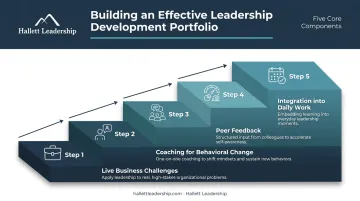
Hallett Leadership's programs are built on exactly this combination. The methodology was refined over 15 years at 20th Century Fox and is now applied across industries. The ALP specifically targets the middle management tier that McKinsey identifies as the critical execution layer — measuring progress through tangible work results, not just satisfaction surveys.
Frequently Asked Questions
What is the difference between strategic thinking and strategic leadership?
Strategic thinking is a cognitive skill — the ability to analyze, envision, and plan. Strategic leadership is that thinking applied through action, communication, and influence. The distinction is execution: strategic thinking happens internally; strategic leadership shows up in how a leader directs, communicates, and inspires others.
What are the 5 P's of strategic thinking?
Mintzberg's well-established 5 P's are Plan, Ploy, Pattern, Position, and Perspective. Each represents a distinct lens through which strategy can be understood — from deliberate planning to emergent patterns in behavior.
What are the 5 C's of strategic thinking?
There's no single universal model. Depending on the source, the 5 C's might include Context, Clarity, Consequences, Connections, and Choices — among other variations. Treat any 5 C's framework as one useful perspective rather than a fixed standard.
Can strategic leadership skills be developed, or are they innate?
Research confirms they're learnable. HBR frames strategic leadership as six specific behavioral skills, and a 2017 meta-analysis of 335 studies showed leadership training produces measurable improvements in learning, behavioral transfer, and organizational results.
What does a leadership development program typically include?
Effective programs combine assessment, skill-building workshops, coaching, peer feedback, and application to real work challenges. Hallett Leadership's Accelerated Leadership Program runs nine months for mid-level managers; senior leaders work through one-on-one executive coaching engagements on a weekly or bi-weekly basis.
Why is strategic leadership especially important at the mid-management level?
Mid-level managers translate organizational strategy into daily execution for their teams. When they lead strategically, alignment and engagement follow. When they don't, strategy stays at the executive level and execution suffers — regardless of how good the strategy is.