Introduction
Executive coaching has moved from boardroom perk to business-critical investment. Organizations once reserved it for a handful of senior leaders — now they're embedding it into leadership infrastructure at every level.
The numbers back this up. According to the ICF's 2025 Global Coaching Study, the global professional coaching market has reached $5.34 billion in revenue, with nearly 123,000 coach practitioners worldwide — a 15% increase since 2023.
That growth reflects real organizational pressure. Skills are becoming obsolete faster than companies can train for them, employee engagement has plateaued at persistently low levels, and the cost of losing a strong leader runs well into six figures. Coaching has become one of the most direct responses to all three.
This article maps the key trends reshaping executive coaching and leadership development — where the market is heading, what's driving demand, and what it means for organizations weighing where to invest next.
Key Takeaways
- The global coaching market has surpassed $5.34 billion, driven by demand for measurable leadership outcomes
- Digital-first delivery is now standard, with AI increasingly embedded in coaching platforms for matching, goal-tracking, and between-session support
- Coaching is expanding well beyond the C-suite — mid-level managers and emerging leaders are the fastest-growing segment
- Organizations now require data-driven ROI with measurable business outcomes
- Wellbeing, resilience, and inclusive leadership have become core coaching priorities, not optional add-ons
Key Trend 1: Digital-First Delivery and AI-Enhanced Coaching
The shift to virtual coaching was already underway before 2020 — but the pandemic accelerated adoption to the point where digital delivery is now the baseline, not the exception. Organizations across industries are using digital coaching platforms to expand reach and improve program consistency at scale.
How AI Is Entering the Coaching Process
AI is taking on the administrative and tracking functions of coaching — matching, monitoring, and reinforcing — so human coaches can concentrate on the work that genuinely requires them.
Current AI applications in coaching include:
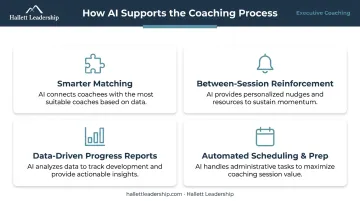
- Smarter matching between coaches and clients based on goals, communication style, and industry context
- Between-session reinforcement tools that prompt reflection, track goal progress, and send accountability nudges
- Data-driven progress reports that surface behavioral patterns over time
- Automated scheduling and session prep to reduce administrative friction
The scale of AI adoption in HR broadly signals where coaching is heading. A Gartner survey of 179 HR leaders found 38% were already piloting or implementing generative AI as of early 2024, up from 19% just six months prior. The Conference Board's 2025 research found AI can handle up to 90% of day-to-day career coaching functions — but concluded that human coaches remain essential for complex, high-stakes development work.
The Human Boundary Matters
AI tools work well for routine functions: tracking habits, reinforcing micro-skills, generating reflection prompts. What they can't replicate is the judgment, relational depth, and behavioral challenge that make coaching genuinely transformative.
That distinction has prompted formal industry action. The ICF's AI Coaching Framework and Standards (updated October 2024) establishes clear requirements: disclosure that users are interacting with a non-human system, confidentiality protections, bias awareness, and alignment with coaching codes of conduct. The ICF's 2025 Code of Ethics — effective April 1, 2025 — explicitly addresses AI-assisted tools, electronic records, and privacy standards.
Organizations implementing AI-augmented coaching need governance built in from the start — not retrofitted after problems surface.
Key Trend 2: Democratizing Coaching Beyond the C-Suite
For years, coaching was concentrated at the top. That's changing rapidly, and the business case for broader access is compelling.
ICF's 2023 Global Coaching Study found that 31% of coaching clients were managers and 25% were executives. Sponsored coaching (where organizations pay) rose to 57% of engagements, up from 52% in 2019. Organizations aren't just tolerating broader coaching access — they're funding it.
Why Mid-Level Managers Are the Real Leverage Point
Gallup's research makes the case clearly: managers account for 70% of the variance in team engagement. The problem is that most organizations aren't developing this population effectively.
DDI's 2024 analysis found:
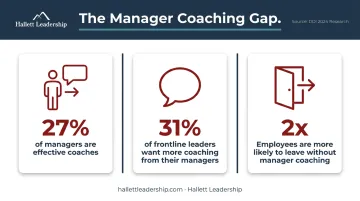
- Only 27% of managers are effective coaches themselves
- 31% of frontline leaders want more coaching from their own managers
- Employees with managers who don't coach are twice as likely to leave
Under-developed managers create compounding problems: disengaged teams, preventable turnover, and strategy that gets lost in translation between the C-suite and the front line.
Building the Leadership Pipeline Through Coaching
When organizations extend coaching to mid-level and emerging leaders early, the benefits compound. Coached managers develop their own coaching skills and pass them down to direct reports, multiplying the investment across the organization rather than concentrating it at the top.
Hallett Leadership addresses this gap directly through the nine-month Accelerated Leadership Program (ALP), developed by Dean Hallett over 15 years at 20th Century Fox. The program operates as a cohort model, bringing together high-potential managers from different departments to challenge assumptions, practice new behaviors, and integrate leadership skills into their daily work.
The curriculum follows a Learn, Do, and Teach sequence: participants acquire leadership principles, apply them through experiential activities and group projects, then become coaches to their own direct reports. The design builds individual leadership capability and organizational coaching capacity at once.
Both the ALP and Hallett Leadership's one-on-one executive coaching draw on the same Discovery Model. Key elements include:
- Weekly goal-setting tied to real leadership challenges, not hypothetical exercises
- On-call coaching availability when actual crises and inflection points arise, not just scheduled sessions
- Behavioral science and experiential learning combined to help leaders break fixed patterns
- Genuine versatility development across different leadership situations and team dynamics
Key Trend 3: Data-Driven Outcomes and ROI Accountability
Buyers now want coaching tied to business metrics. Providers who can't demonstrate measurable results are losing contracts — and clients who settle for anecdotal progress reports are leaving real organizational value on the table.
What the ROI Research Actually Shows
The most cited benchmark comes from a Manchester Review study, which found executive coaching produced an average ROI of 5.7x the initial investment among participants who estimated financial return. A MetrixGlobal Fortune 500 case study reported 529% ROI — rising to 788% when retention benefits were included.
These figures are widely cited — and worth contextualizing. Both studies used small samples and participant-estimated returns, making them useful as directional evidence rather than benchmarks you can bank on.
The more durable finding comes from a 2023 meta-analysis of executive coaching research, which found that behavioral outcomes — measurable changes in how leaders act — showed stronger, more consistent effects than self-reported attitude changes. That's the real case for coaching accountability: track behavior, not just sentiment.
Measurement Approaches That Actually Work
Organizations extracting the most value from coaching build measurement in before the engagement starts — not at the end.
Approaches gaining traction:
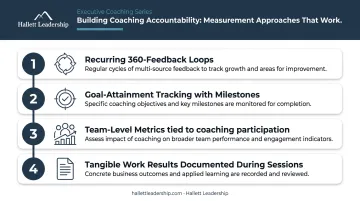
- Recurring 360-feedback loops that capture stakeholder-validated behavior change at regular intervals (not just pre/post)
- Goal-attainment tracking with defined milestones and structured reviews
- Team-level metrics — engagement scores, retention, promotion rates — tied to manager coaching participation
- Tangible work-related results documented during coaching sessions, not extrapolated after
Hallett Leadership builds this rigor into its process. Executives set weekly goals tied to both personal development and high-performance outcomes, with established checkpoints throughout the engagement. Progress is tracked through performance indicators, employee surveys, and direct behavioral observation — not just coach-reported impressions.
That structured approach runs into a real challenge most organizations face: attribution and confidentiality. Coaching outcomes intersect with many variables, and protecting client confidentiality while still demonstrating organizational value requires deliberate program design. Organizations that treat this tension as a design problem — building shared metrics upfront — tend to get far better accountability from their coaching investments.
Key Trend 4: Wellbeing, Resilience, and Inclusive Leadership as Core Coaching Priorities
These topics spent years sitting at the margins of leadership development conversations. Today, they sit at the center — driven by measurable organizational data, not aspirational HR rhetoric.
The Burnout Risk at the Top
Deloitte's 2023 Well-Being at Work survey of 3,150 respondents across the US, UK, Canada, and Australia found 75% of C-suite leaders were seriously considering leaving for a job that better supports their well-being. The same study found more than 75% of executives inaccurately believed workforce well-being had improved, while employees reported it had worsened or stayed flat.
That gap — between how leaders perceive organizational health and how employees actually experience it — is a coaching problem. It reflects underdeveloped self-awareness, limited empathy, and a disconnection from organizational reality that coaching directly addresses.
Hallett Leadership integrates resilience development throughout its coaching engagements — particularly for C-suite clients navigating high-pressure environments. Stress management, emotional regulation, and maintaining focus under ambiguity are treated as leadership capabilities.
Inclusive Leadership and DEI as Coaching Goals
ICF and HCI's 2023 research found that 80% of organizations use coaching to help employees understand and implement DEI initiatives — making it one of the top three areas where coaching is deployed for organizational impact.
Inclusive leadership has moved beyond compliance training. Organizations now treat it as a primary coaching goal, targeting the specific behavioral changes that classroom mandates can't produce:
- Building psychological safety across team levels
- Developing empathy with diverse team demographics
- Creating conditions where people contribute fully
- Sustaining culture shifts through individualized coaching over time
What's Driving These Trends and Their Organizational Impact
Four converging pressures are pushing organizations toward more disciplined, sustained investment in coaching — and each one carries a measurable cost when ignored.
Skill Disruption Is Accelerating Leadership Demands
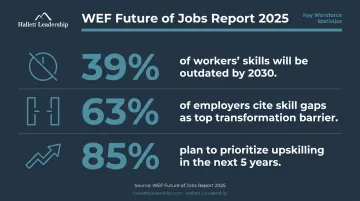
The World Economic Forum's Future of Jobs Report 2025 surveyed more than 1,000 employers representing over 14 million workers. Key findings:
- 39% of workers' existing skill sets will be transformed or outdated by 2030
- 63% of employers identify skill gaps as their biggest barrier to transformation
- 85% plan to prioritize workforce upskilling in the next five years
Leaders who can navigate ambiguity, drive adaptation, and develop their teams through rapid change are the ones organizations are trying to build. Training programs build knowledge. Coaching builds the judgment to apply it under pressure.
The Engagement Gap Is a Leadership Problem
Gallup's 2026 State of the Global Workplace report found only 20% of employees worldwide were engaged in 2025 — representing an estimated $10 trillion in lost global productivity. The root cause isn't compensation or culture in the abstract. It's manager quality.
Given that managers drive 70% of team engagement variance, coaching the manager population is the highest-leverage intervention available to most organizations. It's also where the Deloitte perception gap becomes urgent: executives who don't see the well-being and engagement problem clearly can't address it. Coaching builds the self-awareness to close that gap.
Retention Economics Favor Coaching Investment
Gallup estimates 42% of employee turnover is preventable — and that replacing a leader or manager costs around 200% of their annual salary. DDI's research adds another data point: poor coaching from managers doubles turnover risk, meaning the absence of development is itself a cost driver.
Organizations that invest in manager coaching reduce preventable turnover, protect institutional knowledge, and build the leadership bench that makes sustained growth possible.
Market Professionalization Is Raising the Bar
The coaching industry is tightening its professional standards. ICF's revised Code of Ethics took effect April 1, 2025, with explicit standards covering AI tools, electronic communications, confidentiality, and bias awareness. EMCC maintains a Global Code of Ethics signed by 12 professional bodies across 9 languages. ICF reports that 73% of coaches agree clients and organizations now expect professional credentials.
For buyers, this means due diligence has a clear checklist: credentials, governance standards, measurement frameworks, and AI disclosure practices. Organizations that treat coaching as a governed system with defined outcomes, not a series of informal conversations, are the ones seeing results that hold.
Future Signals for Executive Coaching and Leadership Development
A few near-term developments are worth watching:
- AI governance will become mandatory, not optional: the ICF framework and 2025 Code of Ethics establish a practical baseline now; organizational procurement standards will likely follow
- Team and board-level coaching is formalizing: ICF now maintains specific Team Coaching Competencies, and EMCC has a dedicated Team Coaching Centre for Excellence. Individual coaching alone doesn't address systemic leadership culture gaps
- Industry-specific expertise is gaining weight: as the market matures, buyers are moving toward coaches who understand their sector's specific pressures, not just generalist credential holders
The broader direction is a shift toward inside-out development — models that work on mindset, emotional intelligence, and behavioral patterns rather than installing a toolkit of leadership techniques. Research consistently shows that behavioral change is more durable than skill transfer alone.
Hallett Leadership's Discovery Model reflects this direction directly. The BE–DO–HAVE framework asks leaders to first establish who they need to be before determining what to do — reversing the conventional approach to leadership performance. Rather than chasing outcomes, leaders develop the internal foundation from which strong results follow.
The nine-month Accelerated Leadership Program (ALP) integrates this development into daily work rather than isolating it to training sessions, building new habits through sustained practice in real leadership situations.
The 1–3 year outlook: Coaching will become increasingly embedded in day-to-day work rather than reserved for structured sessions. AI tools will handle between-session reinforcement and habit tracking; human coaches will focus on high-stakes behavioral challenges where relationship and judgment matter most.
Organizations that treat coaching as a strategic system — with governance, measurement, and pipeline logic built in — will widen the leadership bench-strength gap on those that still view it as a one-off intervention.
Frequently Asked Questions
How big is the executive coaching market today?
The ICF's 2025 Global Coaching Study reports $5.34 billion in global coaching revenue, with nearly 123,000 practitioners worldwide — a 15% increase since 2023. This figure covers the broader professional coaching market; executive coaching represents a significant portion, with 25% of coaching clients identified as executives in ICF's research.
Who benefits most from executive coaching programs?
The fastest-growing segment is mid-level and high-potential leaders — managers account for 70% of team engagement variance, making their development directly tied to organizational performance. C-suite leaders also see strong returns, particularly when coaching targets specific decision-making and communication challenges.
How is AI changing executive coaching?
AI is augmenting coaching through smarter coach-client matching, goal-tracking tools, and between-session reinforcement. Human coaches remain essential for the relational work, behavioral challenge, and high-stakes development that AI cannot replicate. The ICF's AI framework sets clear ethical standards for how these tools must be disclosed and governed.
What ROI can organizations expect from executive coaching?
The most cited benchmark is a Manchester Review study showing average ROI of 5.7x among participants who estimated financial returns. ROI is highest when coaching targets specific leadership challenges and measures behavioral change, retention, and business outcomes — not just participant satisfaction.
How is coaching expanding beyond the C-suite?
Organizations are extending coaching to mid-level managers and emerging leaders to build stronger leadership pipelines. DDI's research found that employees whose managers don't coach are twice as likely to leave — making this expansion a retention strategy as much as a development one.
What should organizations look for when choosing an executive coaching program?
Look for three things before committing to a program:
- A diagnostic process that goes beyond self-reported goals
- Structured accountability with checkpoints and stakeholder validation
- A coach whose background matches your specific leadership challenges and organizational context