The cost of this gap is real: disengaged teams, voluntary turnover, and leadership pipelines that run dry exactly when organizations need them most.
This article covers the practical difference between coaching and mentoring, why both matter for leadership growth, what an effective program actually looks like, and how organizations can build a culture where development happens continuously — not just during annual reviews.
The core premise: great leaders are developed, not discovered. The right combination of coaching and mentoring can unlock potential at every level of an organization.
Key Takeaways
- Coaching builds current performance; mentoring shapes long-term careers — a complete strategy needs both.
- Mid-level managers are the most underleveraged lever in organizational performance and deserve targeted investment.
- One-time training events rarely produce lasting behavioral change; development must be embedded in daily work.
- Organizations with structured coaching and mentoring programs see measurable gains in engagement, retention, and leadership pipeline depth.
- When individual development aligns with organizational goals, growth produces results — not just potential.
Coaching vs. Mentoring: What's the Difference?
These terms get used interchangeably — but they serve distinct purposes, and confusing them produces programs that underdeliver.
| Coaching | Mentoring | |
|---|---|---|
| Focus | Present performance and self-awareness | Future career trajectory and growth |
| Who leads it | A trained coach using reflective questioning | A senior leader sharing experience and guidance |
| What it delivers | Behavioral insight, intentional decision-making | Career navigation, sponsorship, institutional knowledge |
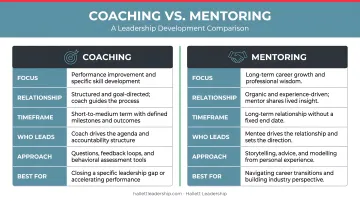
Coaching works at the behavioral level. A coach uses structured conversations and reflective questioning to help a leader address current performance challenges and make more intentional choices. The coach doesn't prescribe answers — the goal is to surface what the leader cannot yet see about themselves.
At Hallett Leadership, that means interrupting the automatic behaviors that keep leaders stuck: reactive defensiveness, rigid certainty, and closed-mindedness. Creating space for self-directed growth is where real development begins.
Mentoring looks further out. A mentor is typically a more experienced leader who shares their own knowledge, offers guidance on career navigation, and may actively sponsor or advocate for the mentee's advancement. As ICF-hosted research notes, the mentor brings career and business knowledge, while the coach brings a more independent perspective.
How They Work Together
These two approaches are complementary, not competing. Consider the difference in practice:
- A first-time manager struggling with delegation benefits from coaching — structured reflection to build self-awareness and break reactive habits
- A high-potential leader preparing for a VP transition benefits from mentoring — guidance from someone who has navigated that path and can share hard-won institutional knowledge
A leader preparing for an executive role may work with a coach on emotional intelligence and communication while also drawing on a mentor's strategic perspective and organizational insight. Together, they cover ground neither approach handles alone.
The Benefits of Coaching and Mentoring for Leadership Development
Self-Awareness and Emotional Intelligence
Coaching helps leaders understand how their behaviors land on others, which directly shapes team trust, communication quality, and decision-making under pressure.
Hallett Leadership's Discovery Model addresses this through a STOP-LOOK-CHOOSE framework: participants learn to pause automatic reactions, survey their options, and choose how they want to show up as a leader. This inside-out approach (developing the person before developing the skills) produces more durable behavioral change than external tactics training alone.
Retention and Manager Quality
People leave managers, not companies. Gallup research found that one in two employees has left a job specifically to get away from a manager, and that managers can influence at least 75% of the reasons for voluntary turnover.
When coaching develops leaders who create psychologically safe, engaged environments, retention follows. SHRM data reinforces this: job satisfaction is nearly double among workers with highly effective managers. Yet only 64% of U.S. workers rate their manager as highly effective, leaving enormous room for improvement.
Team Engagement and Performance
Manager behavior doesn't just affect individual relationships; it shapes team-wide outcomes. Gallup estimates that managers account for at least 70% of the variance in employee engagement scores across business units.
Employees who receive meaningful feedback are measurably more engaged as a result. Gallup found that employees are 3.6x more likely to be motivated to do outstanding work when their manager provides regular feedback rather than annual reviews.
Succession and Pipeline Health
Mentoring programs, designed strategically, keep the leadership pipeline from running dry. The current state of succession planning is a problem most organizations acknowledge but few solve well:
- 86% of leaders call succession planning urgent or important
- Only 14% believe they do it well (Deloitte)
- 30% of newly hired executives fail within 18 months, often due to poor cultural fit
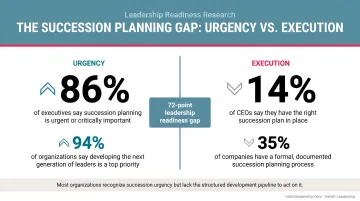
Mentoring embedded in a structured development program (rather than treated as an informal side conversation) systematically identifies and prepares high-potential leaders before gaps emerge, not after.
The Multiplier Effect
Filling the pipeline is only part of the equation. Leaders who receive coaching tend to coach their own teams — and that cascade has real reach.
When managers develop a coaching mindset, it changes how they run one-on-ones, how they give feedback, and how they handle underperformance. The shift from directing to developing multiplies across organizational layers: one well-coached leader can alter the experience of dozens of employees beneath them.
What an Effective Leadership Development Program Looks Like
Beyond the One-Day Seminar
Traditional training events rarely produce lasting change. A 2024 evidence-informed review found that 90% of skills learned in training can atrophy within one year without on-the-job application. Harvard Business Publishing research similarly argues for short learning bursts distributed over time rather than one-off events — because distributed practice limits the forgetting curve and supports real behavioral readiness.
An effective program is ongoing, personalized, and built into real work. Retreats and one-day seminars don't move the needle on their own.
Three Foundational Elements
Any serious leadership development program needs:
- Assessment: A clear picture of the leader's current capabilities, blind spots, and behavioral patterns. Tools like DISC help leaders understand their default style and develop the versatility to adapt it.
- Structured development plan: Defined milestones, goals aligned to both individual growth and organizational objectives, and a clear sequence of learning experiences.
- Ongoing feedback loops: Regular accountability conversations that reinforce new behaviors before old habits reassert themselves.
Tailoring by Leader Level
Development needs vary significantly across organizational levels:
| Leader Level | Primary Development Focus |
|---|---|
| Emerging leaders | Transitioning from individual contributor to people leader; foundational self-awareness |
| Mid-level managers | Team dynamics, communication, navigating competing priorities |
| Senior executives | Strategy, executive presence, decision-making, cultural transformation |
Mid-level managers are often the most under-invested group — responsible for translating strategy into daily work, yet frequently left without adequate development support. That gap shows up directly in team engagement scores.
The Inside-Out Approach
Hallett Leadership's Discovery Model addresses something most programs skip entirely: the inner work that makes external skill development actually stick.
The model follows a BE → DO → HAVE sequence. Most organizations operate in reverse — pushing leaders to produce results before addressing who they are as leaders. The Discovery Model inverts this: leaders first clarify their values, beliefs, and leadership identity, then apply skills and tactics from that foundation. The results follow naturally.
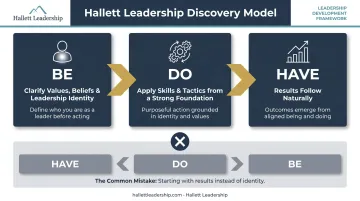
A leader who hasn't examined their automatic behaviors will apply new communication skills through the same defensive, reactive filters. The skills land, but the old patterns undermine them under pressure. Self-awareness, blind spot recognition, and intentional choice-making aren't extras — they're what make the skill-building durable.
Hallett Leadership's Accelerated Leadership Program applies this model in practice — including a 9-month engagement with 1,100 employees at 20th Century Fox that produced measurable results across 15 years of refinement.
Building a Coaching Culture Across Your Organization
A coaching culture is an organizational environment where candid feedback, developmental conversations, and reflective listening happen at every level — between peers, managers, and senior leaders alike, including in informal settings.
What the Shift Requires
Moving from occasional training events to a genuine coaching culture requires concrete changes in how managers operate day-to-day:
- Develop the capacity to hear content, tone, and underlying meaning before reacting — not just waiting for a turn to speak
- Ask questions that surface employee thinking rather than steering toward predetermined answers
- Hold people accountable while remaining genuinely invested in their growth
- Close every conversation with clear next steps that make it actionable
At 20th Century Fox, when Hallett Leadership's development program shifted the culture, employees began generating ideas at a volume the organization wasn't prepared to handle. Senior leadership had to restructure operations — creating steering committees and task forces — to channel the new energy productively. That's what a real coaching culture looks like: the organization has to adapt to the capability it's building.
Executive Buy-In Is Non-Negotiable
A coaching culture requires visible modeling from the top. ICF research reports that coaching cultures help 92% of employees implement upskilling and 90% improve well-being — but those outcomes depend on senior leaders actively participating in development, not just endorsing it on paper.
When executives engage in coaching themselves, the message is clear: development is a leadership priority, not an HR checkbox. That signal changes how the entire organization treats growth conversations.
How to Measure the Success of Leadership Development Programs
Without measurement, development programs are vulnerable to budget cuts and impossible to improve. Success criteria should be defined before a program launches — not evaluated after the fact.
What to Track
Individual-level indicators:
- Shifts in 360 feedback scores over time
- Self-assessment changes before and after the program
- Goal completion rates from development plans
- Observable behavioral shifts reported by direct reports
Team-level outcomes:
- Employee engagement scores (tracked quarterly, not annually)
- Voluntary turnover rates within coached teams
- Productivity and collaboration indicators
Organizational outcomes:
- Internal promotion rates and leadership pipeline health
- Reduction in leadership gaps and time-to-fill for senior roles
- Succession plan readiness
The ROI Case
Tracking these metrics also strengthens the business case for continued investment. An ICF Global Coaching Client Study found that 86% of companies at least made back their coaching investment, with a median return of 7x the initial investment. The data is older, but no serious counter-evidence has emerged — and the directional logic holds.
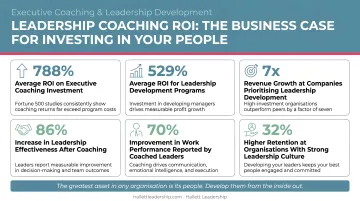
The harder challenge is building measurement into the program from the start. As Deloitte research notes, 75% of organizations rate their ability to accurately evaluate individual worker value as ineffective — which means most leadership development spend goes unmeasured. Organizations that establish clear success criteria upfront don't just justify spend — they generate the data needed to make each program iteration better than the last.
Frequently Asked Questions
What is the difference between coaching and mentoring in leadership development?
Coaching focuses on present performance by building self-awareness, addressing behavioral patterns, and developing emotional intelligence through reflection. Mentoring focuses on career development and long-term growth, with an experienced leader sharing knowledge, guidance, and institutional perspective to help the mentee navigate their path forward.
What does a leadership development coach do?
A coach helps leaders identify blind spots, build self-awareness, set development goals, and work through real challenges using structured conversation and accountability without prescribing answers. The work surfaces what leaders cannot yet see about themselves, creating conditions for self-directed growth.
How do coaching and mentoring contribute to leadership development?
Coaching builds self-awareness, emotional intelligence, and adaptive capability — the inner foundation for effective leadership. Mentoring accelerates growth by sharing hard-won experience and opening doors the leader hasn't yet reached.
What are the 5 steps of leadership development?
A widely recognized progression: (1) self-assessment and blind spot identification, (2) goal-setting aligned to organizational objectives, (3) structured learning and coaching engagement, (4) real-world application with ongoing feedback, and (5) measurement and iteration for continuous improvement. The key is that step five feeds back into step one — growth doesn't end; it restarts at a higher level.
What types of leaders benefit most from coaching and mentoring programs?
All leadership levels benefit, but mid-level managers and emerging leaders typically see the greatest impact. They are navigating the most complex transitions from individual contributor to team leader, or manager to executive, often without structured support for those shifts.
How do you measure the success of a leadership development program?
Key indicators include 360 feedback scores, team engagement and retention rates, coaching goal completion, and internal promotion rates. The most credible programs tie development to tangible work results, not just participant satisfaction scores.