Introduction
Technical expertise gets leaders promoted. Interpersonal skills determine whether they stay effective once they get there.
Most leadership failures trace back to relationship breakdowns, not strategic miscalculations. Research from Hogan Assessments reviewing decades of derailment studies found that the most frequent cause of executive derailment was insensitivity to others — and that every derailed manager in McCall and Lombardo's sample had significant relationship problems.
Not strategic incompetence. Not technical gaps. People problems.
The same pattern surfaces consistently across industries and organizational levels. Leaders lose the confidence of their teams, mishandle conflict, communicate poorly under pressure, or fail to build trust with cross-functional partners — and careers plateau or derail as a result.
Executive coaching exists specifically to address this. By creating a private, structured environment for honest self-examination and behavioral practice, coaching helps leaders develop the interpersonal skills that formal education rarely teaches and performance reviews rarely surface.
This article covers 8 fundamental interpersonal skills that executive coaching consistently targets, and explains why developing them from the inside out tends to produce more durable behavioral change than a workshop or seminar ever could.
Key Takeaways
- Interpersonal skills — not technical expertise — are what drive executive effectiveness (and derailment research confirms it)
- Executive coaching provides the structured space to surface blind spots and build lasting behavioral habits
- This post covers 8 core interpersonal skills — from active listening and empathy to conflict resolution and accountability
- These skills compound — strengthening one accelerates growth in others
- Lasting change comes from developing leaders from the inside out — identity and mindset, not just behavior
Why Interpersonal Skills Are the Foundation of Executive Coaching
Interpersonal skills are specifically about how a leader relates to, influences, and communicates with other people in real time. Unlike general "soft" traits like adaptability or positivity, they're the operational tools a leader deploys in live conversations, under pressure, and in conflict.
That distinction matters because it defines where executive coaching focuses its energy.
What Derailment Research Actually Shows
Hogan's review of decades of derailment research identifies a recurring set of reasons executives fail:
- Troubled relationships and inability to build teams
- Inability to maintain networks across the organization
- Lack of interpersonal savvy
- Inability to deal with conflict constructively
- Low emotional intelligence
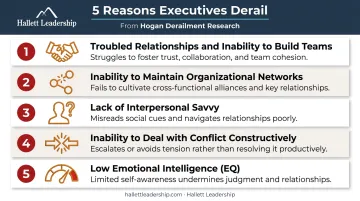
Notice what's absent from that list: poor strategic decisions, insufficient technical knowledge, inadequate functional expertise. Executives rarely derail because of what they know — they derail because of how they show up with other people.
Those interpersonal blind spots are precisely where executive coaching does its work. Through honest, confidential dialogue, coaches help leaders see behavioral patterns that colleagues won't name and performance reviews rarely surface.
The 8 skills below represent the core of that work — the interpersonal capabilities most directly tied to executive effectiveness and most reliably developed through a coaching engagement.
The 8 Fundamental Interpersonal Skills Developed Through Executive Coaching
Active Listening
Active listening goes well beyond hearing words. It means absorbing meaning, noticing emotional tone, and responding in ways that make the other person feel genuinely understood. Most senior leaders believe they're good listeners. Many are not.
The gap between listening to respond and listening to understand is significant — and costly. Gallup research found that employees whose manager is always willing to listen to work-related problems are 4.2x as likely to strongly agree they trust organizational leadership. Yet only 23% of U.S. employees strongly agreed they trusted their organizational leadership in Gallup's survey of over 16,000 employed adults. Active listening is a trust mechanism, not a courtesy.
Hallett Leadership's coaching methodology specifically develops this skill through techniques like deep listening practice, where executives learn to listen "in an open and receptive manner, refraining from internal judgment or commentary." Weekly one-on-one sessions create natural opportunities for coaches to observe listening patterns in real time and provide direct feedback when executives shift from understanding to formulating their next response.
Emotional Intelligence
Emotional intelligence (EQ) encompasses self-awareness, self-regulation, and social awareness : recognizing your own emotional state and understanding how it affects others. For executives, low EQ surfaces as defensiveness under pressure, volatility in difficult conversations, or a consistent inability to read the room.
TalentSmartEQ's research found that EQ explains 58% of a leader's job performance, with 90% of top performers scoring high in EQ compared to just 20% of low performers.
Hallett Leadership builds EQ through their STOP-LOOK-CHOOSE paradigm — a structured practice that interrupts automatic emotional responses and creates space for intentional choice:
- STOP automatic behavior and keep defense mechanisms in check
- LOOK at all available options, including input from others
- CHOOSE not just the best course of action, but how you want to show up as a leader
Leaders who regulate their own emotions consistently generate a measurable shift in team behavior: psychological safety increases, problems surface earlier, and teams take the creative risks that drive performance.
Empathy
Empathy is the capacity to understand another person's perspective and emotional experience — not to agree with it, but to acknowledge it. In leadership, empathy converts formal authority into genuine influence.
The organizational stakes are real. Businessolver's 2025 Workplace Empathy Report found that unempathetic U.S. organizations risk $180 billion in employee attrition costs, with employees at unempathetic organizations 1.5x more likely to leave and 3x more likely to view the workplace as toxic. Catalyst research reinforces this: employees with highly empathic senior leaders were more likely to report innovation (61% vs. 13%) and engagement (76% vs. 32%) compared to those with less empathic leaders.
Hallett Leadership develops empathy by helping executives interrupt the automatic interpretations they apply to other people's behavior. Through weekly coaching sessions, executives practice asking more open-ended questions, sitting with ambiguity before forming judgments, and examining situations through multiple stakeholder lenses.
The coaching environment gives leaders a safe space to reconstruct interactions where empathy was absent and identify what a different response would have looked like.
Assertive Communication
Assertive communication means expressing perspectives, needs, and boundaries clearly and directly without aggression or passivity. It sounds simple. In practice, executives often default to one of two failure modes: under-communicating to avoid conflict, or over-directing to maintain control. Both damage team trust over time.
The consequences aren't abstract. PMI research identified poor communication as a contributing factor in 56% of project failures. Executives who can't state priorities clearly or communicate expectations without ambiguity create an alignment vacuum — and teams fill it with assumptions.
Coaching addresses this by helping leaders find and practice the assertive middle ground: naming what they need, setting clear expectations, and delivering difficult messages without hedging or overloading. For executives responsible for aligning diverse teams around a unified direction, assertive communication isn't optional — it's a core execution skill.
Giving and Receiving Feedback
Feedback is one of the highest-stakes interpersonal acts in any organization. Poorly delivered, it damages trust. Avoided entirely, it allows performance gaps and misalignment to compound. Equally important: leaders who can't receive feedback without defensiveness create environments where no one tells them the truth.
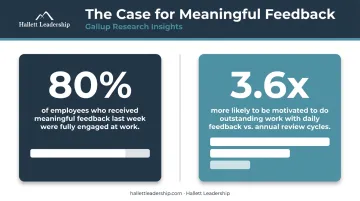
Gallup's research makes the business case plainly: 80% of employees who received meaningful feedback in the past week were fully engaged, and daily feedback made employees 3.6x as likely to be motivated to do outstanding work compared to annual feedback cycles.
Hallett Leadership develops both directions of feedback through structured practice. For giving feedback, coaches teach leaders to balance constructive input with genuine recognition, and to prioritize how they communicate as much as what they communicate. For receiving feedback, leaders practice a specific discipline: when feedback is delivered, the only response is "thank you." No defense, no explanation — just intake and reflection.
The Johari Window framework underpins this work, helping executives understand that feedback doesn't expose personal failure — it maps the gap between how they intend to show up and how they actually land with others. Before introducing this process to their teams, executives practice and master it with their coach first.
Conflict Resolution
Conflict is inevitable in high-performance environments. The real variable is whether the leader resolves it constructively or lets it fester.
The cost of getting this wrong is documented. CPP's global study of 5,000 employees across nine countries found that 85% of employees experience workplace conflict, with U.S. employees spending an average of 2.8 hours per week dealing with it — equivalent to roughly $359 billion in paid hours annually. Poorly managed conflict produced personal attacks for 27% of employees and led 67% to actively avoid a colleague.
Executive coaching addresses conflict by helping leaders identify their default pattern — avoidance, domination, or appeasement — and build new habits for navigating difficult conversations. Hallett Leadership's approach treats emotional regulation as a prerequisite: leaders who can manage their own nervous system under pressure hold space for tense conversations without escalating them.
The objective is to reframe conflict as important organizational information, not a personal threat — something that deserves a structured, calm response rather than a reactive one.
Influence and Trust-Building
In modern organizations, formal authority covers less ground than leaders often assume. Executives routinely need to influence peers, cross-functional partners, board members, and teams who don't report to them directly. Gallup found that 72% of employees work on matrixed teams — meaning influence across organizational lines isn't a rare leadership challenge, it's a daily one.
Trust is the foundation that makes influence sustainable. Gallup data shows that employees who trust their leaders are 3x more engaged and 61% more likely to stay with their organization. Among followers who strongly trust their leader, 1 in 2 are engaged. Where trust is absent, that ratio drops to 1 in 12.
Hallett Leadership builds influence capacity by first helping leaders understand how they are perceived : the gap between intent and impact that only structured feedback can surface. Using tools like the Johari Window, coaches help executives identify trust-eroding behaviors they can't see themselves. From there, coaching focuses on helping leaders communicate in ways that generate genuine buy-in, rather than compliance driven by position alone.
Accountability in Relationships
Interpersonal accountability means owning commitments to others: following through on what was promised, acknowledging when your actions affect the team, and holding others to agreed standards without blame or micromanagement. It operates in both directions — inward toward one's own follow-through, and outward in how accountability culture gets set for the team.
Gallup's research quantifies the leadership gap here: fewer than 50% of leaders are rated outstanding or exceptional at creating accountability. Yet managers who rate their leaders as exceptional in accountability are 3x more likely to be engaged (51% vs. 17%).
Hallett Leadership builds interpersonal accountability through weekly goal-setting with checkpoints, regular follow-up on commitments made in sessions, and structured feedback loops that reinforce follow-through between conversations. Coaches are available not just in scheduled sessions, but when real-time situations create opportunities to practice accountability in the moment. Leaders who practice this consistently shift accountability from a personal expectation to a shared cultural norm — reflected in the engagement data Gallup tracks at the team level.
How Executive Coaching Builds These Skills from the Inside Out
Most organizations have tried to develop interpersonal skills through training workshops. The result is predictable: leaders engage during the session, return to their desks, and revert to familiar patterns within days.
Generic workshops address behavior at the surface without touching the underlying mindset, identity, or automatic responses that drive it. Transformational coaching works at the source — changing the orientation that drives behavior, not just the behavior itself — which is why results hold beyond the session.
The Discovery Model: BE–DO–HAVE
Hallett Leadership's Discovery Model follows a specific progression that distinguishes it from skills-based training:
- BE — Start with self-awareness and identity. Who does this leader need to become?
- DO — Shift behavior in alignment with that identity, guided by coaching and real-time feedback
- HAVE — Experience improved results and relationships as a natural outcome of the changed behavior
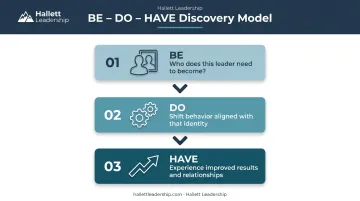
This inside-out sequence matters because it prevents the most common failure mode of leadership training: teaching someone what to do without addressing who they're being when they do it.
The model begins by disrupting the "unconscious competence" state — where leaders operate on autopilot — and moves through intentional confusion and curiosity before new competence is established. Behavioral science, experiential exercises, and one-on-one coaching work together throughout this progression.
What One-on-One Coaching Provides
The individual coaching relationship creates specific conditions that make interpersonal development possible:
- Executives can surface real workplace challenges without political exposure
- Coaches operate outside the organizational hierarchy and can say what colleagues won't
- New behaviors are tested in a safe environment before being applied with teams
- Weekly sessions with accountability checkpoints keep development from stalling
Executive coaching also produces measurable returns. A Manchester Consulting Group study, hosted by the ICF Research Portal, reported executive coaching ROI of 5.7x the initial investment, with benefits including improved relationships with direct reports, peers, and stakeholders, as well as reduced conflict and higher job satisfaction.
Conclusion
None of the 8 interpersonal skills covered here are fixed personality traits. They're learnable, coachable behaviors that develop meaningfully with the right structure, feedback, and practice. Leaders who model active listening become more empathetic. Leaders who build trust enable their teams to perform at higher levels. Leaders who master feedback create cultures where the entire organization can grow.
Organizations that invest in executive coaching for interpersonal skill development don't just develop better individual leaders — they build cultures with stronger collaboration, lower turnover, and more consistent performance at every level.
If you're looking to develop these skills in yourself or your leadership team, Hallett Leadership's executive coaching programs offer personalized, inside-out development that produces lasting behavioral change. The programs are built on Dean Hallett's 15 years of demonstrated results at 20th Century Fox and his work with the Walt Disney Company — grounding every engagement in methods that have worked at scale.
Reach out to explore what a coaching engagement could look like for your organization.
Frequently Asked Questions
What are the 7 interpersonal skills?
The commonly cited 7 interpersonal skills are communication, active listening, empathy, conflict resolution, teamwork, self-awareness, and adaptability. In executive leadership contexts, this list typically expands to include influence, accountability, and feedback — which is why this article covers 8 skills specifically relevant to coaching at the senior level.
What is the 70/30 rule in coaching?
The 70/30 rule refers to the guideline that the coachee should speak approximately 70% of the time while the coach speaks 30%. It reflects the core coaching principle that lasting development is driven by the client's own reflection and discovery — not by advice or instruction from the coach.
What is the average cost for an executive coach?
According to the ICF's 2023 Global Coaching Study, the global average for a one-hour coaching session was $244 in 2022, with coaches primarily serving executives commanding the highest fees. Executive-focused engagements typically involve multi-month programs, so total investment varies based on scope, duration, and coach experience.
How long does it take to develop interpersonal skills through executive coaching?
Meaningful interpersonal skill development through coaching typically requires 3 to 6 months of consistent engagement. Those habits require real workplace practice and consistent reinforcement before they hold up reliably under pressure.
How do strong interpersonal skills impact team performance?
Leaders with strong interpersonal skills create conditions (psychological safety, clear communication, genuine trust) that research consistently links to higher engagement, lower turnover, and stronger performance. Google's Project Aristotle identified psychological safety as the single most important factor in team effectiveness, and it's built almost entirely through interpersonal behavior at the leadership level.