
Introduction
Most executives begin a coaching engagement with genuine motivation — and a goal that sounds something like "I want to be a better leader." Sincere as that is, it gives a coach nothing to work with.
Without specific, intentional goals, coaching sessions drift into reflection without direction. Conversations feel productive in the moment, but weeks pass without measurable change. The executive gets insights; the organization sees nothing shift.
This guide addresses that gap. It covers how to set leadership goals that actually drive change:
- The Vision → Goals → Strategies sequence for building aligned priorities
- The SMART framework applied to executive-level development
- How goals should differ by leadership level
- The mistakes that quietly derail even well-intentioned coaching engagements
Whether you're entering your first executive coaching engagement or refining how you set goals within an existing one, this framework gives you the structure to move from vague intention to measurable progress.
Key Takeaways
- Effective coaching goals are specific, measurable, and anchored to a compelling personal or organizational vision
- Goals exist on a spectrum — short-term goals build early momentum; long-term goals drive transformation
- The SMART framework converts vague leadership ambitions into trackable, coachable outcomes
- Leadership level shapes goal priorities — manager development looks very different from C-suite refinement
- Skipping the vision step produces goals that feel hollow once obstacles appear
Why Goal Setting Is the Foundation of Executive Coaching
Without defined goals, coaching drifts into something else — recurring conversations that feel valuable but produce little verifiable change.
The distinction matters. Executive coaching is a structured growth tool — one where sessions have direction, outcomes are tracked, and both coach and client can recognize progress. Open-ended reflection has its place, but it's not coaching.
What a Good Leadership Coaching Goal Actually Does
An effective coaching goal describes a specific future behavior or outcome, connects to organizational priorities, and establishes a clear measure of progress. It answers: What will be different, and how will we know?
This clarity benefits everyone involved:
- The executive has a target worth working toward
- The coach can design sessions with purpose and track progress between them
- The organization can see a return on its investment in the engagement
According to the ICF, 87% of survey respondents agreed executive coaching delivers high ROI — but that ROI is measured by whether individual, team, and organizational goals were actually met. ROI without defined goals is unmeasurable.
Goals vs. Plans: A Common Confusion
Goals define the what — the desired outcome. Plans define the how — the specific actions and timelines.
Confusing the two is common and costly. Executives who jump straight to planning often work hard toward the wrong outcome. Getting the goal right first makes every plan that follows more useful.
Locke and Latham's foundational goal-setting research found that specific, difficult goals consistently produce higher performance than vague "do your best" intentions — a finding that applies directly to coaching contexts.
From Vision to Goals: A Framework for Leadership Direction
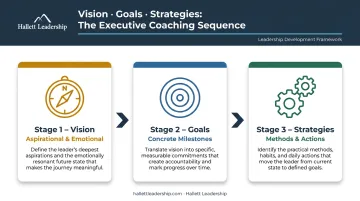
Effective executive coaching follows a clear sequence: Vision → Goals → Strategies.
Vision is the emotional North Star — aspirational, resonant, not yet measurable. Goals translate that vision into concrete milestones, and strategies are the methods for reaching them. Skip the vision, and your goals become a task list rather than a path toward something meaningful.
What a Leadership Vision Looks Like
A vision is not a goal. It shouldn't be quantifiable. It should describe the kind of leader you want to be — and provoke a genuine emotional response.
Compare these two statements:
- Vision: "To be more authentic in my leadership — someone who is transparent and vulnerable in a way that empowers each team member to show up fully."
- Goal: "Hold monthly open-feedback sessions with my team by Q2."
The goal is measurable and time-bound. The vision is what makes the goal worth pursuing.
At Hallett Leadership, the coaching process begins with exactly this kind of vision development. Clients are guided to reflect: What does it look like and feel like when you're thriving as a leader? Who are you in that moment? Only after that foundation is established does goal-setting begin.
The BE–DO–HAVE Model
Hallett Leadership's BE–DO–HAVE model takes this further. The most lasting coaching goals start with who the leader needs to BE — their mindset, values, and self-awareness — before defining what they need to DO and what results they will HAVE.
The practical implication: a leader who begins a coaching engagement by declaring, "I am a leader who communicates with transparency," is already operating from a different internal orientation than one who says, "I want to try to be more open." The inside-out approach produces behavioral change that sticks.
Short-Term Goals
Short-term coaching goals are immediate, skill-building objectives — typically achievable within weeks to a few months. Common examples include:
- Improving how feedback is delivered to direct reports
- Resolving a recurring conflict within the team
- Developing a more consistent delegation practice
- Learning to give and receive feedback (particularly valuable early in a coaching engagement)
These goals build momentum. Early wins matter — they build confidence and show the leader (and the organization) that the coaching process delivers tangible results.
Long-Term Goals
Long-term goals are broader transformation targets pursued over several months to a year or more. Examples include:
- Developing a successor and transitioning leadership responsibilities
- Shifting the organization's culture toward greater collaboration
- Building cross-functional influence at the board or executive committee level
- Developing resilience and adaptability for navigating complex, high-stakes challenges
These goals require sustained effort and tie directly back to the executive's original vision. They're also where the work is most complex: without clear structure and regular recalibration, long-term goals drift — and the gap between intention and outcome widens fast.
How to Apply the SMART Framework to Leadership Goals
SMART — Specific, Measurable, Achievable, Relevant, Time-bound — is the most widely used framework for converting leadership ambitions into coachable objectives. George T. Doran introduced it in a 1981 Management Review article, and it remains the default structure in both management and coaching for good reason.
Here's the practical problem it solves: "Be a better communicator" is a sincere aspiration, but it gives a coach nothing to work with. "Hold weekly one-on-ones with each direct report by the end of Q1 to improve communication clarity and trust" — now that's a goal a coach can actually work with.
Specific
A specific goal answers: Who is involved? What exactly needs to change? Why does it matter?
Useful reflective questions a coach might use to get there:
- "What will this look like when it's working?"
- "Which one behavior, if changed, would have the greatest impact on your team right now?"
Vague goals don't just fail in coaching — research confirms that specific, difficult goals outperform easy or undefined ones across performance contexts.
Measurable
Measurability in leadership coaching doesn't always mean numbers. Progress takes two forms:
- Quantitative: Fewer escalated conflicts, reduced decision-making cycles, improved retention on the team
- Qualitative: Improved 360-degree feedback scores, stronger stakeholder relationships, higher team morale
The key is agreeing in advance on how progress will be evaluated. When that agreement doesn't happen upfront, coaching engagements often conclude without anyone knowing whether they worked.
Achievable and Relevant
Two opposite failure modes exist here:
- Goals set too aggressively create early demoralization, causing the leader to struggle, lose confidence, and disengage
- Goals set too easily produce no real growth; the executive checks boxes without changing anything meaningful
The best coaching goals stretch without breaking. Just as important: they connect to the organization's strategic direction, not just the individual's personal preferences. A goal to "improve executive presence" means little if the business actually needs that executive to strengthen cross-functional alignment.
Time-Bound
Hallett Leadership's coaching structure includes weekly goal-setting with established checkpoints — a rhythm that creates accountability without waiting for end-of-year reviews to see what changed.
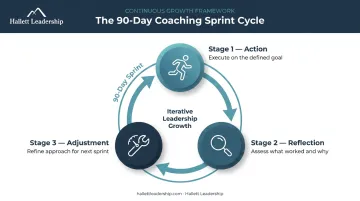
For broader coaching engagements, 90-day goal sprints function well as leading indicators of longer-term progress. They create a natural cycle of:
- Action: Executing on the defined goal within a focused window
- Reflection: Assessing what worked, what didn't, and why
- Adjustment: Refining the approach before the next sprint begins
Without time constraints, coaching engagements drift into indefinite conversations. They may still be useful, but they're no longer the structured development process they need to be.
Core Leadership Coaching Goals at Every Level
Effective coaching goals are not one-size-fits-all. Research from CCL analyzing data across 48,000+ leaders confirms that leadership challenges differ significantly by level — meaning coaching goals must be calibrated to the leader's position, scope, and the specific demands of their role.
Managers
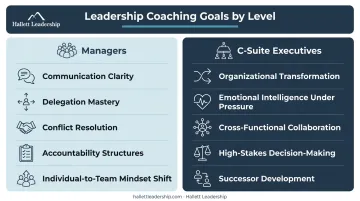
For managers, coaching goals tend to focus on the foundational skills that determine how a team performs day to day:
- Improving communication clarity with direct reports
- Mastering delegation — shifting from doing the work to leading the people who do it
- Resolving team conflict before it escalates
- Setting clear expectations and building accountability structures
- Transitioning from individual contributor thinking to genuine team leadership
Hallett Leadership's approach for middle managers follows a deliberate progression: Learn, Do, Teach. The end goal is a manager who models and coaches these behaviors for their own teams — making the development self-sustaining.
C-Suite and Senior Executives
At the senior level, the focus shifts from managing individuals to shaping how the entire organization thinks, decides, and leads. C-suite coaching goals typically target:
- Driving organizational transformation and culture change
- Enhancing emotional intelligence and managing leadership presence under pressure
- Strengthening cross-functional collaboration across business units
- Refining decision-making in high-stakes, high-ambiguity situations
- Developing successors and building the next generation of leaders
Hallett Leadership's executive coaching programs address these challenges through weekly one-on-one sessions, behavioral assessments (including DISC and related tools), and direct availability when high-stakes decisions require it. The structure ensures leaders have a consistent process to draw on — not just in calm moments, but when the pressure is highest.
Common Mistakes When Setting Leadership Coaching Goals
Vague Goals or Unrealistically Ambitious Ones
Both extremes undermine the engagement. Vague goals give the coach nothing to work with; overly aggressive goals demoralize the executive before progress begins. The fix is collaborative refinement — when a coach pushes for specificity while keeping goals grounded in what's actually achievable, the engagement starts with traction instead of frustration.
Skipping the Vision
Goals set without an underlying vision often feel hollow. When obstacles inevitably appear — and they will — vision is what sustains motivation. Without it, coaching becomes a task list rather than a transformation. It's a surprisingly common gap, and one that tends to stall progress right when momentum should be building.
Failing to Revisit Goals as the Leader Grows
A goal set in month one may no longer fit in month six. The leader has grown, new challenges have surfaced, and the organization itself may have shifted. Rigidly adhering to outdated goals wastes coaching time and frustrates both parties. Build formal review checkpoints into the engagement from the start — treat them as a structural part of the engagement, not an afterthought.
Frequently Asked Questions
What are the goals of leadership coaching?
Leadership coaching goals typically include enhancing self-awareness, improving communication and decision-making, building emotional intelligence, and developing the capacity to inspire and align teams. They're tailored to the individual's role, current challenges, and organizational context.
What is the 70/30 rule in coaching?
The 70/30 rule suggests the client speaks approximately 70% of the time while the coach listens and asks questions for the remaining 30% — keeping the focus on the leader's own thinking rather than the coach's direction.
What are the 5 C's of goal-setting?
The 5 C's vary by framework, but commonly include Clarity, Challenge, Commitment, Complexity, and Consequence. Together they ensure goals are well-defined, motivating, and structured for follow-through.
What is the difference between a vision and a goal in executive coaching?
A vision is an aspirational picture of a desired future state — directional and open-ended. A goal is a specific, measurable milestone on the path toward that vision. Both are necessary for sustained leadership progress.
How long does it take to achieve executive coaching goals?
Short-term goals focused on specific skills may shift within weeks or a few months. Transformational goals — culture change, succession development, or a fundamental shift in leadership style — typically require six months to over a year of consistent work.
How do leadership goals differ between managers and C-suite executives?
Managers tend to focus on interpersonal and operational skills: delegation, communication, team accountability, and conflict resolution. C-suite executives focus on strategic vision, organizational culture, cross-functional alignment, and preparing the next generation of leaders to succeed them.