Introduction
Most leaders earn their promotions by being exceptional at their jobs — hitting targets, solving problems, delivering results. What they're rarely evaluated on is their ability to develop the people around them. That gap matters more than most organizations realize.
Gallup research shows that companies fail to choose candidates with the right manager talent 82% of the time, and only 1 in 10 people naturally possess high manager ability. The selection problem is widespread — and its consequences compound quickly.
Managers drive 70% of the variance in team engagement, making coaching capability one of the highest-leverage variables in any organization's performance.
Closing that gap starts with developing the right skills. This article breaks down the 6 core principles of leadership coaching: what they are, why they work, and how leaders at every level can apply them — in 1-on-1s, team meetings, and performance conversations.
Key Takeaways
- Create safety and challenge simultaneously — people grow when they feel secure enough to be honest and stretched enough to improve.
- Imposed solutions kill ownership — work within the coachee's agenda, not your own.
- Ask more, tell less — the right question surfaces better thinking than the best advice.
- Self-awareness comes first — leaders can't coach what they haven't examined in themselves.
- Without reflection, experience just repeats — reflection is what converts it into growth.
- Model what you coach — credibility is built through behavior, not instruction.
Why Every Leader Needs to Think Like a Coach
The traditional directive model — where the manager has the answers and the team executes — worked reasonably well when change was slow and expertise was concentrated at the top. Neither of those conditions reliably exists anymore.
When organizations face fast-moving decisions, distributed expertise, and talent that has real options about where to work, the "tell-and-direct" approach creates bottlenecks. Leaders become the ceiling on their teams' performance rather than a multiplier of it.
The data on coaching cultures is compelling. ICF and HCI research found that 61% of organizations with strong coaching cultures were classified as high-performing, compared to just 27% of those without. Highly engaged teams — the direct output of manager-led coaching — show 14–18% higher productivity and 23% higher profitability.
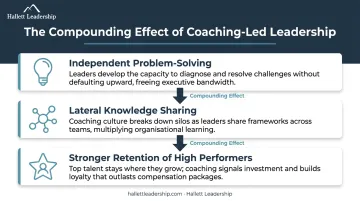
The insight underneath these numbers: when leaders coach, they don't just improve one person's performance. They build capacity that multiplies across the entire team. That compounding effect shows up in concrete ways:
- Team members solve problems independently instead of escalating every decision
- Institutional knowledge spreads laterally rather than staying locked at the top
- High performers stay longer because they feel invested in, not just managed
The 6 principles below give leaders a practical framework for making that shift.
The 6 Core Principles of Leadership Coaching Skills
Principle 1: Create a Safe Yet Challenging Environment
Google's Project Aristotle identified psychological safety as the single most important dynamic in effective teams. Amy Edmondson's foundational research defines it as the shared belief that a team is safe for interpersonal risk-taking — where people can surface mistakes, dissent, and uncertainty without fear of punishment.
But safety alone isn't enough. Without challenge, it becomes comfort. Effective coaching requires holding both at once: people need to feel secure enough to be honest and stretched enough to grow.
What this looks like in practice:
- Ask questions that signal genuine curiosity rather than evaluation ("What's your read on this?" rather than "Did you consider X?")
- Respond to mistakes with exploration, not blame ("What would you do differently?" not "How did this happen?")
- Set clear, high expectations and make it safe to admit when someone isn't meeting them
- When the balance tips too far toward comfort, performance stagnates; too far toward pressure, people stop communicating early enough to course-correct
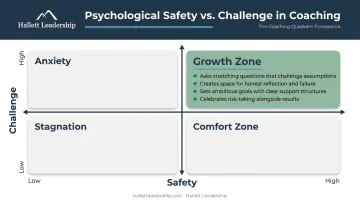
The practical test: can people on your team tell you bad news without preparing a defense first?
Principle 2: Work Within the Coachee's Agenda
This is where many well-intentioned leaders derail. A conversation starts as coaching and gradually becomes advising — the leader's experience, preferred approach, and implicit agenda quietly take over. The employee leaves with a solution they didn't generate and a problem they don't fully own.
Coaching is fundamentally about building the other person's capacity to think, decide, and act. The moment a leader substitutes their judgment for the coachee's, that process stops.
At Hallett Leadership, this distinction sits at the core of the coaching methodology. Coaches act as partners who help leaders clarify their own vision and challenge their own assumptions — not as experts dispensing answers.
Opening a coaching conversation the right way:
- "What's the thing you most want to focus on today?"
- "What outcome would make this conversation useful for you?"
- "What are you working through that you want to think out loud about?"
One important nuance: organizational needs and individual agendas sometimes diverge. When they do, name it directly rather than pretending it isn't there:
"There's a business need we also need to address — can we make space for both?"
This keeps the conversation honest without hijacking the coachee's development.
Principle 3: Facilitate and Collaborate Rather Than Advise
A Zenger Folkman analysis of 3,492 participants found that the best listeners aren't passive — they ask questions that promote discovery and act as a "trampoline" for another person's thinking. A separate peer-reviewed study of 548 employees confirmed that supervisors' active-empathetic listening significantly predicts work engagement.
Advice can create dependence. Good questions build judgment.
Hallett Leadership teaches leaders to replace reflexive advice-giving with questions that shift ownership back to the team member:
- "What are your options?" — opens up thinking beyond the obvious
- "What assumptions might you be making here — and are they still true?" — challenges fixed thinking without confronting it
- "What haven't you tried yet?" — surfaces creativity rather than directing it
- "What outcome would make this a win for everyone involved?" — promotes alignment and broader thinking
The shift feels uncomfortable at first, especially for leaders who built their careers by having good answers. The discipline is learning to hold back the answer long enough for the other person to find their own — which is almost always more durable than the one you would have given.
Principle 4: Build and Advocate Self-Awareness
Tasha Eurich's research with nearly 5,000 participants found that 95% of people believe they are self-aware, while only 10–15% actually meet the criteria. Leaders are not exempt from this gap — and in many cases, their positional authority makes honest feedback harder to come by, widening the blind spot further.
This matters for coaching because a leader cannot credibly guide someone else toward self-knowledge while remaining blind to their own patterns, triggers, and impact on others.
How leaders develop genuine self-awareness:
- Gather 360-degree feedback from direct reports, peers, and senior leaders — structured input surfaces what self-report consistently misses
- Use behavioral assessments (Hallett Leadership uses DISC, the Enneagram, and 16 Types) to identify default patterns and build the versatility to adapt
- Reflect for 15 minutes after significant interactions — even brief, consistent reflection begins closing the gap between intention and impact
- Share what you're actively working on and invite feedback publicly — this creates permission for others to do the same
The Discovery Model at Hallett Leadership begins here — moving leaders from unconscious autopilot through confusion and into genuine curiosity about how they actually operate, versus how they think they operate.
Principle 5: Promote Learning from Experience
Experience is not the same as development. Plenty of leaders have 20 years of experience that is really one year repeated 20 times — same patterns, same blind spots, same default responses. What converts experience into growth is reflection.
Harvard Business School research supports this directly: employees who spent 15 minutes reflecting after training performed 22.8% better than a control group on subsequent assessments. The coaching principle isn't "let people struggle and they'll figure it out." It's "help people process what happened, why, and what they'd do differently."
Embedding reflection without adding formal programs:
- Run a 10–15 minute post-project debrief: "What worked, what didn't, what would we do differently?"
- Add a checkpoint question to 1-on-1s: "What's one thing you learned in the last two weeks that changed how you're thinking about something?"
- After difficult conversations, ask: "What did you notice about how that went? What would you adjust?"
- Build a brief "what did we learn?" round into existing team meeting rhythms
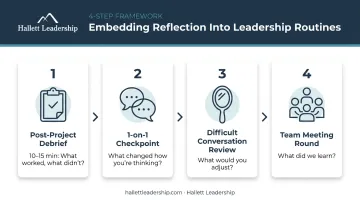
None of these require a new program. They require a leader willing to treat every project and setback as a development opportunity — not just a performance event to score and move on from.
Principle 6: Model What You Coach
McKinsey identifies role modeling as one of four core levers for lasting behavior change in organizations. Peer-reviewed research on leader behavioral integrity confirms the mechanism: when leaders' words and actions align, employee performance improves. When they don't, the behavior people observe overrides the message they hear.
The most damaging thing a leader-coach can do is coach vulnerability while shutting down dissent, or coach accountability while avoiding their own commitments. Teams notice the gap immediately, and trust — the precondition for every other coaching principle — erodes.
What modeling looks like in practice:
- Acknowledge a mistake openly: "I handled that situation poorly. Here's what I'd do differently."
- Share something you're actively working on: "I'm trying to listen more before responding in meetings — call me out if I'm not."
- Invite feedback on your own leadership in team settings, not just in performance reviews
- Participate in the same development experiences you ask of your team
Hallett Leadership builds this into the Accelerated Leadership Program through peer feedback exchanges — moments where leaders practice giving and receiving honest feedback in a structured, safe environment. The cohort model means no one's watching someone else be vulnerable while staying protected themselves.
How These Principles Build a Coaching Culture from the Inside Out
Lasting coaching culture doesn't start with skill training. It starts with identity.
Hallett Leadership's foundational BE–DO–HAVE model puts this directly: instead of waiting for the right conditions or title, leaders start by asking who do I need to be to lead this way? That identity question — answered honestly and reinforced through daily practice — is what makes these 6 principles stick long-term.
When leaders internalize these principles, their teams begin to mirror the behavior. Coaching becomes less of a formal program and more of how the team actually operates. Over time, that shift shows up in concrete ways:
- Coaching conversations become as routine as status updates
- Teams surface concerns earlier, when they're still solvable
- Decision-making improves because people own their thinking rather than waiting for direction
- Retention strengthens because employees feel genuinely invested in, not just managed
Hallett Leadership's Discovery Model develops these principles from the inside out: behavioral science, experiential learning, and one-on-one coaching work together so leaders apply each principle in their real work — not just in a training room.
Applying These Principles Across Leadership Levels
The 6 principles apply at every level, but the emphasis shifts based on where a leader sits.
| Leadership Level | Primary Focus Areas |
|---|---|
| Emerging leaders | Self-awareness, creating psychological safety, foundational questioning skills |
| Mid-level managers | Working within others' agendas, facilitation over advice, embedding reflection |
| Senior executives | Modeling what they coach, separating organizational agenda from individual coaching, cultural consistency |
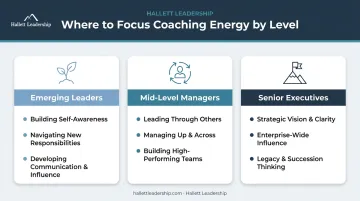
Mid-level managers are the critical leverage point in any coaching culture. McKinsey's 2023 research on middle managers found that 86% say coaching employees is a top way they add value — yet they spend less than one-third of their time on talent and people management, and only 20% strongly agree their organizations support them in that role.
That disconnect explains why coaching cultures often stall at the middle. Managers touch the largest number of people daily, yet they're the most likely to be administratively overloaded and the least likely to receive coaching development themselves.
Making Coaching Sustainable at Scale
- Embed coaching behaviors into existing rhythms — 1-on-1s, team check-ins, performance conversations — rather than adding separate coaching programs
- Reduce administrative burden on managers before expecting coaching capacity to increase
- Train managers in listening, questioning, reflection, and feedback as concrete skills, not abstract values
- Reinforce at the senior level by modeling the same behaviors being asked of managers
Frequently Asked Questions
What are the 5 key leadership skills?
Most frameworks cite communication, self-awareness, decision-making, emotional intelligence, and the ability to develop others. That last one now sits at the center of modern leadership models, which is why coaching ability has become a core competency rather than a nice-to-have.
What are the 5 skills of coaching?
Active listening, powerful questioning, building trust, giving constructive feedback, and championing self-awareness.
What is the difference between managing and coaching?
Managing focuses on directing tasks and ensuring outcomes. Coaching focuses on developing the person — their thinking, capability, and ownership — so they can solve problems independently. Good leaders do both, but knowing which mode a situation calls for is the real skill.
Can leadership coaching skills be learned, or are they innate?
They're learnable. Gallup's data showing that only 1 in 10 people naturally possess high manager talent is an argument for development, not a verdict on fixed ability.
How do coaching principles impact team performance and retention?
Gallup data shows highly engaged teams produce 14–18% higher productivity and 23% higher profitability — and managers drive 70% of the variance in that engagement. Teams led by coach-like leaders consistently show stronger performance and lower turnover because employees feel ownership over their work, develop real capability, and see a future in the organization — not just a to-do list.