Introduction
Organizations spend significant resources building EHS compliance systems, yet incidents keep happening. The technical infrastructure is often solid. The procedures exist. The checklists get completed. What fails is the human layer — specifically, the site manager who either brings safety culture to life or quietly lets it erode under production pressure.
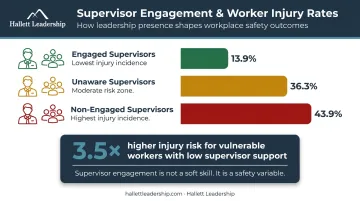
Research published in Safety and Health at Work found that workers with non-engaged supervisors reported injury prevalence of 43.9% — compared to just 13.9% among workers with engaged supervisors. That gap isn't a compliance gap. It's a leadership gap.
This article provides a practical framework for designing a global EHS leadership program built specifically for site managers. From core curriculum design to cross-cultural scaling and measurable outcomes, it covers everything needed to build a program that changes how managers actually lead — not just what they report.
Key Takeaways
- Site managers are the highest-leverage point in any EHS system; their engagement level directly predicts injury rates
- Compliance training addresses knowledge gaps; leadership development addresses behavioral gaps
- Effective programs combine experiential learning, one-on-one coaching, and structured accountability routines
- Global programs need a standardized competency framework with localized delivery
- Measure success with leading indicators, not incident rates alone
Why Site Managers Are the Linchpin of Global EHS Success
Site managers occupy the most consequential position in any EHS system. They sit between corporate safety strategy and the frontline workers executing it every day. When they're engaged, safety culture holds. When they're absent or distracted, even the best-designed compliance systems break down.
The data on this is clear. The same 2018 study cited above found that workers with unaware supervisors reported physical injury prevalence of 36.3% — more than double the 16.1% rate among workers with aware supervisors. For workers combining occupational health vulnerability with low supervisor support, injury risk was at least 3.5 times higher than for those with supportive leadership.
The Investment Mismatch
Most organizations concentrate EHS investment at two levels: executive buy-in and frontline worker training. Site managers get neither the authority coaching nor the leadership development they need to execute consistently.
Supervisors who haven't been developed as safety leaders default to the behaviors that got them promoted:
- Technical expertise over safety coaching
- Task management over team observation
- Output focus over hazard awareness
Safety becomes a box to check rather than a culture to build.
CPWR/CDC research on Foundations for Safety Leadership found that leaders at small and medium firms used safety leadership skills less frequently than large-company leaders before training — suggesting the capability gap is most acute precisely where it's least likely to be addressed.
Closing that gap requires deliberate leadership development — the kind that targets the specific behaviors distinguishing an effective safety leader from a compliant one.
What a Global EHS Leadership Program Must Accomplish
From Compliance Administration to Culture Leadership
The core goal is straightforward: produce site managers who can lead safety culture, not just administer safety procedures. That means influencing behavior, making judgment calls under pressure, holding teams accountable with empathy, and representing EHS values without direct supervision.
This requires a hard distinction between two things most organizations blur together:
| Compliance Training | Leadership Development |
|---|---|
| Addresses knowledge gaps | Addresses behavioral and character gaps |
| Teaches what the rules are | Develops who the manager is |
| Effective for procedures | Effective for culture |
| Can be delivered once | Requires ongoing reinforcement |
Both matter. But compliance training alone — which is what most organizations provide — cannot produce the behavioral consistency that global EHS performance demands.
Three Levels of Outcomes
A well-designed program should target outcomes across three levels:
- Individual: Self-awareness, communication skills, decision-making under pressure, emotional regulation
- Team: Psychological safety, near-miss reporting culture, accountability without fear
- Organizational: Consistent safety performance across sites, regardless of geography or local management style
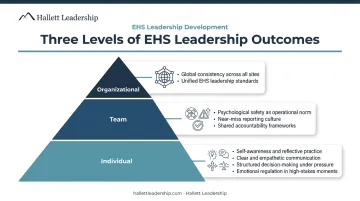
Hallett Leadership's Discovery Model targets exactly this progression — starting with individual self-awareness, moving through team-level accountability, and ultimately building the cultural consistency that sustains performance across regions.
Globally Consistent, Locally Adaptive
Site managers in Southeast Asia, the Gulf, and North America face different regulatory environments, workforce demographics, and risk profiles. A global program must standardize the leadership competency framework while allowing for localized delivery, language adaptation, and region-specific case examples.
For executive sponsors, the program should move four concrete needles:
- Reduced incident rates across all sites
- Measurable behavior change in site managers
- Higher near-miss reporting frequency
- Improved safety culture scores by region
These aren't soft outcomes — they're the metrics that justify the program's scope and budget.
Core Components of a Global EHS Leadership Program
Component 1 — Situational Risk Leadership
Site managers routinely face time-pressured decisions where applying standard procedure isn't enough. This module trains them to:
- Recognize leading risk indicators before incidents occur
- Triage dynamic situations rather than defaulting to generic responses
- Communicate urgency clearly — to crews and corporate leadership simultaneously
Hallett Leadership's Accelerated Leadership Program addresses this directly. The Stop-Look-Choose framework teaches leaders to pause automatic responses, assess all available options, and select the best course of action under pressure — a capability that transfers directly to high-stakes safety situations.
Component 2 — Communication and Influence Skills
Site managers often lack formal authority over subcontractors, visiting crews, or cross-functional teams. They need to persuade, not just instruct.
Effective delivery includes behavioral styles frameworks (such as DISC) to help managers understand how different people receive information — and adapt their approach accordingly. A communication style that works with a dominant personality won't land with a cautious one. Hallett Leadership uses these frameworks as a foundation for developing genuine influence skills rather than formulaic scripts.
Component 3 — Coaching and Accountability Structures
The best site managers coach their teams the same way they themselves are being developed. That means equipping them to:
- Model safe behavior visibly, especially during high-pressure production moments
- Run structured toolbox talks and incident debriefs that reinforce accountability
- Give constructive feedback that corrects behavior without triggering defensiveness
- Follow through on corrective actions — consistently, not selectively
Hallett Leadership's approach makes this explicit: executives and managers become better coaches by experiencing effective coaching themselves and then modeling those methods with their own teams.
Component 4 — Cross-Cultural and Cross-Site Leadership
Research on national culture and safety identifies six cultural dimensions that affect safety behavior, including power distance, individualism-collectivism, and uncertainty avoidance. A site manager who leads effectively in one cultural context may inadvertently undermine trust in another.
Key areas of focus include:
- Leading safety in high power-distance cultures where workers are reluctant to challenge authority
- Adapting communication style without compromising safety standards
- Building trust with crews whose backgrounds, languages, or norms differ from the manager's own
Component 5 — Experiential Learning Methodology
Lecture-based and online-only EHS training consistently underperforms for one reason: knowledge recall isn't behavior change. A NIOSH-supported meta-analysis of 95 safety and health training studies found that high-engagement methods — behavioral modeling, substantial practice, and dialogue — were more effective than passive instruction.
Leadership development requires experiential exercises, role-play scenarios, structured peer feedback, and real-world application back on site. Hallett Leadership's Discovery Model combines these elements with ongoing one-on-one coaching — pairing a structured group learning environment with a private space to work through real dilemmas and build new habits.

That distinction matters practically. A one-week seminar leaves managers with new information. Nine months of integrated coaching and experiential practice changes how they actually lead.
Building Leadership Behaviors, Not Just Technical Skills
The BE-DO-HAVE Model
Hallett Leadership's programs are grounded in a foundational principle: who the manager is determines what they do, which determines what the site has.
The BE-DO-HAVE framework asks three questions in sequence:
- Who do I need to be to accomplish this goal?
- What do I need to do?
- What do I need to have?
Most organizations default to the reverse — focusing on what systems to have and what procedures to do, while assuming that being will follow. It doesn't. Site managers who develop genuine self-awareness and accountability from within are more effective than those who follow safety procedures from external pressure alone.
Behaviors That Separate High Performers
The site managers with the strongest EHS outcomes share a recognizable behavioral profile:
- Speak up proactively rather than waiting for incidents to force the conversation
- Create environments where workers feel genuinely safe reporting near-misses
- Take ownership of culture rather than delegating it upward
- Maintain visible safety standards during high-pressure production moments — precisely when it's tempting to look the other way
A 2024 study of 14,943 frontline workers found that psychological safety was positively associated with safety improvement and intent to stay — but only about half of respondents felt comfortable questioning people in higher authority. The site manager's behavior determines which half their crew falls into.
The Executive Coaching Accelerator
Group program modules build shared language and frameworks. But developing the behaviors above — proactive communication, genuine accountability, calm under production pressure — requires more than shared vocabulary. One-on-one coaching accelerates individual behavior change by giving site managers a structured, private space to:
- Process real leadership dilemmas without performance stakes
- Receive honest feedback on their blind spots
- Build confidence to lead differently under pressure
Hallett Leadership's coaching engagements include approximately 1-2 hours of direct coaching per week, with ongoing availability during critical moments. The focus is on removing specific obstacles and building the internal capability to handle them without outside intervention over time.
The Technical-to-Leadership Transition Problem
Organizations routinely promote technically strong EHS professionals into site manager roles without providing leadership development support. The pattern is predictable: the new manager keeps doing what made them successful as an individual contributor — handling tasks themselves, focusing on technical accuracy, avoiding the messiness of managing people.
Hallett Leadership's case documentation includes a manager named Mike, promoted for exceptional technical work, who continued doing everything himself while his team disengaged from lack of direction. Through nine months of the Accelerated Leadership Program, the shift was concrete:
- Moved from task ownership to genuine delegation
- Team reported clearer direction and higher morale
- Performance outcomes improved alongside engagement
Nine months — not a one-week seminar. That timeline reflects how long it actually takes to replace ingrained habits with new leadership defaults.
Adapting Your Program Across Cultures, Sites, and Regulations
The Core Plus Model
The most widely adopted design framework for global EHS leadership programs is the "Core Plus" model, built around a simple distinction:
- Core establishes the non-negotiable leadership competencies and program frameworks applied consistently across every site and region
- Plus layers in localized delivery, regional case studies, language adaptation, and regulatory context at the site level
- Governance defines who owns each layer — typically a global program lead for Core, and regional HR or EHS leads for Plus
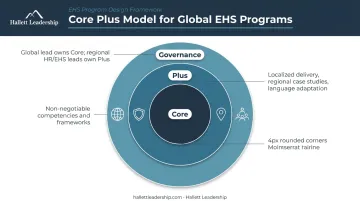
No two sites run different programs, but every site experiences one that feels relevant to their context. ISO 45001:2018 supports this structure directly, requiring an OH&S management system appropriate to the organization's context while mandating worker consultation and participation at applicable levels.
Culturally Intelligent Facilitation
Getting the Core right is only half the work. The Plus layer lives or dies on culturally intelligent facilitation — and that requires deliberate design, not improvisation:
- Use local co-facilitators or site champions who understand regional norms and can recognize when a standard exercise won't land
- Adapt role-play scenarios to local hazard types and workforce demographics
- Ensure materials are available in the primary languages of participants
- Adjust communication frameworks to account for power distance — in high power-distance cultures, explicit encouragement to speak up to authority must be built directly into the program design
Handling Regulatory Variation
Cultural adaptation addresses how the program is experienced. Regulatory variation addresses what compliance content gets included — and these two problems need separate solutions. The practical approach:
- Keep the leadership curriculum consistent across all jurisdictions
- Layer compliance content in as region-specific modules
- Ensure a site manager in Southeast Asia and one in North America share the same leadership behaviors — even when their compliance requirements differ considerably
How to Measure Whether Your Program Is Working
Leading vs. Lagging Indicators
Lagging indicators — TRIR, LTIFR, incident rates — confirm outcomes after the fact. Essential for reporting, they can't signal problems early enough to change course.
Leading indicators signal whether site manager behavior is actually changing:
- Near-miss reporting frequency (formula: near-miss count × 200,000 / hours worked)
- Toolbox talk quality ratings from crew members
- Corrective action close rates — specifically, percentage completed by due date vs. flagged 30 or 60 days overdue
- Management-led safety meeting frequency
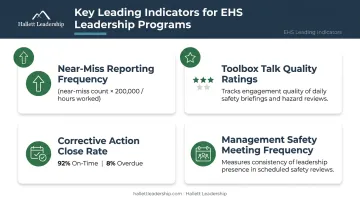
The Campbell Institute's leading indicators framework treats these as proactive, preventive measures that monitor EHS system performance before incidents occur.
Behavioral Measurement Tools
Combine multiple methods to build a complete picture:
- 360-degree feedback conducted before and after program completion, measuring how crews and peers rate site manager safety leadership
- Direct observation checklists completed during site visits to assess specific behaviors (toolbox talk quality, PPE modeling, near-miss response)
- Self-reported confidence surveys on specific leadership scenarios, tracked across program milestones
Connecting to Business Outcomes
Those behavioral measurements only sustain executive buy-in when they tie directly to financial outcomes. The NSC reported a 2024 cost of $48,000 per medically consulted work injury and $1,540,000 per workplace fatality. Total costs of work injuries reached $167 billion in 2022.
A program that meaningfully reduces incident rates across a multi-site operation carries substantial financial weight. The real measurement challenge is building a clear enough chain from leading indicator improvements to those cost reductions to justify sustained investment from executive sponsors.
Frequently Asked Questions
What components should a global leadership development program have?
A global program needs five core elements: a standardized leadership competency framework, experiential learning modules, individual coaching, culturally adaptive delivery, and a measurement system — applied consistently across all sites while local regulatory and cultural context shapes how content is delivered.
What is a good example of management leadership in an EHS program?
A site manager who proactively coaches crews on near-miss reporting, models PPE use without exception (including during high-pressure production moments), and runs regular accountability check-ins that treat safety as a genuine performance standard rather than a compliance checkbox.
What is an EHS management program?
An EHS management program is an organization's structured system for identifying, controlling, and continuously improving environmental, health, and safety risks. Its effectiveness depends heavily on whether site-level managers are equipped to lead it — not just administer it. That distinction is where most programs either succeed or stall.
How do you measure the effectiveness of an EHS leadership program?
Use leading indicators (near-miss reporting rates, corrective action close times, toolbox talk quality) and behavioral assessments (360-degree feedback, observation audits) alongside — not instead of — incident rates. Lagging indicators confirm outcomes; leading indicators show whether the program is working before incidents occur.
What is the difference between EHS training and EHS leadership development?
EHS training builds knowledge and procedural compliance. EHS leadership development builds the behavioral capabilities that determine whether that knowledge is consistently applied across a site under production pressure: communication, coaching, accountability, and cultural influence.