
Introduction
Leadership has never been more demanding. Executives and senior managers are expected to drive performance, retain top talent, navigate constant change, and build collaborative cultures — often without a single trusted advisor who will tell them the truth.
Leadership books and group training programs have their place. But they don't follow you into a difficult board conversation, a team conflict, or a high-stakes hiring decision. They don't tell you what you're missing. An executive coach does.
What follows are five concrete reasons why executive coaching delivers results that generic development programs can't — grounded in real behavioral shifts, measurable outcomes, and compounding leadership growth.
Key Takeaways
- Executive coaching provides objective, confidential input that leaders almost never get from their own teams
- It identifies and closes the specific capability gaps holding a leader back — not generic ones
- Better leadership behavior directly shapes team engagement, retention, and culture
- Emotional intelligence and executive presence are coachable skills that compound over time
- 86% of companies recouped their coaching investment, with a median ROI of 700% (ICF Global Coaching Client Study)
What Is Executive Coaching?
Executive coaching is a structured, one-on-one engagement between a leader and an experienced coach designed to improve leadership effectiveness, decision-making, and interpersonal impact — with a focus on real-world outcomes, not theoretical frameworks.
The International Coaching Federation defines coaching as "partnering with clients in a thought-provoking and creative process that inspires them to maximize their personal and professional potential." In a leadership context, that means working through the specific challenges, gaps, and development areas that a leader faces in their actual role.
A few important clarifications:
- Designed for C-suite executives, senior directors, and mid-level managers with high-growth potential — not a remediation tool for struggling employees
- Distinct from therapy, mentoring, life coaching, or group training programs
- Accelerates behavioral and strategic shifts that produce better business results, stronger teams, and more effective leadership
For leaders who are already performing well, coaching provides the structured reflection and targeted feedback that self-directed growth rarely delivers — which is exactly why the reasons to hire one are worth examining.
5 Reasons to Hire an Executive Coach
Reason 1: You Gain Clarity, Focus, and an Honest Outside Perspective
The higher a leader rises, the less candid feedback they receive. Direct reports defer. Peers hesitate to challenge. Board members operate at arm's length. As Harvard Business Review notes, blind spots grow as seniority increases — and most leaders don't realize it's happening.
The data behind this is striking. A Korn Ferry Institute analysis found that professionals at poor-performing companies had 20% more blind spots than those at financially strong companies — and were 79% more likely to have low overall self-awareness.
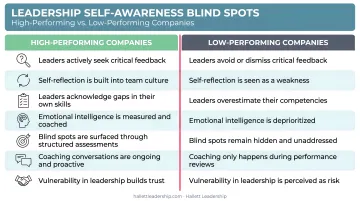
An executive coach creates something rare: a confidential, neutral space where a leader can think out loud, challenge their own assumptions, and get genuinely objective input. No direct report, peer, or board member can fully provide this. Their interests are always adjacent to yours.
When this matters most:
- High-stakes transitions or role changes
- Periods of organizational change where clarity is scarce
- When the team is consistently agreeable but results are stagnating
- Any moment a leader suspects they're operating on incomplete information
KPIs affected: Decision-making quality, speed of strategic clarity, reduction in costly leadership miscalculations
Reason 2: You Break Through Leadership Plateaus
The skills that got a leader to their current level are rarely the skills needed to advance further. Technical expertise and individual performance give way to influence, vision-setting, and the ability to develop others. Many leaders stall not because they lack effort, but because no one has ever shown them precisely what needs to change.
Executive coaching addresses this directly. A 2023 meta-analysis of 20 randomized controlled trial studies found executive coaching produced a moderate overall effect (Hedges' g = 0.43) across behaviors, attitudes, and personal characteristics — meaningful change that generic training rarely achieves alone.
The productivity gap between training and coaching is even more pronounced in older but frequently cited research: management training alone increased productivity by 22.4%, while training combined with executive coaching increased it by 88% — a finding from a study in a public agency that, while dated, directionally aligns with what practitioners observe consistently.
When leaders plateau, the impact spreads. They become bottlenecks for the teams and organizations depending on their growth — and DDI's 2025 Global Leadership Forecast found that 40% of stressed-out leaders had considered leaving to improve their well-being, a clear sign that leadership gaps carry real talent-retention consequences.
When this matters most:
- After a performance review flagging leadership behaviors
- When preparing for a significantly larger role
- When a leader has been at the same level for an extended period without clear reasons why
Reason 3: You Build Stronger Teams and a High-Performance Culture
A leader's behavior is not a personal matter — it shapes every interaction their team has, every day. Gallup research consistently shows that managers account for 70% of the variance in team engagement. When leadership behavior changes, team dynamics change with it.
Coaching addresses this at the source. Rather than trying to fix team dysfunction through team-building activities or HR interventions, coaching targets the leader's communication style, conflict resolution approach, and collaborative habits — the behaviors that either build or erode team performance.
The organizational cost of getting this wrong is substantial:
- Global employee engagement fell to 20% in 2025, costing the world economy an estimated $10 trillion in lost productivity, according to Gallup's State of the Global Workplace report
- SHRM found 84% of U.S. workers blame poor managers for creating unnecessary stress
- Gallup estimates replacing a manager-level employee costs around 200% of their annual salary
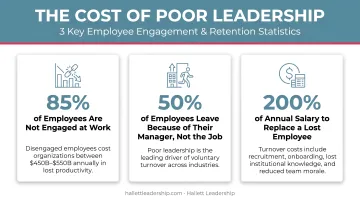
High turnover, disengagement, and internal conflict are often symptoms of leadership behavior — not team dysfunction. Addressing the leader addresses the root cause.
Hallett Leadership's work with 20th Century Fox illustrates this dynamic at scale. After workshopping 1,100 employees through a nine-month leadership development program, the organization's culture shifted from one that inhibited unsolicited ideas to one where employees actively contributed innovations — with enough momentum that a formal steering committee had to be created to manage the volume.
KPIs affected: Employee engagement scores, retention rates, team collaboration metrics, manager effectiveness ratings
Reason 4: You Develop Emotional Intelligence and Executive Presence
Emotional intelligence is one of the highest-leverage capabilities a leader can develop. It's also notoriously difficult to improve through self-study alone.
Reading about self-regulation doesn't build it. Practicing it under real conditions, with structured feedback, does.
A 2023 review in Heliyon examining 104 peer-reviewed articles on emotional intelligence, leadership, and work teams confirmed the link between EI and leadership effectiveness. And a 2017 quasi-experimental study found coaching significantly improved leaders' emotional and social intelligence competencies — outcomes that classroom instruction rarely replicates.
Executive coaching surfaces behavioral patterns a leader may not see in themselves, then provides structured feedback and exercises to build these skills in the context of real daily work.
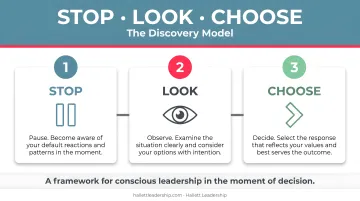
At Hallett Leadership, this is central to the coaching philosophy. The Discovery Model — which combines behavioral science with experiential learning — trains leaders to STOP automatic behavioral responses, LOOK at all available options, and CHOOSE the most effective course of action deliberately. This is EI development in practice, not in theory.
Executive presence — how a leader communicates, commands a room, navigates pressure, and inspires trust — is built from the inside out. Coaching addresses the internal drivers that produce external results. A leader who builds composure under pressure and genuine connection with their team changes how their people show up — and that shift shows up in results.
When this matters most:
- When feedback consistently points to communication or interpersonal issues
- Before high-visibility presentations, negotiations, or board interactions
- When stress responses are affecting team morale or decision quality
Reason 5: You Accelerate Strategic Growth and Business Results
The return on investment from executive coaching extends well beyond personal development. Well-coached leaders set clearer goals, hold themselves and others more accountable, and make faster, better-informed decisions that affect the entire organization.
The ROI data, while older and based on self-reported financials, points in a consistent direction. The 2009 ICF Global Coaching Client Study reported a median company ROI of 700% and found that 86% of companies made back their coaching investment. Additional studies from Manchester Consulting reported returns of 5.7 times the initial investment.
These figures require context — methodologies vary, sample sizes for financial calculations are limited, and results depend heavily on engagement quality. That said, they directionally reflect what leadership behavior research already predicts: when a leader improves, team engagement, decision quality, and organizational performance follow.
Coaching also instills something most leaders lack: a consistent discipline of reflection and goal review that keeps them aligned with long-term strategy instead of pulled by daily demands. That habit compounds — a leader who builds it in year one makes measurably different decisions by year three.
Downstream business metrics affected: revenue growth, team output, operational efficiency, employee retention, and competitive positioning
What Happens Without Executive Coaching
When leaders operate without honest outside input, decisions get made in echo chambers.
Feedback loops reinforce blind spots. Team members eventually stop bringing problems forward — not because problems disappear, but because past experience taught them it's not worth it.
The organizational consequences are predictable:
- Talented employees leave because they don't feel heard or see growth modeled by their managers
- Leaders in transition fail at striking rates — research from DDI and CCL consistently shows executive failure within the first 18 months can reach over 50%, for both internal promotions and external hires
- Culture problems surface at the team level but trace back to individual leadership behaviors that were never addressed
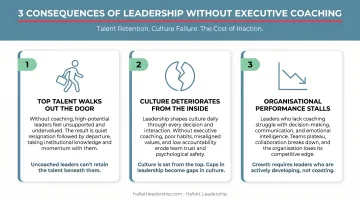
These patterns show up in attrition data, engagement surveys, and missed strategic targets. The cost of underdeveloped leadership is real — it's just harder to see on a balance sheet than a coaching investment.
How to Get the Most Value from Executive Coaching
Coaching produces the best results when the leader enters the engagement prepared to be challenged — and committed to applying what they learn between sessions.
A few factors consistently separate leaders who see strong outcomes from those who don't:
- Openness to honest feedback: Leaders who treat uncomfortable observations as data, not threats, progress faster and get more from every session
- Integration into real work: Effective coaching connects directly to live business challenges. Hallett Leadership's STOP-LOOK-CHOOSE framework is built for this — it activates in actual leadership moments, not just scheduled coaching calls
- Consistency over time: Behavioral change compounds through self-awareness, practice, and reinforcement. According to HBR research, the most common executive coaching engagement runs seven to twelve months for good reason
Leaders who commit to the process don't just grow individually. Their teams perform better, decisions improve, and the culture around them shifts — often visibly within a single quarter.
Conclusion
The five reasons covered here — clarity and honest feedback, breaking through plateaus, stronger team performance, emotional intelligence development, and measurable business outcomes — aren't abstract promises. They're behavioral shifts that compound when coaching is treated as a sustained leadership practice.
Most leaders don't need to be convinced that development matters. The real question is whether they're ready to commit to the kind of honest self-examination and intentional growth that produces lasting change.
The leaders who grow fastest aren't the ones with the most talent — they're the ones who sought honest perspective and acted on it. That's exactly what the right executive coach provides.
Frequently Asked Questions
What are the top reasons to hire an executive coach?
The five core reasons span self-awareness, performance, leadership, emotional intelligence, and measurable business results. The impact compounds when coaching becomes an ongoing practice rather than a single event.
What qualities should an effective executive coach have?
An effective executive coach brings real-world leadership experience, strong listening skills, and the ability to deliver honest feedback. Equally important: a structured approach to tracking progress, not just offering motivation or general advice.
How is executive coaching different from leadership training or mentoring?
Training delivers general skills to groups; mentoring shares a mentor's personal experience. Executive coaching is a personalized, ongoing engagement focused on the specific leader's behavioral gaps, goals, and real-time work challenges.
How long does executive coaching typically last?
HBR research found the most common engagement length is seven to twelve months — long enough for behavioral change to take root and produce measurable results across team performance.
Can executive coaching benefit mid-level managers, or is it only for C-suite leaders?
Coaching is highly effective for mid-level managers and emerging leaders — particularly those preparing for larger roles, managing teams for the first time, or navigating significant organizational change.
How do I know if I'm ready to hire an executive coach?
The clearest signal is a genuine desire to improve combined with a willingness to act on honest feedback. Leaders who stay committed between sessions — not just during them — see the strongest results.