Introduction
Most leadership training teaches people what to do. Advanced strategic leadership coaching asks a harder question first: who do you need to be?
That inside-out distinction matters more than it sounds. Organizations pour enormous resources into leadership development — U.S. companies alone spent $160 billion on training in a single year, yet leaders routinely revert to old behaviors when the underlying mindset stays unchanged. Checklists and frameworks don't fail because they're poorly designed. They fail because behavior change that skips the inner work doesn't hold.
This article is for senior leaders and mid-level managers who've been through the standard programs and are asking what comes next. What do advanced techniques actually look like — and how do you build something that multiplies coaching capability across an organization rather than keeping it locked in a single relationship? That's what this guide unpacks.
Key Takeaways
- Strategic leadership coaching develops leaders from the inside out: mindset, behavior, then organizational results
- The four pillars of advanced coaching — presence, powerful questioning, emotional regulation, and cultural awareness — function as an integrated system
- 95% of people believe they're self-aware; only 10–15% actually are — closing that gap is the engine of advanced development
- Measuring coaching ROI requires both leading indicators (360-degree feedback, behavioral shifts) and lagging indicators (engagement, retention, performance)
- Middle managers are the highest-leverage group for coaching investment — and the most underserved
What Is Strategic Leadership Coaching — And Why Advanced Techniques Matter
Strategic leadership coaching develops a leader's ability to cast an organizational vision, shape culture, and guide others to execute that vision. It's distinct from general executive coaching, which typically focuses on individual performance. Strategic coaching operates at the intersection of the leader's inner development and the organization's external outcomes.
That gap shows up quickly at the senior level. Most theoretical seminars and talking-head workshops deliver insights that disappear in the crush of daily work. As Hallett Leadership founder Dean Hallett observes, most executives have never been coached effectively and must rely solely on their own intelligence and intuition — leaving powerful developmental leverage untouched.
The Advanced Distinction
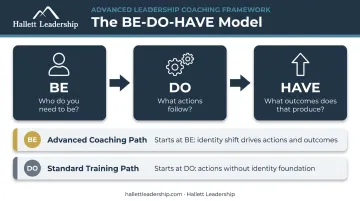
Advanced techniques engage a different mechanism entirely. Standard training delivers knowledge. Advanced coaching creates behavioral change by working with the psychological and emotional patterns that either accelerate or block a leader's effectiveness — what Hallett Leadership's BE-DO-HAVE model describes:
- BE — Who do you need to be to lead at this level?
- DO — What actions follow from that way of being?
- HAVE — What outcomes does that produce for your organization?
Most training programs start at DO and hope BE follows. Advanced coaching reverses the sequence. The inner shift comes first.
McKinsey's research on inside-out leadership — drawing on input from more than 500 CEOs — found that companies emphasizing human capital development are 1.5x more likely to sustain high performance and carry roughly half the earnings volatility of peers. Self-awareness and inner development are structural advantages — not soft extras.
The Four Pillars of Advanced Strategic Leadership Coaching
Advanced coaching techniques cluster around four interconnected capabilities. None of them work well in isolation. Each one amplifies the others — and gaps in any single pillar limit the whole system.
Pillar 1 — High-Quality Presence and Attention
Presence is not the same as active listening. Active listening is a technique. Presence is full cognitive and emotional engagement — the ability to sense what's unspoken, notice what's beneath the surface, and create conditions where people feel genuinely seen.
Leaders who develop this level of attention build psychological safety without manufacturing it. When a manager walks into a conversation already composing their response, they're not present — and the person across the table knows it immediately, even if they can't name it.
In Hallett Leadership's Accelerated Leadership Program, being fully present at work is treated as a core leadership capability — a prerequisite for every other advanced skill that follows.
Pillar 2 — Powerful, Open-Ended Questioning
Advanced coaches use questions not to gather information, but to create self-discovery. The goal is shifting a leader from reactive thinking to genuine strategic reflection.
Some of the most effective question types include:
- "What assumptions are you making about this situation — and are they still true?"
- "What's the real challenge we're trying to solve here?"
- "What's one thing we're not talking about that we probably should be?"
- "If we could start over, what would we do differently?"
Dean Hallett's approach to questioning treats curiosity as a strategic tool. When he helped design Fox's digital supply chain, the breakthrough didn't come from presenting solutions — it came from asking stakeholders questions that surfaced insights already present but unexamined. The same principle applies in coaching: powerful questions don't supply answers, they create the conditions where leaders find their own.
Pillar 3 — Emotional Regulation and Behavioral Awareness
Before a leader can coach others effectively, they have to manage their own emotional responses. Quieting the impulse to jump in with solutions — before a person has fully processed their own thinking — requires genuine self-regulation, not just patience.
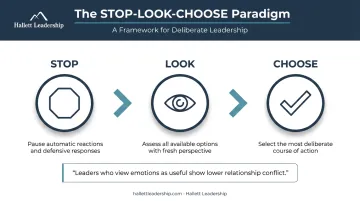
Hallett Leadership addresses this through the STOP-LOOK-CHOOSE paradigm:
- STOP automatic reactions and defensive responses
- LOOK at all available options with fresh perspective
- CHOOSE the most deliberate course of action
A 2024 study of 326 managers found that leaders who viewed emotions as useful — rather than obstacles to manage — showed higher emotional repair capacity and lower relationship conflict than peers who suppressed emotional awareness. The downstream effect: emotionally regulated leaders build psychologically safer teams, not by accident but by consistent behavioral modeling.
Pillar 4 — Culturally Aware and Contextually Sensitive Coaching
Strategic leaders coach across diverse teams, functions, geographies, and backgrounds. What counts as direct feedback in one cultural context reads as aggressive in another. What signals engagement in one team signals disrespect in a different one.
Advanced coaching requires understanding how cultural context shapes communication styles, conflict responses, and what "good leadership" looks like. HBR research involving focus groups with 400+ managers and executives across the US, Asia, Latin America, and the Middle East identified what cross-cultural trust actually requires:
- Learning colleagues' cultural backgrounds, not just their roles
- Understanding both results and character — not adapting surface-level style alone
- Recognizing that trust-building norms vary significantly across geographies
Leaders who develop cultural awareness don't just avoid miscommunication. They build credibility with team members who have historically received generic, context-blind feedback.
Mastering Emotional Intelligence and Self-Awareness as a Strategic Leader
EQ is not a personality trait you either have or don't. It's a set of capabilities that can be developed — and the data on why it matters is hard to ignore.
According to TalentSmartEQ, emotional intelligence accounts for 58% of success across job types, and 90% of top performers score high in EQ. The self-awareness gap compounds this: HBR research found that while 95% of people believe they're self-aware, only 10–15% actually are.
That gap is where coaching does its most important work.
The Four EQ Domains in a Coaching Context
| EQ Domain | What It Means in Practice |
|---|---|
| Self-Awareness | Knowing your triggers, blind spots, and impact on others |
| Self-Management | Regulating impulses and modeling composure under pressure |
| Social Awareness | Reading team dynamics and organizational subtext accurately |
| Relationship Management | Coaching, inspiring, and influencing others toward shared goals |
Overconfident leaders dismiss feedback loops. Underconfident leaders under-delegate and micromanage. Both patterns are self-awareness failures — and both are addressable through structured coaching.
How Hallett Leadership Develops EQ Experientially
Knowing what emotional intelligence is does not increase it. Hallett Leadership's approach is built on this directly: EQ develops through doing, not reading.
Their programs use several specific mechanisms:
- Peer feedback exchanges that surface blind spots participants didn't know existed — and reveal how others actually experience their leadership
- Impromptu speaking exercises that put leadership identity under mild pressure, building the muscle of composure in real time
- The Johari Window framework, which moves content from blind spot to conscious awareness through deliberate feedback and self-disclosure
The result of these exercises isn't awareness of EQ principles. It's behavioral change. A 2020 controlled study of a three-month coaching-based leadership intervention with executives and middle managers found measurable improvements in coaching skills, psychological capital, and engagement — with gains sustained at a four-month follow-up. That sustained transfer is what separates experiential development from a one-day workshop.
That durability matters most when the pressure is highest. Leaders who've built genuine self-awareness through this process understand their own biases and emotional defaults — so when decisions are urgent and the stakes are real, their choices reflect values rather than reaction. This is the practical payoff of the BE-DO-HAVE model: identity built through coaching directly shapes how leaders perform when it counts.
Building a Coaching Culture That Multiplies Leadership Across Your Organization
The highest return on a coaching investment doesn't come from developing one leader. It comes when that leader begins applying the same techniques with their direct reports — and those managers do the same with theirs.
That multiplier effect only happens when coaching capability is built into management practice, not treated as a leadership perk.
What a Real Coaching Culture Looks Like
The ICF/HCI research across 545 organizations found that only 13% had a strong coaching culture — but those organizations reported:
- 65% high employee engagement vs. 52% elsewhere
- 60% reported revenue growth above industry peers
The same study found that 51% of managers using coaching skills received fewer than 30 hours of informal coaching training, and 22% received none at all. That gap is where most coaching culture initiatives break down.
The Middle Manager Leverage Point
Middle managers are the most critical and most underserved layer in any leadership development strategy. They sit between organizational vision and daily execution. When they develop advanced coaching skills, they translate strategic intent into actual team behavior — in ways executive communication alone can't replicate.
McKinsey data reinforces this: organizations with strong managers realize 21x greater total shareholder return than those with weak managers. The ROI argument for investing in management-level coaching isn't aspirational. It's computable.
That's the logic behind Hallett Leadership's nine-month Accelerated Leadership Program, built specifically for this tier. It develops coaching capability through the Discovery Model, integrating behavioral science, experiential learning, and one-on-one coaching directly into participants' daily work rather than separating it out.
Conditions That Sustain a Coaching Culture
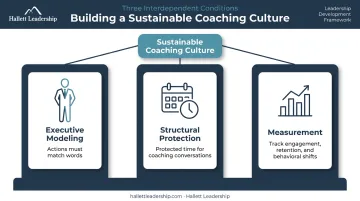
Three conditions determine whether a coaching culture takes root or fades:
- Executive modeling: Leaders at the top must visibly practice coaching behaviors, not just endorse them. As Dean Hallett puts it, "your actions must match your words."
- Structural protection: Coaching conversations need protected time, not just intent. The ALP builds in regular weekly touchpoints between participants and coaches as a deliberate commitment.
- Measurement: Without tracking engagement, retention, and behavioral shifts, there's no way to distinguish sustained cultural change from temporary motivation.
How to Measure Progress and Results in Strategic Leadership Coaching
Organizations investing in coaching need more than participant satisfaction scores. They need evidence that behavioral change is real, lasting, and connected to business outcomes — not just that leaders felt energized after a session.
Leading vs. Lagging Indicators
| Indicator Type | Examples |
|---|---|
| Leading | 360-degree feedback scores, self-reported EQ assessments, manager observation of coaching behaviors |
| Lagging | Team engagement scores, retention rates, decision-making speed, project completion rates |
The Manchester Review study of 100 executives found coaching ROI averaged 5.7x the initial investment, with 53% reporting increased productivity and 77% reporting improved relationships with direct reports. A 2023 meta-analysis of 20 randomized controlled trials reinforces this: executive coaching produced a moderate overall effect (Hedges' g = 0.43), with notably stronger behavioral outcomes (g = 0.73). The behavioral evidence, in other words, is more robust than the financial ROI data alone.
Gallup's engagement research adds important downstream context: disengaged employees cost the global economy $8.8 trillion, and managers account for 70% of variance in team engagement. Coaching that makes managers more effective directly reduces that cost — which is why aligning development goals to organizational metrics matters so much.
Aligning Coaching Goals to Organizational Outcomes
Individual development that isn't tied to organizational objectives becomes a personal benefit rather than a business investment. The connection requires structure:
- Set SMART goals at the start of each engagement, linked to specific business outcomes
- Use OKRs to map individual leader behavior to team and organizational metrics
- Build structured performance reviews that reference coaching progress, not just output
Hallett Leadership builds this into its coaching engagements through weekly goal setting — establishing checkpoints around personal development and high-performance results, then coaching through to completion. Development and accountability live in the same process, not separate tracks.
Frequently Asked Questions
What is the difference between strategic leadership coaching and standard executive coaching?
Executive coaching typically focuses on individual performance and career development. Strategic leadership coaching connects a leader's development to organizational vision, team culture transformation, and long-term business outcomes, giving it broader scope and higher organizational leverage than individual-focused work.
What advanced coaching techniques are most effective for senior leaders?
The four most impactful techniques are empathetic presence, powerful open-ended questioning, emotional regulation, and culturally sensitive coaching. They work as a system: presence enables deeper questioning, emotional regulation makes feedback land, and cultural awareness ensures the process builds trust rather than eroding it.
How long does it take to see measurable results from strategic leadership coaching?
Behavioral shifts typically begin within three to six months of sustained engagement. Organizational-level changes in culture, engagement, and retention generally become visible over six to eighteen months, depending on program intensity and how consistently leaders apply what they're developing.
Can middle managers benefit from strategic leadership coaching, or is it only for executives?
Middle managers are often the highest-leverage group for this investment. They directly shape day-to-day team culture and translate executive strategy into actual behavior, which makes their development critical to closing the gap between organizational vision and what actually gets executed.
How does emotional intelligence coaching differ from general leadership training?
General training delivers EQ concepts cognitively. EQ coaching develops leaders through experiential reflection, real-time feedback, and behavioral practice: the kind of work that creates durable behavioral change rather than temporary awareness that fades under pressure.
How do I know if my organization is ready for advanced strategic leadership coaching?
Key readiness signals include executive willingness to model coaching behaviors (not just endorse them), a commitment to measuring outcomes, and recognition that current programs produce awareness without lasting behavioral change. When leaders know what to do but revert under pressure, an experiential, inside-out approach is likely what's missing.