Introduction
Most organizational change efforts stall not from a flawed strategy, but from unexamined habits — the communication patterns, group dynamics, and decision-making routines that quietly undermine execution at every level.
Process consultation (PC) addresses exactly this gap. Developed by Edgar Schein, it's a collaborative OD approach in which the consultant helps an organization perceive, understand, and act on its own internal dynamics, rather than diagnosing the problem and handing over a solution.
For organizational leaders, HR professionals, and OD practitioners, that distinction is operationally significant. When the root cause of a performance problem is relational or cultural rather than technical, the consultant's role is to build the organization's capacity to solve it — not to deliver the solution directly.
This article explains what process consultation is, how it differs from expert-model consulting, how its layered intervention framework works in practice, and when it is and isn't the right tool.
Key Takeaways
- Process consultation is an OD intervention where the consultant works with the client to diagnose and solve problems, building client capability rather than delivering outside answers.
- Edgar Schein's core principle: clients must own the problem and solution for change to stick.
- PC moves through progressive levels of intervention, from open exploration to more directed challenge.
- Best suited for relational, cultural, and communication dysfunction, not technical knowledge gaps.
- The goal is lasting organizational capability, not a one-time fix.
What Is Process Consultation?
Process consultation (PC) is an OD methodology built on a straightforward premise: organizations learn best by working through their own problems, not by outsourcing them. The consultant's role is to build a working relationship that helps the client perceive, understand, and act on the interpersonal and group dynamics — the "process events" — shaping how work actually gets done.
The emphasis falls on the client. They define the problem, generate the solution, and own the outcome.
Schein introduced this model in his 1969 book Process Consultation: Its Role in Organization Development, and later refined it in Process Consultation Revisited (1999). His central claim: organizations benefit most from participating in their own diagnosis, not from receiving one delivered externally.
How PC Differs from Other Consulting Models
Schein identified three distinct helping models, and the contrast between them clarifies what makes PC distinctive:
| Model | Who Diagnoses | Who Solves | Outcome |
|---|---|---|---|
| Expert | Consultant | Consultant | Organization remains dependent |
| Doctor-Patient | Consultant | Consultant | Organization remains dependent |
| Process Consultation | Client + Consultant | Client (facilitated) | Organization becomes capable |
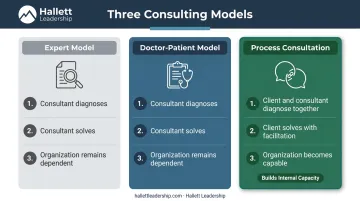
In both the expert and doctor-patient models, the organization hands the problem to someone else and waits for a prescription. In PC, the organization develops the capacity to identify and address its own dynamics — so the next problem doesn't require an outside fix.
Why Organizations Turn to Process Consultation
The Problems That Require It
PC becomes necessary when an organization is experiencing process-level dysfunction — specifically, challenges rooted in how people interact, communicate, and make decisions rather than gaps in technical knowledge. Common triggers include:
- Persistent communication breakdowns between teams or leadership layers
- Recurring conflict that doesn't resolve despite repeated interventions
- Unclear or contested decision-making authority
- Low trust between staff and leadership
- Resistance to change that resurfaces no matter how the initiative is framed
These are not problems a training program or restructuring exercise will fix. They sit below the surface of the organizational chart, invisible to interventions built for more visible, structural issues.
What Conventional Interventions Miss
Surveys, restructuring, and training programs address symptoms above the waterline. The dynamics actually driving the dysfunction (communication norms, group psychology, unspoken power dynamics) remain unexamined. Organizations repeat the same interventions and wonder why the problem keeps coming back.
That gap is exactly where participation-based approaches gain their edge.
The Case for Participation
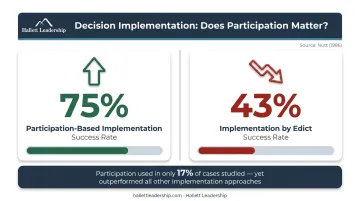
The participatory nature of PC is one of its most evidence-supported advantages. Nutt's 1986 study in the Academy of Management Journal found 75% success rates for persuasion and participation-based implementation tactics, compared to just 43% for implementation by edict. Participation was used in only 17% of cases studied — yet it outperformed every other approach.
This connects directly to what Schein called the principle of psychological ownership. Pierce, Kostova, and Dirks (2001) define it as the state in which individuals feel a target is genuinely theirs — built through direct control over it and personal investment in it.
Schein's 1997 MIT working paper put the implication plainly: "The client owns the problem and the solution."
When employees help develop the diagnosis and the solution, adoption follows. When a solution is handed to them, it rarely does.
How Process Consultation Works: The Four Levels of Intervention
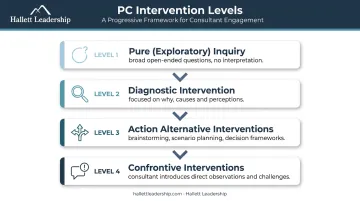
PC is not a single technique. It's a layered framework in which the depth of intervention depends on the trust established, the organization's readiness, and what the situation demands. Interventions move from open exploration toward progressively more directed engagement.
Pure (Exploratory) Inquiry
The engagement opens with broad, open-ended questions: What is going on? Can you walk me through the situation? The consultant listens without interpreting, imposing direction, or rushing toward solutions. The sole objective is to understand the problem as the client actually experiences it.
This phase is strategically critical. Many organizational issues present with surface symptoms that mask deeper structural or relational causes. Skipping exploratory inquiry means solving the wrong problem, which is the most common failure point in conventional consulting engagements.
Diagnostic Intervention
Once a baseline understanding exists, questions become more focused. The shift moves from what is happening to why is it happening. The consultant begins steering conversation toward feelings, causes, perceptions, and consequences, without yet inserting their own interpretations.
Diagnostic tools used at this stage include:
- Structured feedback sessions with key stakeholders
- Direct observation of team meetings and workflows
- Collaborative data review (not delivered as an external audit)
A critical insight often surfaces here: employees and leaders already hold most of the knowledge needed to diagnose their own problem. The process makes that knowledge visible and actionable.
Action Alternative Interventions
When the client clearly understands the problem, not just the consultant, the work shifts to generating options. The consultant facilitates structured processes such as brainstorming, scenario planning, and decision frameworks that enable the organization to develop and evaluate its own solutions.
By working through the analysis and decision-making themselves, leaders and teams build strategic and diagnostic skills that outlast the engagement.
Confrontive Interventions
At this level, the consultant introduces their own observations or hypotheses directly, challenging the client to examine what they may have overlooked or avoided. This can include:
- Surfacing unspoken resistance within the team
- Naming psychological safety gaps that limit candid dialogue
- Reframing a group's recurring interpretation of a persistent conflict
Timing is everything. Confrontive inquiry should only be deployed once a trusting, balanced relationship exists. Used prematurely, it shuts dialogue down. Used at the right moment, it unlocks perspectives the client couldn't access independently.
Schein's principle: be "constructively opportunistic": respond to moments of genuine openness, not a fixed agenda.
The Consultant's Role: Facilitation, Not Authority
The demand on the PC consultant is counterintuitive. Rather than demonstrating expertise and providing answers, the process consultant must actively resist "fixing" things — even when the problem seems obvious — because imposing a solution undermines the client's ownership and makes the outcome fragile.
Schein articulated this as "accessing one's ignorance." The consultant enters with deliberate openness, setting aside assumptions and expert positioning to remain genuinely attuned to what is happening within the organization. Diagnosis and intervention are never truly separate in PC — every act of inquiry already shifts how people think about the issue. Questions must be chosen with that in mind.
Leader Readiness Matters
For PC to work, organizational leaders must be willing to engage in reflective dialogue and tolerate uncertainty. This isn't a small ask. It requires leaders to recognize that their own assumptions may be part of the problem — and to sit with that discomfort rather than deflect it.
Leaders who have built self-awareness and facilitative communication skills through structured development work are measurably better positioned for this kind of engagement. Hallett Leadership's Discovery Model addresses this readiness gap directly.
The model begins at a state of unconsciousness — characterized by certainty, defensiveness, and resistance to new inputs — and moves leaders through confusion and curiosity toward genuine expanded awareness. The Johari Window framework helps leaders surface blind spots and challenge assumptions they hadn't examined.
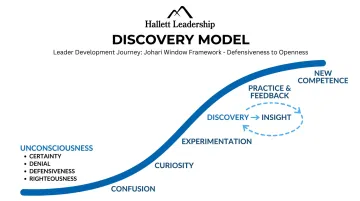
That progression is exactly what PC demands. Without it, even a skilled consultant will hit a wall — not because the diagnosis was wrong, but because the leaders weren't ready to hear it.
When Process Consultation Is — and Isn't — the Right Fit
Where PC Works Best
Process consultation is the right tool when the core challenge is relational, cultural, communicative, or political — when the organization's own thinking, norms, or group dynamics are a significant part of the problem:
- Recurring leadership conflicts that don't resolve through direct conversation
- Low trust between departments or between leadership and staff
- Culture misalignment after a merger or acquisition
- Resistance to change that doesn't respond to rational arguments or repeated mandates
These are the conditions where toxic culture exerts its most powerful effects — MIT Sloan Management Review reported in 2022 that toxic culture was approximately 10 times more predictive of attrition than compensation during the Great Resignation period.
Where PC Is Not the Right Tool
PC is not a substitute for domain expertise. When an organization genuinely lacks specific technical knowledge — regulatory compliance, specialized engineering capability, financial restructuring — the expert model is more efficient and appropriate. PC is a complement to technical consulting, not a replacement for it.
Two warning signals that PC is being misapplied:
- A consultant is brought in to validate a solution leadership has already decided on
- The engagement is structured to produce a predetermined outcome rather than genuine collaborative discovery
That's expert consulting dressed in PC language. It fails for the same reasons imposed solutions always fail.
Organizational Readiness
Even in the right context, PC can stall if the organization isn't ready for it. The approach requires leadership that is genuinely willing to be uncertain, engage in open inquiry, and accept that their own assumptions may be part of the problem.
Organizations that haven't yet developed this level of psychological safety may need preparatory work before a PC engagement yields real results. Leadership development and trust-building are sometimes prerequisites — not parallel tracks.
Conclusion
Process consultation is a philosophy about how lasting organizational change happens. When organizations are guided to see and solve their own dynamics, results are more durable, internal adoption follows more readily, and the organization develops real capability it keeps long after the engagement ends.
For leaders, knowing whether a challenge calls for process consultation or expert-model consulting is itself a strategic decision. Making that distinction well — and then engaging productively in the collaborative inquiry PC requires — depends on self-awareness and facilitative capacity.
Those aren't traits leaders stumble into. They're built through deliberate development work: structured coaching, behavioral feedback, and the kind of inside-out leadership growth that Hallett Leadership's programs are designed to produce.
Frequently Asked Questions
What is process consultation in organizational development?
Process consultation is an OD approach developed by Edgar Schein where the consultant works collaboratively with the client organization, helping it perceive and act on its own internal dynamics rather than prescribing external solutions. The defining principle: the client owns both the problem and the solution.
How is process consultation different from expert consulting?
In expert consulting, the consultant diagnoses the problem and delivers a solution, leaving the organization dependent on outside expertise. In process consultation, the consultant builds the organization's own capacity to identify and resolve its challenges — producing more durable change because the capability stays inside the organization.
What are the 5 phases of the consulting process?
The commonly referenced five phases are: entry and contracting; discovery and dialogue; analysis and the decision to act; engagement and implementation; and evaluation and closure. In process consultation specifically, diagnosis and intervention overlap rather than follow a strict sequence.
What are the 7 C's of consultation?
Mick Cope's framework defines the 7 C's as: Client, Clarify, Create, Change, Confirm, Continue, and Close. These guide the consulting relationship from initial entry through sustained change, and apply across consulting models — not exclusively to process consultation.
What is Edgar Schein's process consultation model?
Schein's model positions the consultant as a facilitator, using layered inquiry — from open exploratory questions to increasingly direct, challenging ones — to help the client system build its own diagnostic and problem-solving capacity. The approach is iterative: questions shift in depth as the client's self-awareness develops.
When should an organization use process consultation?
PC works best when the core challenge is relational, cultural, or communicative — persistent team conflict, trust breakdown, or change resistance that logic alone won't fix. When the problem requires specialized technical expertise the organization doesn't have internally, the expert model is the better fit.