
Introduction
Most executives reach senior roles by being genuinely skilled in something — a technical domain, a functional area, a track record of results. What rarely gets examined on the way up are the behavioral patterns that start limiting performance once they arrive: the communication habits that suppress honest feedback, the stress responses that drive reactive decisions, the blind spots that turn a capable leader into an organizational bottleneck.
Leadership development programs address this in theory. But most deliver frameworks and insights that dissolve under the pressure of a real Monday morning.
Executive behavior coaching directly targets the specific behavioral patterns that determine how a leader actually shows up — in difficult conversations, high-stakes decisions, and the daily moments that either build or erode team trust. What follows is a practical look at how it works, why it produces measurable results, and how to get real value from it.
Key Takeaways
- Executive behavior coaching targets the behavioral patterns — blind spots, reactive habits, communication defaults — that shape a leader's real-world effectiveness
- It goes deeper than skill training by working at the source of leadership friction, not just the surface
- Core advantages include sharper decision-making, stronger team communication, and culture change driven by behavioral modeling
- Ignoring it compounds costs — turnover, disengagement, poor execution, and cultures built around unexamined habits
- Maximum return requires honest engagement, consistent between-session application, and treating coaching as ongoing practice
What Is Executive Behavior Coaching?
Executive behavior coaching is a structured, one-on-one development process focused on identifying and changing the behavioral patterns that drive — or undermine — a senior leader's effectiveness. It's future-focused and action-oriented — distinct from therapy, consulting, or a training program in both method and intent.
The International Coaching Federation defines coaching as "partnering with clients in a thought-provoking and creative process that inspires them to maximize their personal and professional potential" — and requires coaches to maintain clear distinctions from therapy and consulting. Executive behavior coaching sits squarely within that definition, applied specifically to how leaders lead.
Who It's For
Typically used with:
- C-suite executives navigating high-stakes decisions and organizational complexity
- Senior VPs and directors managing across functions or geographies
- Mid-level managers transitioning into broader leadership roles
- High-potential leaders preparing for greater organizational influence
These are leaders who are already performing. The coaching exists to close the gap between current impact and what's actually possible.
What It's Built to Change
The goal isn't behavioral self-awareness for its own sake. It's measurable change in how a leader communicates, makes decisions, handles conflict, and shapes culture — all of which flow directly into team performance and business results.
Hallett Leadership's approach is built around a Stop-Look-Choose framework: helping leaders stop automatic behavioral responses, look at all available options, and choose the best course of action deliberately. That shift from reactive habit to deliberate choice is where lasting behavioral change takes root.
Key Advantages of Executive Behavior Coaching
The advantages below are operational, not abstract. They connect directly to outcomes organizations track: decision quality, engagement, retention, and culture health.
Advantage 1: Sharpened Self-Awareness Leads to Faster, Clearer Decision-Making
Self-awareness — knowing how your behavioral tendencies, stress responses, and cognitive biases show up in real time — is the foundation of effective executive decision-making. Without it, leaders misread situations, react on instinct, and repeat patterns that create friction.
The numbers here are striking. Tasha Eurich's research in HBR found that while 95% of people believe they're self-aware, only 10–15% actually meet the criteria. That gap is especially consequential at the executive level, where a single leader's blind spots can cascade into poor hiring decisions, misaligned teams, and failed initiatives.
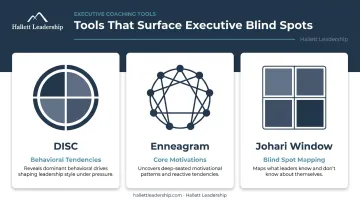
Behavior coaching surfaces those blind spots through structured feedback, assessment tools, and guided self-reflection. Hallett Leadership uses instruments like DISC, the Enneagram, and the Johari Window framework to move content from a leader's blind spot into conscious awareness, where it can be acted on.
KPIs most impacted:
- Decision speed and consistency
- Reduction in reactive conflicts
- Team alignment scores
- Executive error rates in high-stakes scenarios
When this matters most: Self-awareness gains are especially critical during organizational change, leadership transitions, rapid scaling, and high-pressure crises — precisely when default behavioral patterns are most likely to take over.
Advantage 2: Stronger Communication Patterns Drive Team Performance and Engagement
An executive's communication behavior is one of the highest-leverage variables in team performance. How a leader gives feedback, handles conflict, models candor, and creates (or closes) psychological safety doesn't just affect morale — it directly determines whether people do their best work or quietly disengage.
Gallup research quantifies this clearly: managers account for up to 70% of variance in team engagement, and 80% of employees who received meaningful feedback in the past week were fully engaged. These aren't soft metrics. Highly engaged teams achieve 23% higher profitability than less engaged ones.
Communication breakdowns at the executive level don't stay contained. They amplify downward through teams, creating confusion, suppressed feedback, and elevated turnover. And turnover is expensive. Gallup estimates replacing a mid-to-senior level employee costs approximately 200% of annual salary.
Hallett Leadership's coaching addresses communication at the source. Leaders work on specific patterns in real workplace scenarios, including:
- Adjusting tone and pacing under pressure
- Drawing out reserved team members instead of letting dominant voices fill the room
- Giving honest feedback without triggering defensiveness
These are habit-level changes built in the context of the leader's actual team and challenges — not generic frameworks applied from a slide deck.
KPIs most impacted:
- Employee engagement scores
- Voluntary turnover rates
- Frequency and quality of feedback conversations
- Psychological safety survey results
When this matters most: The impact is most pronounced when a leader is managing a newly inherited team, navigating a restructuring, leading a distributed workforce, or steering through cultural transformation.
Advantage 3: Behavioral Consistency Builds Sustainable Culture
Culture is not what organizations declare in values statements. It's the aggregate of daily behavioral choices made by leaders — what gets rewarded, what gets tolerated, what gets modeled at the top.
McKinsey research found that transformations are 5.3 times more likely to succeed when leaders model the behaviors they want employees to adopt. That advantage only holds when behavioral change is consistent, not episodic.
This is where executive behavior coaching does something training programs can't. Structured coaching develops behavioral habits rather than one-time skills, and those habits embed themselves in how a leader operates daily.
Over time, the patterns shape team norms, which shape hiring standards, which shape retention and execution quality.
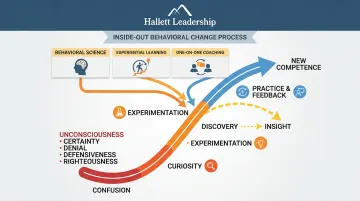
Hallett Leadership's Discovery Model is designed around this inside-out mechanism, combining behavioral science, experiential learning, and one-on-one coaching to create lasting change rather than cycling through short-term fixes. A documented outcome from Hallett's 15-year engagement at 20th Century Fox: leaders shifted from operating in silos to working collaboratively across divisions, and the organization gained access to ideas and thinking from across the entire 1,100-person workforce. That shift didn't happen from a training event. It came from sustained behavioral modeling at every leadership tier.
One more compounding benefit: leaders who go through behavior coaching often become better coaches themselves, extending the development culture through their own teams.
KPIs most impacted:
- Long-term retention rates
- Culture health scores
- Succession bench strength
- Cross-functional collaboration effectiveness
When this matters most: Fast-growing companies still defining their culture, organizations in leadership transition, and enterprises where mid-level manager behavior directly shapes frontline execution.
What Happens When Executive Behavioral Coaching Is Ignored
Unaddressed behavioral patterns don't stay contained — they spread through the organization until they define it.
Leaders who never examine their defaults create organizational environments that reflect their blind spots. Teams mirror reactive communication styles. Cultures reward compliance over candor. Decision-making processes get shaped by biases that no one is allowed to name.
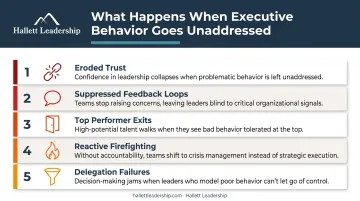
The most common operational consequences:
- Eroded trust from inconsistent leadership behavior — teams lose clarity on expectations and stop taking interpretive risks
- Suppressed feedback loops — communication patterns that signal it's unsafe to be honest lead to decisions made on incomplete information
- Top performer exits — high performers leave because of leadership behavior, not the role; Gallup finds 42% of voluntary turnover is preventable, and 45% of leavers had no proactive manager conversation about their future in the three months prior
- Reactive firefighting as the dominant leadership mode, replacing strategic focus
- Delegation failures where a leader's habits become organizational bottlenecks
What makes this especially costly: these consequences are often invisible until the damage is significant. Turnover is measured after people leave. Culture problems surface during exit interviews. Strategy failures get attributed to market conditions rather than the leadership behavior that shaped execution.
The data backs this up. Work Institute's 2025 Retention Report found that management-related factors drove a growing share of exits, with professional-behavior-related reasons increasing 150% between 2022 and 2024. These aren't edge cases — they're patterns that compound until they become crises.
How to Get the Most Value from Executive Behavior Coaching
Bring the Unpolished Version
Coaching only produces real change when a leader engages with their actual behavioral patterns — not the version they'd present to a board. The friction points, reactive moments, and conversations that fell flat: that's the material that produces insight. Curating it protects the ego and wastes the engagement.
Do the Work Between Sessions
Behavior change doesn't happen during coaching conversations. It happens in the daily moments between them: the difficult conversation, the high-stakes decision, the feedback that needs to be given.
Hallett Leadership's coaching structure supports this with weekly goal-setting, approximately 1–2 hours of direct coach communication per week, and ongoing accessibility when critical moments arise. Leaders who apply new behavioral approaches in real workplace situations, then debrief what happened, build the durable habits that produce lasting change.
Define and Track Success Metrics
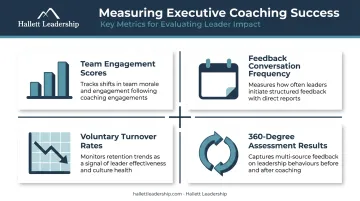
Effective coaching engagements define success upfront: what specific behaviors are being targeted, and how will progress be measured? Without measurement, coaching becomes a talking exercise. Relevant metrics to track include:
- Team engagement scores
- Feedback conversation frequency
- Voluntary turnover rates
- 360-degree assessment results at regular intervals
Treat It as an Ongoing Practice
The executives who see the highest return don't complete a coaching engagement — they internalize coaching as a continuous discipline. Behavioral patterns are not permanently fixed after one program. Roles change, contexts evolve, new challenges surface. Periodic recalibration isn't a sign that the first engagement failed. It's a recognition that leadership demands change as fast as the organizations these leaders run.
Conclusion
Executive behavior coaching delivers its value through what leaders do repeatedly, not what they understand in theory. The behavioral patterns a leader reinforces daily either compound performance or compound dysfunction across their entire organization.
These three core advantages build on each other in sequence. Self-awareness produces better decisions, which create clearer communication, and that clarity is what builds the trust and psychological safety that make culture change possible. None of these happen from a single intervention — they emerge from consistent behavioral practice over time.
For organizations considering the investment: the question isn't whether executive behavior coaching delivers ROI. The sharper question is what unexamined leadership behavior is already costing — in turnover, disengagement, failed initiatives, and culture erosion that rarely gets attributed to its source.
The leaders who commit to this work don't just perform better themselves. They build organizations capable of sustaining high performance after them.
Frequently Asked Questions
What is an executive performance coach?
An executive performance coach is a trained professional who works one-on-one with senior leaders to identify and shift the behavioral patterns — decision-making, communication, stress response — that determine their effectiveness in high-stakes roles. It is distinct from consulting (which prescribes solutions) and therapy (which addresses emotional health history); coaching focuses on self-directed change applied directly to current leadership challenges.
What are the 70/30 and 80/20 rules in coaching?
The 70/30 rule holds that the coachee should speak roughly 70% of the session, with the coach speaking 30% — keeping the leader in charge of their own self-discovery. The 80/20 rule holds that about 80% of a coaching engagement's value comes from 20% of the insights identified: the high-impact blind spots that affect performance outcomes most.
How long does executive behavior coaching typically take to show results?
Most structured engagements run 3–6 months, with early shifts in self-awareness often visible within the first 4–6 weeks. Measurable behavioral change — observable by direct reports and peers — becomes apparent at the 90-day mark when consistent application between sessions has occurred.
How is executive behavior coaching different from leadership training?
Leadership training delivers frameworks and concepts to groups; behavior coaching applies those frameworks to a specific leader's actual patterns, challenges, and context in a one-on-one setting. Training provides knowledge — coaching builds the habits needed to use that knowledge under pressure, when default behavioral patterns take over.
What behaviors does executive behavior coaching typically focus on?
The most common focus areas include communication patterns (feedback delivery, candor, listening), decision-making under pressure, emotional regulation and stress response, conflict resolution, and the ability to delegate effectively. These behaviors have direct downstream effects on team performance and culture.
How do you measure the ROI of executive behavior coaching?
ROI is measured through pre- and post-engagement assessments: 360-degree feedback, team engagement scores, voluntary turnover rates, and individual performance metrics. A 2023 meta-analysis of randomized controlled trials found behavioral effect sizes of g = 0.73 for executive coaching, and ICF survey data puts average organizational ROI at approximately 7x the cost of the engagement.