Introduction
Most organizations invest heavily in revenue growth while quietly underinvesting in the people who sustain it. The result is a fragile leadership pipeline that breaks under pressure — exactly when resilience matters most.
The numbers are stark. According to DDI's 2025 research, only 20% of CHROs have leaders ready to fill critical business roles, and fewer than half of critical leadership positions could be filled immediately by internal candidates.
Developing next-generation leaders is not simply a matter of promoting top performers. It requires intentionally cultivating the mindset, behaviors, and capabilities that allow individuals to lead others effectively. That transition demands structured, deliberate development — not just a new title.
This guide walks through the complete process: how to identify high-potential employees, the core competencies that matter most, proven development strategies, and how to build a formal program with measurable outcomes.
Key Takeaways
- Leadership development is a strategic business priority, not a one-time training event.
- High-potential employees are identified through behavioral signals, not just performance metrics.
- Effective development builds self-awareness and emotional intelligence before tactical skills.
- Formal programs require strategic alignment, personalization, and visible senior sponsorship to work.
- Measurable, work-related outcomes are what separate meaningful development from generic training.
Why Developing Next-Generation Leaders Is a Business Priority
The Business Case Is Clear
Organizations that neglect leadership development don't just lose future leaders — they pay for it now. Research from Harvard Business Review shows that employees at high-trust companies report 50% higher productivity, 13% fewer sick days, and 76% more engagement than those at low-trust organizations. Leadership quality is central to building that trust.
The cost of getting it wrong is concrete. Gallup estimates that replacing a manager or senior leader costs roughly 200% of their annual salary — and that's before accounting for the productivity loss during transition.
The Succession Planning Connection
That replacement cost is exactly why leadership development and succession planning belong in the same conversation. When key roles become vacant — planned or not — organizations with a prepared pipeline adapt. Those without one scramble.
DDI reports that high-quality succession planning makes companies 3.5x more likely to be recognized as a most admired company and 2.8x more likely to outperform industry peers financially. These aren't soft outcomes. They're competitive advantages built through years of deliberate people investment.
Retention of High-Potential Talent
Developing leaders is also one of the most effective retention strategies available. DDI's research found that high-potential employees are 2.7x more likely to leave within a year if they lack regular growth and development opportunities.
Put simply: high-potential employees need to see a trajectory — and visible investment in their development is what keeps them from finding one elsewhere.
How to Identify High-Potential Employees
Performance ≠ Potential
Korn Ferry reports that only 30% of top performers have high leadership potential — meaning most of an organization's best individual contributors may not be its best future leaders. The skills that drive individual excellence (technical mastery, personal productivity, detail orientation) often work against what leadership requires.
Identifying high-potential employees means looking beyond output and examining how someone operates — how they influence peers, respond to setbacks, and think about the organization beyond their own role.
Signs of Leadership Potential
Look for these behavioral and attitudinal markers when assessing emerging leaders:
- Resilience under pressure — they stay grounded when things get difficult, rather than shutting down or deflecting
- Growth mindset — they seek feedback rather than avoid it, and treat mistakes as information
- Emotional intelligence — they read team dynamics accurately and respond with empathy rather than reactivity
- Initiative beyond the job description — they identify problems and act on them without being asked
- Systemic thinking — they consider downstream effects and cross-functional implications, not just their immediate task
- Influence without authority — they move peers and stakeholders through credibility and communication, not title
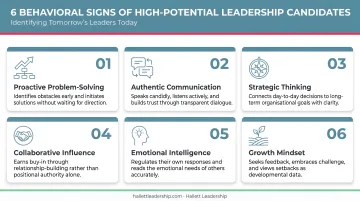
Many of these qualities are developable. Identifying potential is where the development journey begins — and strong programs build on that foundation rather than treat it as a fixed ceiling.
Where to Look for Emerging Leaders
Sourcing channels worth building into your process:
- Internship and early-career programs — often the earliest and most underutilized pipeline source
- Cross-departmental projects — reveal how individuals operate outside their comfort zone and how they influence others
- 360-degree feedback — surfaces behavioral patterns that upward performance reviews miss
- Senior leader nominations — those closest to daily work are often best positioned to spot potential
Subjective selection without defined criteria introduces bias and risks overlooking candidates who don't fit a conventional leadership mold. Only 21% of leaders say their organization recruits and promotes from diverse candidate pools, per DDI data. Defining explicit criteria before selecting participants — such as the behavioral markers above — helps ensure the process is consistent and equitable.
Core Competencies to Develop in Future Leaders
Without a competency framework, "leadership development" stays vague. Frameworks translate ambiguous ideas about leadership into specific, measurable behaviors that can be assessed, trained, and tracked over time. They also prevent programs from devolving into generic training that feels disconnected from real organizational needs.
The core competencies most critical for next-generation leaders:
| Competency | Why It Matters |
|---|---|
| Emotional intelligence & self-awareness | Foundation for trust, communication, and team performance |
| Communication & active listening | How leaders influence, align, and retain their teams |
| Decision-making under ambiguity | Required for any leadership role with real stakes |
| Collaborative influence | Leading without positional authority — cross-functional leadership |
| Adaptability to change | Critical in volatile, fast-moving organizational environments |
| Coaching others toward results | Multiplies leadership impact across the team |
Each of these competencies carries measurable weight. A 2023 peer-reviewed study confirmed that emotionally intelligent leaders directly improve team performance and business results — making the case that these skills belong in the same category as financial acumen or operational expertise.
Developing them requires addressing both dimensions of leadership:
- Internal dimension — how a leader thinks, manages their emotions, and sees themselves
- External dimension — how they communicate, delegate, and build relationships
The inside-out approach — building internal clarity before external behavior — produces development that is sustainable and authentic rather than performative.
Proven Strategies to Develop Leaders from the Inside Out
Effective leadership development is not a classroom event. It's an integrated, ongoing process combining self-discovery, real-world practice, feedback, and coaching.
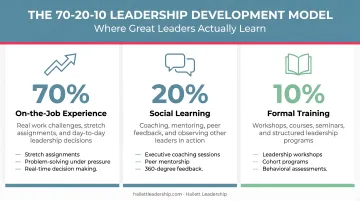
The Center for Creative Leadership's 70-20-10 model provides a useful benchmark: 70% of executive development comes from on-the-job experiences, 20% from interactions with others, and 10% from formal training. Programs that invert this ratio — heavy on coursework, light on application — consistently underdeliver.
Experiential and Action-Based Learning
Stretch assignments are among the most effective development tools available. Placing emerging leaders in unfamiliar, higher-responsibility situations where they must make real decisions with real stakes builds capability and confidence faster than any passive learning method.
Practical experiential methods include:
- Stretch assignments that place emerging leaders in temporary ownership of a real project, initiative, or team
- Cross-functional rotations that build the systems-level view and empathy senior roles demand
- Group projects with presentations to senior management, embedding accountability directly into the learning experience
This is how Hallett Leadership structures its Accelerated Leadership Program — participants work through collaborative projects with peer feedback and direct exposure to organizational challenges, not simulations of them.
Mentorship, Coaching, and Senior Sponsorship
Three distinct relationships play complementary roles in comprehensive development:
- Mentorship draws on accumulated wisdom and shared experience from leaders who've navigated similar paths
- Coaching focuses on specific behaviors, with measurable goals and structured feedback built into each session
- Sponsorship goes further: a senior leader actively advocates and creates advancement opportunities the emerging leader couldn't access alone
These roles are not interchangeable. Sponsors use their influence to open doors that mentors and coaches can't.
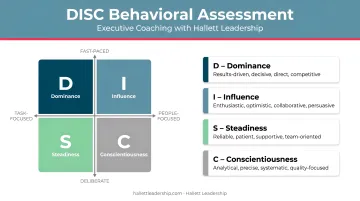
Structured coaching relationships like these are central to how Hallett Leadership's Discovery Model operates. The model pairs behavioral science tools — including DISC and Myers-Briggs — with one-on-one executive coaching to help leaders develop from the inside out.
A core component is the STOP-LOOK-CHOOSE framework, which trains leaders to pause automatic reactions, assess available options, and make deliberate, values-grounded choices. Over time, this builds emotional intelligence, self-regulation, and sharper decision-making that translate into measurable team outcomes.
Senior leaders must be visible in these programs — not just as nominators, but as mentors, storytellers, and role models. When executives demonstrate their own commitment to growth, they signal that development is a cultural value, not a checkbox.
Building a Formal Leadership Development Program
Most leadership programs fail not because of poor intentions, but because of poor architecture. The difference between a program that changes behavior and one that gets forgotten after week two comes down to how deliberately it's built.
Step 1: Align the Program to Strategy and Define Competencies
Before building anything, ask: What leadership capabilities do we need to achieve our strategic goals over the next three to five years?
The answers shape everything — which competencies the program develops, which participants it targets, and what success looks like. Programs that skip this step are quickly dismissed internally as disconnected from real business priorities.
Transparency in the selection process matters just as much as the selection itself. Employees who understand the criteria — even if not selected — are more likely to develop toward those criteria over time, creating a self-reinforcing pipeline.
Step 2: Design Personalized and Progressive Development Paths
Once strategy defines the destination, the development path has to fit the individual — not just the role. One-size-fits-all curricula undermine engagement, especially among high-potential employees who resist generic training. Effective programs use Individual Development Plans (IDPs) tailored to each participant's strengths, gaps, career stage, and role requirements.
A well-structured IDP typically includes:
- Targeted skill-building aligned to identified competency gaps
- Stretch assignments with defined scope and accountability
- Regular coaching touchpoints (not just annual reviews)
- Career milestones that make progress visible and meaningful
Build in ongoing feedback mechanisms — real-time coaching loops, not just annual performance conversations. Celebrating small wins (a confident decision, a successfully delegated project, improved team dynamics) reinforces progress and keeps participants engaged when the work gets hard.
How to Measure Leadership Development Progress
Measurement is what separates a leadership development investment from a sunk cost. Define success metrics before the program begins, not after the results are already lost.
Relevant indicators to track:
- Behavior change observed by managers and peers through structured feedback
- Retention rates of high-potentials enrolled in the program
- Promotion readiness assessments at defined milestones
- Team engagement scores under developing leaders
- Business outcomes tied directly to leadership roles
DDI research finds that 78% of HR leaders identify observable behavior change as the most valuable measure of leadership development success.
Only 34% of organizations can demonstrate that their leadership development program significantly impacted business objectives, according to Brandon Hall Group research. The gap isn't a lack of results — it's a lack of measurement infrastructure designed before the program launches.
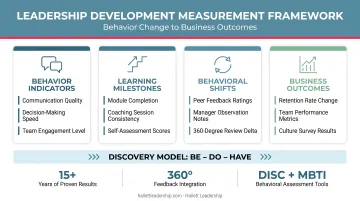
Organizations that track leadership development like any other business initiative — with defined milestones, accountable owners, and scheduled reviews — see measurably greater returns on their people investment.
Hallett Leadership's core philosophy reflects this directly: development is measured through very tangible work-related results, not training completion certificates.
Frequently Asked Questions
What are the 7 C's of leadership?
The UCLA Social Change Model identifies seven values: Consciousness of Self, Congruence, Commitment, Collaboration, Common Purpose, Controversy with Civility, and Citizenship. Practitioners also use informal variants like Competence, Communication, and Character — these are useful frameworks, not a single authoritative standard.
How do you identify high-potential employees for leadership development?
High-potential employees are identified through a combination of performance data, behavioral assessments, 360-degree peer feedback, and observed qualities like adaptability, initiative, and the drive to grow. The key distinction: potential is separate from current performance level — research suggests only about 30% of top performers actually have high leadership potential.
What is the difference between leadership training and leadership development?
Leadership training covers discrete skill-building events like workshops and courses. Development goes deeper, building mindset, self-awareness, and lasting behavioral change through ongoing coaching, mentorship, and real-world practice.
How long does a leadership development program typically take?
Structured programs typically run anywhere from six months to two or more years, depending on depth and organizational goals. The most effective approach treats development as continuous rather than time-bound. The goal is building a leadership pipeline, not finishing a curriculum.
What role does executive coaching play in developing next-generation leaders?
Executive coaching delivers individualized support that group training simply can't match. It helps leaders build self-awareness, address specific behavioral challenges, and apply new skills within their actual work environment, accelerating results compared to cohort-only programs.
How do you sustain a leadership pipeline over the long term?
Sustaining a pipeline requires embedding leadership development into organizational culture through transparent selection criteria, active senior leader involvement, ongoing coaching relationships, and clear connections between program participation and real career advancement.