Introduction
Organizations routinely promote their strongest individual contributors into leadership roles — then watch those same people struggle. The technical skills that made them exceptional as individual contributors have little bearing on their ability to lead, motivate, and develop a team. Without proper development support, the gap shows up fast: disengaged teams, elevated turnover, and a leadership bench that can't carry the organization forward.
CMI's 2023 Better Management Report found that 82% of managers entered management without formal training, and 52% held no leadership qualification at all. The downstream consequences aren't abstract — a SHRM survey found that unprepared first-time managers caused 41% of workers to feel stressed or anxious and 34% to consider leaving the organization.
Closing that gap requires more than a training seminar. Executive coaching and leadership mentoring each address different dimensions of leadership growth — and used together, they build the kind of capability that sticks. This article breaks down what each approach involves, how they differ, and when combining both makes sense for your organization.
Key Takeaways
- Executive coaching closes specific performance gaps through structured, one-on-one engagement within a defined timeframe.
- Leadership mentoring builds institutional wisdom, cultural fit, and career perspective across a longer relationship.
- Effective leadership development starts inside out: self-awareness and emotional intelligence first, external behaviors second.
- Mid-level managers are the critical bridge between senior strategy and team execution, and must not be overlooked.
- Development programs tied to real work outcomes consistently outperform standalone HR initiatives.
What Is Executive Coaching and Leadership Mentoring?
Defining Each Approach
Executive coaching is a structured, one-on-one process designed to help leaders strengthen specific capabilities — communication, decision-making, emotional intelligence, executive presence — within a defined timeframe. It's goal-oriented and tied to measurable outcomes. As the International Coaching Federation defines it, coaching is a thought-provoking, creative partnership that maximizes a leader's personal and professional potential.
Leadership mentoring is a longer-term developmental relationship between a more experienced leader and an emerging one. The mentor shares lived experience, organizational wisdom, and career guidance — not a formal skills curriculum. ATD frames mentoring as a reciprocal relationship focused on long-term career growth and learning to navigate an organization from the inside.
These are also distinct from traditional training programs:
| Format | Delivery | Nature |
|---|---|---|
| Executive Coaching | One-on-one, structured | Individualized, adaptive |
| Leadership Mentoring | Relationship-driven dialogue | Relational, forward-looking |
| Group Training | Cohort-based curriculum | Structured, standardized |
Conflating the three produces weak results — each format serves a different developmental need, and the philosophy behind each one explains why.
The Core Philosophy Behind Each Approach
Coaching operates on the belief that the leader already has the capacity to grow. A skilled coach uses powerful questions and structured reflection to surface what the leader cannot yet see on their own — creating conditions for self-discovery rather than providing answers. Hallett Leadership's Discovery Model is built on exactly this principle: the coach's role is to interrupt automated behavior and help leaders move from unconscious, habitual responses to intentional, values-aligned choices.
Mentoring is advisory in nature. The mentor draws on direct experience to guide the mentee — sharing what they personally navigated in similar situations. In practice, most high-performing development programs draw on both: coaching to build self-awareness and close behavioral gaps, mentoring to accelerate judgment through someone else's hard-won experience.
Executive Coaching vs. Leadership Mentoring: Key Differences
Side-by-Side Comparison
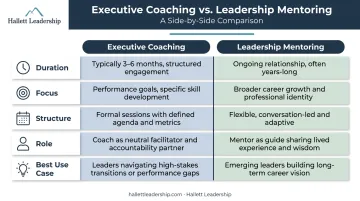
| Dimension | Executive Coaching | Leadership Mentoring |
|---|---|---|
| Duration | 6–12 months (SHRM benchmark) | 1–3+ years |
| Focus | Specific performance or behavioral gap | Career development, cultural integration |
| Structure | Goal-driven, scheduled sessions | Relationship-driven dialogue |
| Role | Coach facilitates self-discovery | Mentor shares lived experience |
| Best use case | Skill gaps, role transitions, blind spots | Succession prep, organizational navigation |
When to Choose Coaching
Executive coaching is the right tool when:
- A leader needs to close a specific skill or behavioral gap quickly
- They are preparing for a high-stakes role transition
- They need a confidential space to examine leadership blind spots with objective support
When to Choose Mentoring
Mentoring is the right fit when:
- A leader needs cultural integration in a new organization or role
- Long-term career navigation and succession preparation are the priority
- The leader lacks exposure to how senior leaders think and operate at the strategic level
Why Treating Them Interchangeably Fails
Using mentoring to resolve an urgent performance gap delays resolution. Applying short-term coaching where sustained relationship-building is needed produces shallow results. Either mistake signals to the leader that the organization doesn't understand what they actually need — which erodes trust before development even begins.
The most effective programs combine both. For instance, pair an executive entering a new role with a coach for the first six months (focused skill-building) alongside a mentor for the first 18–24 months (cultural and strategic integration). Each relationship serves a distinct purpose, and the two reinforce each other in ways neither can achieve alone.
How Executive Coaching and Mentoring Develop Future Leaders
What Coaching Builds
Executive coaching accelerates development of the capabilities most critical to leadership effectiveness:
- Emotional intelligence — the ability to regulate responses and build authentic team relationships
- Decision-making under pressure — making sound choices when information is incomplete and stakes are high
- Executive presence — communicating with credibility and inspiring confidence across levels
- Self-awareness — understanding blind spots before they undermine trust or performance
The one-on-one structure matters here. It creates psychological safety for the kind of honest self-examination that rarely happens in group settings. Research on emotional intelligence and leadership — drawn from a review of 104 peer-reviewed articles — consistently links emotionally intelligent leadership to stronger team performance and higher retention and revenue growth.
What Mentoring Builds
Mentoring develops the qualities that no classroom can replicate:
- Institutional knowledge and stakeholder navigation
- Resilience built through exposure to how senior leaders handle failure and ambiguity
- An understanding of organizational culture at the strategic level
- Long-term career perspective and succession readiness
HBR reports that 98% of Fortune 500 companies have mentoring programs — yet only 37% of professionals report actually benefiting from them. The gap isn't program prevalence. It's program design. Mentoring relationships that lack structure, clear goals, and intentional pairing produce little measurable impact.
The Organizational Multiplier Effect
When leaders are developed through coaching and mentoring, they model those same behaviors with their own teams — asking better questions, developing direct reports, creating feedback-rich environments. Leadership development multiplies when senior leaders become developers of other leaders.
Hallett Leadership's 9-month Accelerated Leadership Program with 1,100 employees at 20th Century Fox illustrates this directly. The program shifted the studio's culture from one that inhibited unsolicited ideas to one where employees actively contributed innovations.
The transformation ran deeper than behavior change. Senior leadership had to build new organizational infrastructure just to manage the volume of ideas being generated — proof that when development is done right, it changes how the whole organization operates.
The Inside-Out Approach: Developing Leaders from Within
Starting with Who the Leader Is
Lasting leadership change doesn't begin with tactics. It begins with who the leader is, how they think, and what they believe about their own potential.
Hallett Leadership's BE – DO – HAVE model reflects this principle directly: leaders must first develop the mindset and self-awareness (BE) before their actions (DO) can produce the results they want (HAVE). This challenges conventional development logic, which too often jumps straight to behavioral change without addressing the underlying drivers.
The rationale is grounded in data. Research published in HBR found that while 95% of people believe they are self-aware, only 10–15% actually are. Leaders who lack genuine self-awareness cannot see how they show up under pressure, how they influence others, or where their blind spots undermine the trust their teams need to perform.
The Discovery Model in Practice
Hallett Leadership's Discovery Model applies inside-out development through three integrated components:
- Behavioral science — tools including DISC, the Johari Window, and the BE–DO–HAVE framework give leaders a structured language for understanding themselves and others
- Experiential learning — role-playing, feedback exercises, outdoor challenges, and peer cohort dynamics translate insight into practiced behavior
- One-on-one coaching — personalized, weekly engagement that interrupts automated patterns and creates accountability for behavioral change
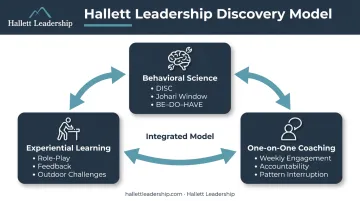
The model follows a progression: from unconscious, habitual behavior through confusion (which signals old patterns breaking down), to curiosity, experimentation, and finally new competence. That discomfort is where real growth begins.
This progression only holds when development connects to real work — not just scheduled sessions. The ALP's (Accelerated Leadership Program) 9-month structure includes project work presented directly to senior management, personal leadership affirmations practiced daily under real work pressure, and coaching available when actual organizational challenges arise — not just during scheduled check-ins.
Coaching Executives to Develop Others
When senior leaders learn to coach, the organizational impact multiplies. Hallett Leadership's one-on-one coaching focuses on senior management precisely because those leaders shape how positive behaviors get modeled and rewarded throughout the organization.
Leaders who model coaching behaviors convert every daily interaction into a development opportunity:
- Listen to understand, not just to respond
- Ask powerful questions that surface insight rather than hand down answers
- Provide candid feedback that builds trust instead of eroding it
The results show up in the people around them. In one ALP case study, a leader's development directly produced higher engagement, productivity, and loyalty among his direct reports — and he shifted from executing tasks to actively coaching and mentoring his team.
Building an Effective Leadership Development Program That Sticks
Why Most Programs Fail
McKinsey's research on leadership development identified four recurring failure modes:
- Overlooking organizational context
- Decoupling reflection from real work
- Underestimating the role of mindsets
- Failing to measure results
The result: organizations invest significantly in development but see little sustained behavior change. HBR's analysis echoes this — learners revert to old behaviors when organizational systems don't support new practices. Training without ongoing reinforcement produces temporary improvement, nothing more.
Core Elements of a Sustainable Program
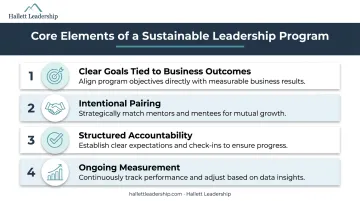
An effective program requires:
- Clear goals tied to business outcomes — specific, measurable, and connected to real organizational priorities
- Intentional pairing that matches coaches and mentors to participants based on context and development needs
- Structured accountability built into the program design from day one
- Ongoing measurement defined before the program launches, so success criteria are agreed upon upfront
Measurement as a Non-Negotiable
Success metrics should be established at the start. Useful indicators include:
- Promotion rates within the participant cohort
- 360-degree feedback shifts before and after
- Team retention rates among participants' direct reports
- Observed behavioral changes in real work contexts
- Succession readiness assessments
The measurement framework should connect directly back to the business goals that justified the program. If the goal was to reduce mid-level management turnover, then retention data — not just session completion rates — is what matters.
Measurement alone doesn't drive change — leadership does. Programs accelerate when senior leaders engage as active participants, modeling the behaviors the program is designed to build. At 20th Century Fox, Dean Hallett's program required senior leaders to adapt organizational structures in response to what participants were learning. That structural responsiveness is what made the change stick.
Frequently Asked Questions
What is executive coaching and mentoring?
Executive coaching is a structured, goal-oriented process that targets specific leadership capabilities within a defined timeframe. Leadership mentoring is a longer-term advisory relationship focused on career growth, cultural integration, and the transfer of organizational wisdom.
What is the 70/30 rule in coaching?
The 70/30 rule refers to the balance of conversation in a coaching session: the coachee should speak approximately 70% of the time, while the coach speaks only 30%. This structure reinforces that coaching is about facilitating self-discovery, not dispensing advice.
How does executive coaching differ from leadership mentoring?
Coaching is structured, time-bound, and focused on specific behavioral or performance outcomes. Mentoring is relationship-based, longer-term, and focused on career development and the transfer of organizational wisdom. Both serve distinct growth needs and deliver the strongest results when used in combination.
What qualities should I look for in an executive coach?
Look for deep self-awareness, emotional intelligence, a willingness to challenge rather than validate, and a track record of measurable results. The depth of a coach's insight into you corresponds directly to the depth of that coach's own self-awareness — that's the standard Hallett Leadership holds its coaching to.
How long does executive coaching typically take to show results?
Most engagements run 6–12 months. Meaningful behavioral shifts are often visible within the first 90 days when goals are clear and sessions are consistent, but durable change requires the full engagement period.
Can coaching and mentoring be used together in a leadership development program?
Combining both yields stronger outcomes. Coaching addresses immediate performance gaps with precision; mentoring builds the longer-term cultural and strategic foundation. This integrated approach is how Hallett Leadership's programs are structured.